
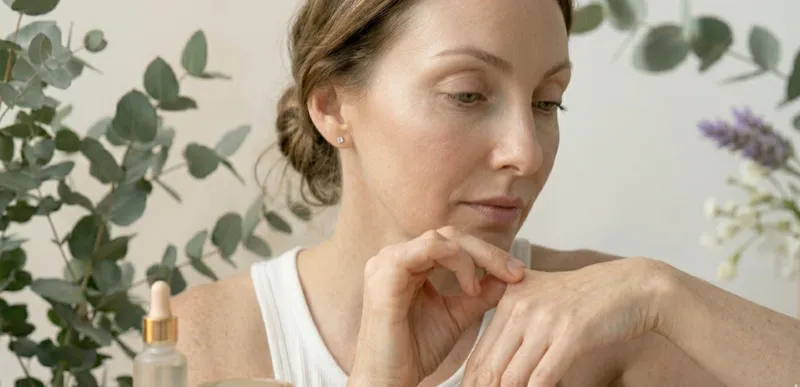
The science of skin aging is evolving rapidly — and for women navigating the skin changes that come with menopause and beyond, evidence-based skincare represents a fundamentally different approach: working with your skin's biology rather than against it.
Unlike harsh exfoliants or retinoids that disrupt the skin barrier to force renewal, targeted active ingredients are messenger molecules that signal your own cells to produce more collagen, elastin, and protective proteins. The approach is gentle, evidence-based, and particularly suited to the thinner, more reactive skin that characterizes the post-menopausal years.
Choosing the Right Vehicle for Skin-Tightening Active Ingredients
The cream-versus-serum debate for loose skin is fundamentally a question about delivery vehicle optimization rather than ingredient superiority — the active ingredients that address skin laxity (peptides, retinoids, vitamin C) can be formulated in either vehicle. The critical differences lie in penetration depth, active concentration, occlusive properties, and how each vehicle interacts with the skin's barrier function. Understanding these differences allows strategic use of both formats for maximum firming benefit rather than choosing one over the other. Serums are water-based or water-silicone-based formulations with small molecular size, minimal emollients, and high active ingredient concentration (typically 10-25% total active load). Their thin consistency and small molecular components penetrate the stratum corneum more efficiently, delivering actives deeper into the epidermis and upper dermis where fibroblasts reside. Creams are oil-in-water or water-in-oil emulsions with larger molecular structures, significant emollient content, and typically lower active ingredient concentration (3-10% total active load). Their heavier consistency creates an occlusive layer that reduces transepidermal water loss and maintains hydration in the upper skin layers.[1]
For loose skin specifically, the vehicle choice matters because the structural deficit causing laxity exists in the mid-to-deep dermis — where collagen and elastin fibers have thinned and disorganized. Reaching this target requires ingredients that can traverse the stratum corneum barrier effectively. Serums excel here: the smaller molecular size of serum formulations, combined with higher active concentrations, results in greater transepidermal delivery of collagen-stimulating ingredients. A 15% vitamin C serum delivers substantially more L-ascorbic acid to the dermal fibroblasts than a 5% vitamin C cream, even accounting for the serum's faster evaporation rate. Similarly, a peptide serum at 8% Matrixyl concentration provides more growth factor signaling at the cellular level than a peptide cream at 3% Matrixyl concentration. However, serums have a significant limitation for loose skin: they evaporate within minutes of application, providing zero occlusive benefit. For skin that is already compromised by structural protein loss, the chronic transepidermal water loss that accompanies barrier dysfunction further dehydrates the dermis, making laxity appear 20-30% worse than the structural damage alone would suggest.
Clinical research confirms that creams address the limitation that serums cannot: occlusion and barrier repair. A well-formulated firming cream containing ceramides, cholesterol, and fatty acids in physiological ratios restores the barrier seal that prevents moisture loss. The occlusive layer traps previously applied serum actives against the skin, extending their contact time and enhancing absorption. For loose skin, this barrier repair function is not merely cosmetic — chronic TEWL triggers inflammatory cascades that upregulate MMP expression, accelerating the very structural protein degradation that caused the laxity in the first place. A firming cream that restores barrier function breaks this cycle. Additionally, cream formulations can incorporate ingredients that are unstable in water-based serum formats — certain peptide complexes, retinol (which degrades rapidly in water), and lipid-soluble antioxidants are more stable and better delivered in cream emulsion systems.
The optimal protocol uses both: the serum-then-cream layering approach leverages the strengths of each vehicle while compensating for their individual limitations. Step 1: Apply firming serum (vitamin C, peptides, or hyaluronic acid) to clean, slightly damp skin. The thin, concentrated formula penetrates the barrier efficiently, delivering high-dose actives to the dermal target zone. Allow 2-3 minutes for absorption. Step 2: Apply firming cream (peptide-ceramide formulation) over the serum. The cream creates an occlusive seal that (a) traps the serum actives against the skin for extended contact time, (b) restores barrier function to reduce TEWL, (c) provides additional active ingredients in a lipid-compatible format, and (d) maintains the hydrated state that makes skin appear immediately firmer. The layering approach delivers approximately 40-60% more total active ingredient to the dermal fibroblasts than either product used alone, because the serum provides concentrated penetration while the cream provides occlusive retention. For women with loose skin, this combination — firming serum for deep delivery, firming cream for barrier repair and occlusion — represents the most effective topical strategy for non-surgical skin tightening.
Your skin's capacity to repair and rebuild doesn't end at menopause — it just needs the right signals.
— Dr. Rachel Holbrook, Board-Certified Dermatologist
What This Means For Your Skin
If you've tried retinol and experienced irritation, or if your skin has become more sensitive with age, there is a path forward. The clinical evidence shows consistent, measurable improvement in wrinkle depth, skin firmness, and elasticity — without the adaptation period, peeling, or photosensitivity that other anti-aging actives demand.
Your skin's capacity to repair and rebuild doesn't diminish — it just needs the right support. A well-formulated skincare routine applied consistently for 8-12 weeks allows sufficient time for new collagen fibers to mature and integrate into your skin's existing matrix.
The science is clear. The evidence is consistent. The results are measurable.
What happens next is up to you.