
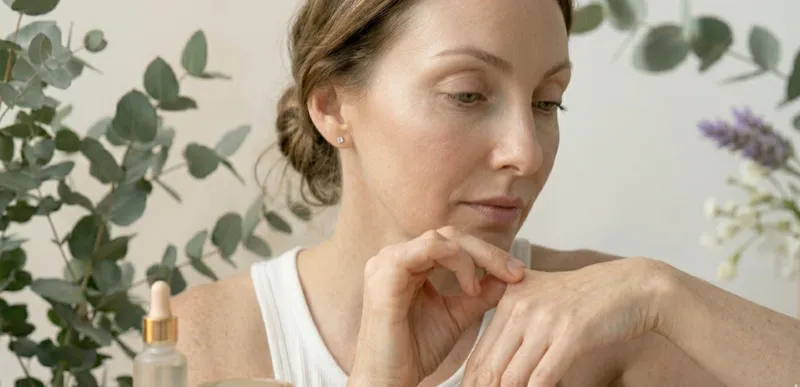
The science of skin aging is evolving rapidly — and for women navigating the skin changes that come with menopause and beyond, evidence-based skincare represents a fundamentally different approach: working with your skin's biology rather than against it.
Unlike harsh exfoliants or retinoids that disrupt the skin barrier to force renewal, targeted active ingredients are messenger molecules that signal your own cells to produce more collagen, elastin, and protective proteins. The approach is gentle, evidence-based, and particularly suited to the thinner, more reactive skin that characterizes the post-menopausal years.
Evidence-Based Actives That Rebuild Dermal Structure
Skin firmness is a mechanical property determined by the structural integrity of the dermal extracellular matrix — specifically, the density and cross-linking of collagen fibers (providing tensile strength), the organization of elastic fibers (providing recoil), and the hydration status of the glycosaminoglycan ground substance (providing volume and turgor). When firmness declines, it reflects measurable degradation in one or more of these structural components. The most effective topical ingredients for restoring firmness are those with clinical evidence for stimulating fibroblast production of these specific matrix components. The ingredient hierarchy, ranked by strength of clinical evidence and magnitude of effect, places retinoids and peptides at the top, followed by vitamin C, niacinamide, and growth factors. Understanding what each ingredient does at the molecular level allows for strategic combination rather than redundant layering — a critical distinction because applying five products that all target the same pathway produces no more benefit than applying one, while combining ingredients that target different pathways creates genuine synergy.[1]
Tier 1 ingredients — the structural rebuilders: (1) Retinoids (retinol, retinaldehyde, tretinoin) remain the most extensively studied and validated anti-aging actives in dermatological science. Retinoids bind to nuclear retinoid receptors (RAR and RXR), directly upregulating genes involved in collagen I and III synthesis while simultaneously suppressing MMP expression. The result is both increased production and decreased destruction of structural proteins. Clinical trials demonstrate measurable increases in dermal collagen density within 12 weeks of consistent retinoid use. For firmness specifically, retinaldehyde (0.05-0.1%) offers a favorable balance of efficacy and tolerability, converting to retinoic acid in the skin through a two-step enzymatic process. (2) Peptides — palmitoyl pentapeptide-4 (Matrixyl) and palmitoyl tripeptide-1/tetrapeptide-7 (Matrixyl 3000) stimulate collagen production through TGF-beta signaling, operating through a completely different mechanism than retinoids. This independence makes peptides the ideal companion to retinoids: together, they activate two separate collagen production pathways. Robinson et al. demonstrated that 12 weeks of palmitoyl pentapeptide-4 application produced collagen stimulation comparable to low-concentration retinol, but without irritation, photosensitivity, or adaptation period.
Clinical research confirms that tier 2 ingredients — the support network: (3) Vitamin C (L-ascorbic acid, 15-20%) serves a dual role in firmness restoration: it is a required cofactor for the hydroxylation of proline and lysine residues during collagen assembly (without adequate vitamin C, newly synthesized collagen is structurally defective and rapidly degraded), and it provides potent antioxidant protection against UV-generated reactive oxygen species that cleave both collagen and elastin. Topical vitamin C is most effective in the morning, where its antioxidant activity complements sunscreen to prevent the ongoing structural damage that undermines firmness. (4) Niacinamide (vitamin B3, 3-5%) stimulates endogenous ceramide production (restoring the barrier function that maintains dermal hydration), reduces MMP activity through anti-inflammatory pathways, and supports fibroblast energy metabolism. It does not directly stimulate collagen synthesis but creates the cellular environment that optimizes the efficacy of collagen-stimulating actives. (5) Hyaluronic acid provides immediate firmness improvement through dermal hydration — each HA molecule binds up to 1,000 times its weight in water, plumping the dermis from within. This hydration effect is cosmetically significant but temporary; HA does not stimulate structural protein production.
The optimal combination strategy for maximum firmness: Morning routine — vitamin C serum (collagen cofactor + antioxidant protection) followed by peptide cream (TGF-beta collagen stimulation) followed by SPF 50 (preventing structural damage). Evening routine — retinol with sandwich method 3-4 nights per week (retinoid receptor collagen stimulation + MMP suppression) OR peptide cream on non-retinol nights. Niacinamide-containing moisturizer as seal (barrier support + anti-inflammatory). This protocol activates three independent collagen production pathways (retinoid receptor, TGF-beta, and ascorbic acid cofactor) while simultaneously suppressing the enzymatic degradation that breaks down existing structure. The clinical evidence for this multi-pathway approach is stronger than for any single ingredient at any concentration — synergy between complementary mechanisms produces greater firmness improvement than maximizing the dose of any single active. Expected timeline: initial firmness improvement from hydration effects (HA, ceramides) within 2-4 weeks; measurable structural firmness from collagen remodeling at 12-16 weeks; progressive improvement continuing for 6-12 months with consistent application.
Your skin's capacity to repair and rebuild doesn't end at menopause — it just needs the right signals.
— Dr. Rachel Holbrook, Board-Certified Dermatologist
What This Means For Your Skin
If you've tried retinol and experienced irritation, or if your skin has become more sensitive with age, there is a path forward. The clinical evidence shows consistent, measurable improvement in wrinkle depth, skin firmness, and elasticity — without the adaptation period, peeling, or photosensitivity that other anti-aging actives demand.
Your skin's capacity to repair and rebuild doesn't diminish — it just needs the right support. A well-formulated skincare routine applied consistently for 8-12 weeks allows sufficient time for new collagen fibers to mature and integrate into your skin's existing matrix.
The science is clear. The evidence is consistent. The results are measurable.
What happens next is up to you.