
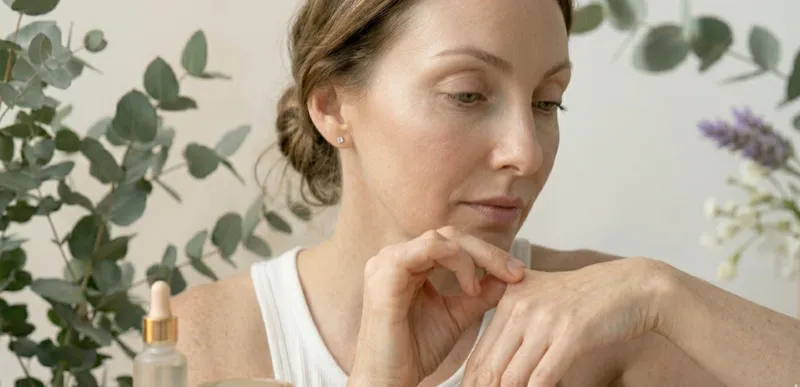
The science of skin aging is evolving rapidly — and for women navigating the skin changes that come with menopause and beyond, evidence-based skincare represents a fundamentally different approach: working with your skin's biology rather than against it.
Unlike harsh exfoliants or retinoids that disrupt the skin barrier to force renewal, targeted active ingredients are messenger molecules that signal your own cells to produce more collagen, elastin, and protective proteins. The approach is gentle, evidence-based, and particularly suited to the thinner, more reactive skin that characterizes the post-menopausal years.
Simple Self-Assessment Methods to Track Your Skin's Structural Health
Measuring skin firmness at home provides a practical baseline that transforms subjective perceptions ('my skin feels looser') into observable, trackable data points. While clinical instruments like the Cutometer and Ballistometer provide precise quantitative measurements of skin elasticity and viscoelasticity, simple at-home tests can reveal meaningful information about dermal structural integrity using the same mechanical principles. The value of self-assessment lies not in absolute measurement (which requires calibrated instruments) but in tracking relative changes over time — is your skin more or less firm than it was three months ago? Are the areas you're treating showing measurable improvement? These directional assessments guide treatment decisions and provide the motivational feedback that supports long-term adherence to skincare protocols.[1]
The Snap-Back Test (assessing elastic recoil): this is the most informative at-home firmness test because it directly measures the functional property of elasticity — the skin's ability to return to its resting position after deformation. Method: use the thumb and index finger to gently pinch a fold of skin on the back of the hand (the dorsal hand skin closely mirrors facial skin aging). Pinch and hold for 5 seconds, then release. Using a timer (smartphone stopwatch), measure how long the skin takes to fully flatten back to its pre-pinch state. Interpretation: under age 30 with good elasticity, the skin snaps back in under 1 second. Age 30-45, typically 1-3 seconds. Age 45-60, typically 3-5 seconds. Over 60 or with significant photodamage, 5-10+ seconds. A snap-back time longer than expected for your age suggests accelerated elastic fiber degradation (possibly from UV damage, smoking, or post-menopausal hormonal decline). Perform this test monthly on the same area under similar conditions (hydration level, time of day) to track directional changes during treatment.
Clinical research confirms that the Gravity Test (assessing structural firmness): sit upright in front of a mirror and observe the jawline, cheek contour, and nasolabial area. Then lean forward at 90 degrees (looking straight down at the floor) and observe the same areas in a handheld mirror. Youthful, firm skin maintains its contour in both positions — gravity simply cannot pull well-supported tissue out of place. Skin with diminished firmness shifts visibly when the gravitational vector changes: cheeks that look smooth upright may show noticeable droop when inverted, and the jawline that appears defined from straight-on may show jowling from below. The degree of positional shift correlates with the severity of dermal structural loss. This test is particularly useful for tracking improvement in jawline definition during treatment — photograph yourself in both positions monthly to create a visual record of firmness changes that are difficult to perceive day-to-day.
The Texture Assessment (assessing collagen density): under bright, natural light, gently stretch the skin of the inner forearm and release. Observe the surface texture immediately after release. Dense, well-collagenized skin shows a smooth, uniform surface — like the surface of a slightly inflated balloon. Skin with reduced collagen density shows visible micro-wrinkling, cross-hatching, or a crepe-like texture when stretched and released — the reduced structural scaffolding cannot maintain smooth surface tension. The inner forearm is used because it receives minimal sun exposure, isolating chronological aging from photoaging. Compare the forearm (chronological aging only) to the back of the hand or outer forearm (chronological + photo aging) to visualize how much additional structural damage UV exposure has caused. For treatment tracking, perform all three tests monthly, ideally on the same day under consistent conditions. Photograph results when possible. The most meaningful indicator is directional change — if your snap-back time decreases from 4 seconds to 3 seconds over three months of treatment, that represents genuine elastic fiber improvement regardless of the absolute number. These self-assessments, combined with before-and-after photographs under consistent lighting, provide the practical feedback loop that guides treatment optimization.
Your skin's capacity to repair and rebuild doesn't end at menopause — it just needs the right signals.
— Dr. Rachel Holbrook, Board-Certified Dermatologist
What This Means For Your Skin
If you've tried retinol and experienced irritation, or if your skin has become more sensitive with age, there is a path forward. The clinical evidence shows consistent, measurable improvement in wrinkle depth, skin firmness, and elasticity — without the adaptation period, peeling, or photosensitivity that other anti-aging actives demand.
Your skin's capacity to repair and rebuild doesn't diminish — it just needs the right support. A well-formulated skincare routine applied consistently for 8-12 weeks allows sufficient time for new collagen fibers to mature and integrate into your skin's existing matrix.
The science is clear. The evidence is consistent. The results are measurable.
What happens next is up to you.