
The science of skin aging is evolving rapidly — and for women navigating the skin changes that come with menopause and beyond, evidence-based skincare represents a fundamentally different approach: working with your skin's biology rather than against it.
Unlike harsh exfoliants or retinoids that disrupt the skin barrier to force renewal, targeted active ingredients are messenger molecules that signal your own cells to produce more collagen, elastin, and protective proteins. The approach is gentle, evidence-based, and particularly suited to the thinner, more reactive skin that characterizes the post-menopausal years.
Using Extended Occlusion to Maximize the Nocturnal Repair Window
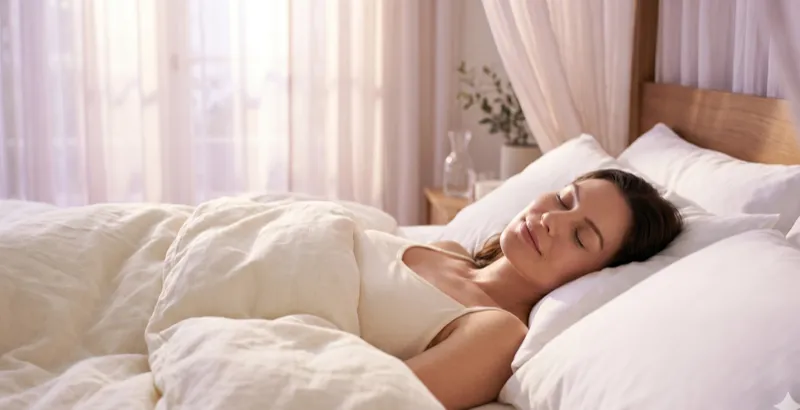
Overnight face masks (sleeping masks, sleeping packs) represent a delivery strategy rather than a distinct product category — their primary function is extended occlusion that maximizes product contact time and hydration retention during the nocturnal repair window. While a standard evening skincare routine provides active ingredients and barrier support, the products begin evaporating and absorbing into the pillowcase within the first 1-2 hours of sleep. An overnight mask adds a physical occlusive layer that: (1) prevents transepidermal water loss for the full 6-8 hours of sleep, maintaining maximum dermal hydration throughout the repair window; (2) traps previously applied active ingredients against the skin surface, extending their absorption time and increasing the total dose delivered to the dermis; and (3) creates a sealed hydration chamber that optimizes the cellular environment for fibroblast collagen synthesis and keratinocyte renewal.[1]
The occlusion principle — why extended contact time matters: the stratum corneum is a semi-permeable barrier that regulates the rate at which topical ingredients penetrate to the dermis. Under normal conditions (no occlusion), ingredients applied to the skin surface are absorbed at rates determined by their molecular size, lipophilicity, and concentration gradient. A significant percentage evaporates before absorption, and the concentration gradient decreases as the active is absorbed, slowing the delivery rate. Under occlusion, evaporation is eliminated (increasing the available dose), the stratum corneum hydrates (swelling the intercellular spaces and increasing permeability by 3-5 fold), and the concentration gradient is maintained longer (because the occluded product remains on the surface rather than evaporating). Studies demonstrate that occluded application can increase the total drug delivery of topical actives by 40-200% compared to non-occluded application.
Clinical research confirms that building an effective overnight mask protocol: rather than purchasing a dedicated overnight mask product (many of which contain minimal active ingredients in a heavy emollient base), the most effective approach builds the overnight mask from your existing active products: Step 1 — Apply full evening routine (HA serum → retinol sandwich or peptide cream → ceramide cream). Step 2 — Wait 10-15 minutes for the routine to partially absorb. Step 3 — Apply the occlusive mask layer. Options: (a) Thick layer of CeraVe Healing Ointment or Aquaphor (the most effective occlusive — petrolatum-based, blocks 99% of TEWL). (b) Generous application of pure squalane oil (lighter, more cosmetically elegant, blocks 80-90% of TEWL). (c) A dedicated overnight mask product (hyaluronic acid-based gel masks provide moderate occlusion with high comfort). (d) Medical-grade silicone face patches (provide focal occlusion on targeted areas — forehead, cheeks, nasolabial folds). Step 4 — Use a dedicated pillowcase or lay a towel over the pillow to prevent product transfer.
How often to use overnight masks: (1) Weekly intensive — 1-2 nights per week using the full occlusive protocol. This provides a periodic deep treatment that amplifies the nightly routine's effects without the inconvenience of daily heavy occlusion. (2) Nightly light occlusion — applying a slightly thicker-than-usual layer of ceramide cream or mixing in 2-3 drops of squalane oil provides mild occlusion every night without the heaviness of a full mask. This is the most sustainable approach for daily use. (3) Recovery protocol — after aggressive treatments (retinol introduction, post-procedure recovery, seasonal barrier compromise), overnight masks on consecutive nights for 3-5 nights accelerate barrier recovery and reduce irritation. Expected results: immediate morning improvement in hydration and plumpness (first use). With weekly use: sustained improvement in barrier function (2-4 weeks), enhanced efficacy of concurrent active ingredients (cumulative), and progressive texture and firmness improvement as the optimized overnight environment supports collagen accumulation. The overnight mask is not a standalone treatment — it is an amplifier that makes your evening routine 40-200% more effective by optimizing the delivery environment during the most productive repair hours.
Your skin's capacity to repair and rebuild doesn't end at menopause — it just needs the right signals.
— Dr. Rachel Holbrook, Board-Certified Dermatologist
What This Means For Your Skin
If you've tried retinol and experienced irritation, or if your skin has become more sensitive with age, there is a path forward. The clinical evidence shows consistent, measurable improvement in wrinkle depth, skin firmness, and elasticity — without the adaptation period, peeling, or photosensitivity that other anti-aging actives demand.
Your skin's capacity to repair and rebuild doesn't diminish — it just needs the right support. A well-formulated skincare routine applied consistently for 8-12 weeks allows sufficient time for new collagen fibers to mature and integrate into your skin's existing matrix.
The science is clear. The evidence is consistent. The results are measurable.
What happens next is up to you.