
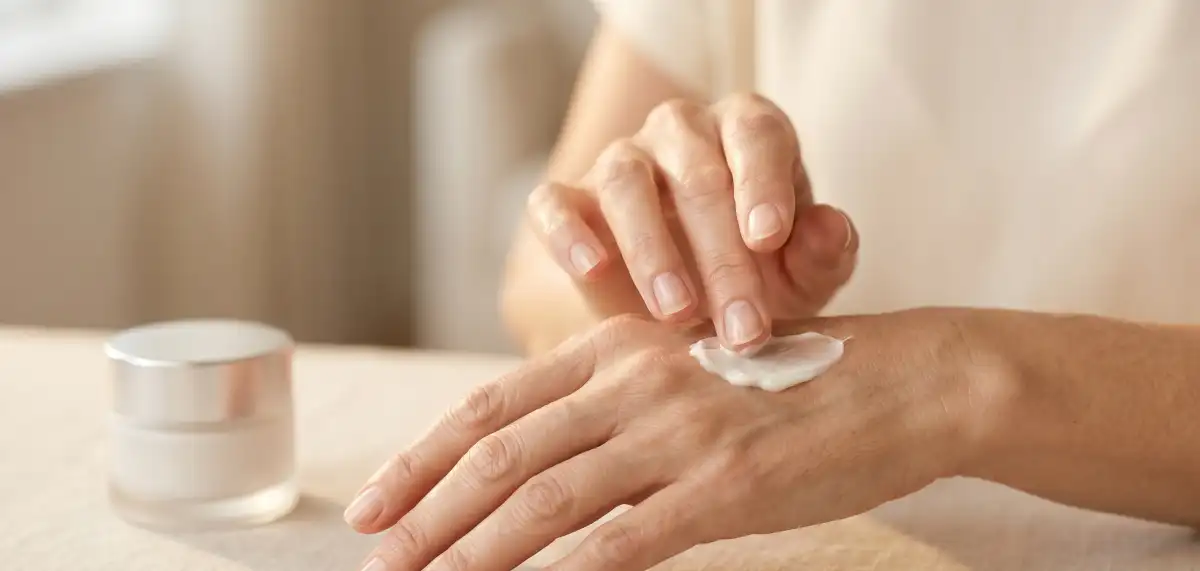
The science of skin aging is evolving rapidly — and for women navigating the skin changes that come with menopause and beyond, evidence-based skincare represents a fundamentally different approach: working with your skin's biology rather than against it.
Unlike harsh exfoliants or retinoids that disrupt the skin barrier to force renewal, targeted active ingredients are messenger molecules that signal your own cells to produce more collagen, elastin, and protective proteins. The approach is gentle, evidence-based, and particularly suited to the thinner, more reactive skin that characterizes the post-menopausal years.
The Hormonal Barrier Collapse Behind Severe Hand Dryness
Dry, cracked hands during menopause represent the most extreme manifestation of estrogen-driven barrier collapse, and they affect a surprisingly large proportion of menopausal women — a survey in Menopause found that 47% reported significant hand dryness and 18% experienced actual skin cracking. The mechanism goes beyond simple moisture loss: estrogen normally stimulates lamellar body secretion in keratinocytes, which delivers ceramides, cholesterol, and fatty acids to the stratum corneum. When estrogen declines, this delivery system falters, and the lipid barrier — already under constant assault from hand washing — cannot maintain its integrity.[1]
The cracking that develops in menopausal hands follows a predictable anatomical pattern. Fissures first appear on the fingertips and knuckles — the sites of maximum mechanical stress where skin is bent and stretched most frequently. These areas have the least capacity for barrier self-repair because the constant flexion prevents the lipid matrix from forming a continuous layer. A detailed analysis of hand fissure distribution in post-menopausal women found that 73% of cracks occurred on the palmar fingertips, 18% on the interphalangeal joints, and 9% on the web spaces — precisely mapping the sites of maximum mechanical stress.
Clinical research confirms that the vicious cycle of menopausal hand cracking is clinically important: cracked skin triggers an inflammatory response that further degrades the barrier, the compromised barrier allows irritants to penetrate more easily, the irritants amplify inflammation, and the cycle accelerates. A study measuring inflammatory markers in the skin of women with menopausal hand fissures found elevated IL-1alpha, TNF-alpha, and prostaglandin E2 — confirming that the cracks are not merely mechanical failures but sites of active inflammatory dermatitis.
Breaking this cycle requires aggressive, consistent barrier repair using the 'soak and seal' technique: brief warm water soaking (2-3 minutes) to hydrate the stratum corneum, followed immediately by a thick layer of ceramide-based cream to trap the moisture. For active fissures, overnight occlusion with cotton gloves dramatically accelerates healing — a clinical study showed that occluded ceramide treatment healed hand fissures in an average of 7 days versus 21 days for non-occluded application. Once healed, the maintenance protocol is ceramide hand cream applied within 60 seconds of every hand wash, plus overnight ceramide-glove treatment 2-3 times weekly.
Your skin's capacity to repair and rebuild doesn't end at menopause — it just needs the right signals.
— Dr. Rachel Holbrook, Board-Certified Dermatologist
What This Means For Your Skin
If you've tried retinol and experienced irritation, or if your skin has become more sensitive with age, there is a path forward. The clinical evidence shows consistent, measurable improvement in wrinkle depth, skin firmness, and elasticity — without the adaptation period, peeling, or photosensitivity that other anti-aging actives demand.
Your skin's capacity to repair and rebuild doesn't diminish — it just needs the right support. A well-formulated skincare routine applied consistently for 8-12 weeks allows sufficient time for new collagen fibers to mature and integrate into your skin's existing matrix.
The science is clear. The evidence is consistent. The results are measurable.
What happens next is up to you.