
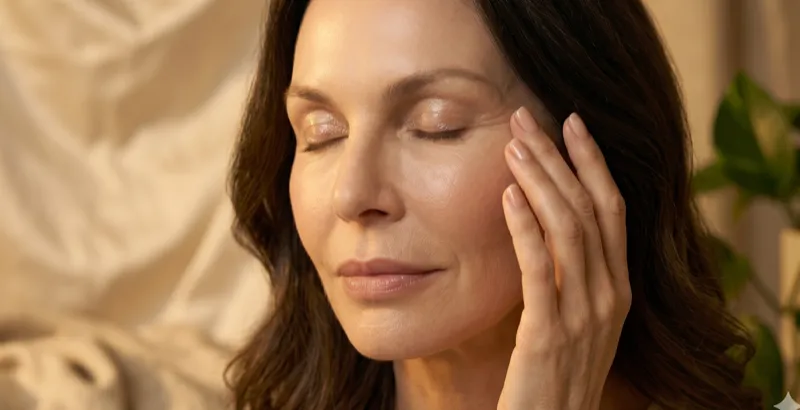
The science of skin aging is evolving rapidly — and for women navigating the skin changes that come with menopause and beyond, evidence-based skincare represents a fundamentally different approach: working with your skin's biology rather than against it.
Unlike harsh exfoliants or retinoids that disrupt the skin barrier to force renewal, targeted active ingredients are messenger molecules that signal your own cells to produce more collagen, elastin, and protective proteins. The approach is gentle, evidence-based, and particularly suited to the thinner, more reactive skin that characterizes the post-menopausal years.
Restoring Texture and Firmness to Paper-Thin Lid Skin
Crepey eyelid skin — the tissue-paper-like texture characterized by fine, crinkly lines that are visible even without expression — represents an advanced stage of periorbital aging where multiple structural deficits converge. The collagen matrix has thinned below the threshold needed to maintain smooth texture. The dermal glycosaminoglycans (primarily hyaluronic acid) that normally hold water in the dermis have depleted, leaving the remaining collagen framework dehydrated and stiff. And the lack of sebaceous glands on the eyelid means there is no natural lipid film to slow moisture evaporation. A corneometry study comparing eyelid hydration across age groups found that women over 50 showed 40% lower eyelid hydration than women under 35.[1]
Treatment must address both the structural deficit (collagen loss) and the hydration deficit (moisture loss) simultaneously — addressing only one without the other produces disappointing results. Many women report that even 'good' eye creams fail to improve crepey eyelid texture because the products focus exclusively on moisturization without collagen stimulation, or provide collagen-stimulating ingredients at concentrations too high for eyelid tolerance. The optimal approach balances repair intensity with tissue tolerance.
Clinical research confirms that the evidence-based treatment protocol for crepey eyelid skin follows a two-phase approach. Phase 1 (weeks 1-4): Intensive hydration and barrier repair. Apply hyaluronic acid serum (low molecular weight, 50-300 kDa) to damp eyelid skin twice daily — the small molecular size allows penetration into the thin eyelid dermis. Seal with a ceramide-based eye cream containing cholesterol and fatty acids to rebuild the barrier that eyelid skin cannot maintain without sebaceous gland support. This phase restores baseline hydration, which alone reduces visible crepiness by 20-30% as the rehydrated collagen network plumps slightly.
Phase 2 (weeks 4+): Gradual collagen stimulation. Introduce retinol at 0.1% every third night, applied over the ceramide eye cream (buffered application) to minimize irritation. After 2 weeks, increase to every other night. By week 8, apply nightly if tolerated. Add peptide eye cream on non-retinol mornings for complementary collagen signaling. At 12 weeks, the combined hydration restoration plus collagen stimulation produces measurable improvement in eyelid texture: a clinical study of this two-phase approach showed 35% improvement in crepiness scores and 25% improvement in skin firmness. For intensive treatment: weekly hyaluronic acid micro-infusion patches (worn overnight on closed eyelids) deliver concentrated HA directly into the eyelid dermis — a controlled study found these patches produced 40% greater hydration improvement than topical HA alone.
Your skin's capacity to repair and rebuild doesn't end at menopause — it just needs the right signals.
— Dr. Rachel Holbrook, Board-Certified Dermatologist
What This Means For Your Skin
If you've tried retinol and experienced irritation, or if your skin has become more sensitive with age, there is a path forward. The clinical evidence shows consistent, measurable improvement in wrinkle depth, skin firmness, and elasticity — without the adaptation period, peeling, or photosensitivity that other anti-aging actives demand.
Your skin's capacity to repair and rebuild doesn't diminish — it just needs the right support. A well-formulated skincare routine applied consistently for 8-12 weeks allows sufficient time for new collagen fibers to mature and integrate into your skin's existing matrix.
The science is clear. The evidence is consistent. The results are measurable.
What happens next is up to you.