
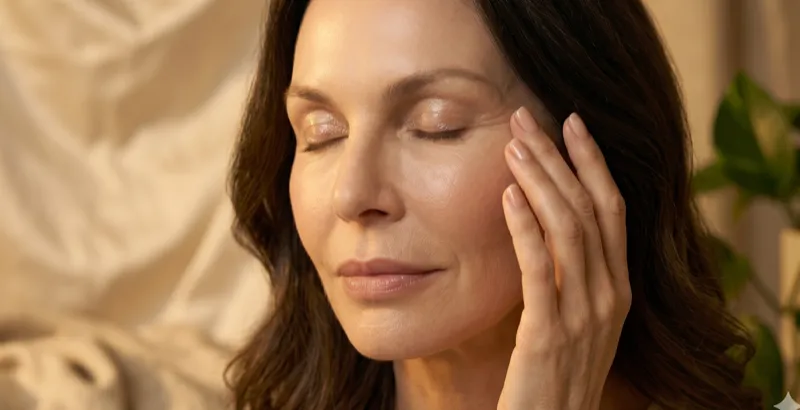
The science of skin aging is evolving rapidly — and for women navigating the skin changes that come with menopause and beyond, evidence-based skincare represents a fundamentally different approach: working with your skin's biology rather than against it.
Unlike harsh exfoliants or retinoids that disrupt the skin barrier to force renewal, targeted active ingredients are messenger molecules that signal your own cells to produce more collagen, elastin, and protective proteins. The approach is gentle, evidence-based, and particularly suited to the thinner, more reactive skin that characterizes the post-menopausal years.
A Gentle Daily Protocol for the Most Delicate Facial Skin
An eyelid-specific skincare routine is not a luxury — it is a necessity because the periorbital area has fundamentally different characteristics than the rest of the face and requires adapted products and techniques. Using your regular facial moisturizer on eyelids is insufficient (it lacks the specific ingredients eyelid skin needs) and potentially harmful (it may contain concentrations of actives that irritate the thin eyelid dermis). A survey of dermatologists found that 80% recommended a separate eye product for patients over 35, citing the unique vulnerabilities of periorbital skin.[1]
Morning routine — Hydration and protection: Step 1: After facial cleansing (which should avoid the eyelid area — let water rinse suffice for eyelid cleansing), pat the eye area until just slightly damp. Step 2: Apply a single drop of hyaluronic acid serum to each eye area, using the ring finger to gently pat (never rub) from the inner corner outward along the orbital bone. Step 3: Apply peptide eye cream — a product containing acetyl tetrapeptide-5 and/or palmitoyl tripeptide-1 — tapping along the orbital bone. The cream provides both active treatment and a base for SPF. Step 4: Apply mineral SPF (zinc oxide or titanium dioxide) to the periorbital area, extending to the orbital bone. Mineral formulations sting less than chemical SPFs near the eyes.
Clinical research confirms that evening routine — Repair and stimulation: Step 1: Remove eye makeup with a dedicated micellar water or oil-based remover on a cotton pad, holding the pad against the eye for 10 seconds to dissolve makeup, then wiping gently in one direction (never rubbing back and forth). This technique removes makeup while minimizing the mechanical stress that stretches thin eyelid skin. Step 2: On retinol nights (3-4 per week): apply a rice-grain-sized amount of retinol eye cream (0.1-0.2%) along the orbital bone, keeping the product on bone rather than directly on the mobile eyelid. The retinol migrates slightly overnight, reaching the eyelid without direct application to the most sensitive tissue. Step 3: Apply ceramide eye cream over the retinol for barrier protection and occlusion.
Weekly additions: Once weekly — a hydrating eye mask (gel patches or cream mask) worn for 15-20 minutes provides intensive moisture infusion to the chronically dehydrated eyelid skin. The occlusion created by the mask forces ingredients deeper into the thin dermis. Once weekly — gentle eye area massage: using a small amount of facial oil, apply gentle circular pressure along the orbital bone (never on the eyeball), moving from inner corner to outer corner, then outward along the brow bone. This 2-minute massage improves lymphatic drainage (reducing puffiness), increases microcirculation (supporting fibroblast activity), and provides a brief moment of dedicated attention to the area that shows aging first. Important rule: never apply facial exfoliants (AHAs, BHAs, scrubs) to the eyelid area — the 0.5mm dermis cannot withstand chemical or physical exfoliation without damage.
Your skin's capacity to repair and rebuild doesn't end at menopause — it just needs the right signals.
— Dr. Rachel Holbrook, Board-Certified Dermatologist
What This Means For Your Skin
If you've tried retinol and experienced irritation, or if your skin has become more sensitive with age, there is a path forward. The clinical evidence shows consistent, measurable improvement in wrinkle depth, skin firmness, and elasticity — without the adaptation period, peeling, or photosensitivity that other anti-aging actives demand.
Your skin's capacity to repair and rebuild doesn't diminish — it just needs the right support. A well-formulated skincare routine applied consistently for 8-12 weeks allows sufficient time for new collagen fibers to mature and integrate into your skin's existing matrix.
The science is clear. The evidence is consistent. The results are measurable.
What happens next is up to you.