
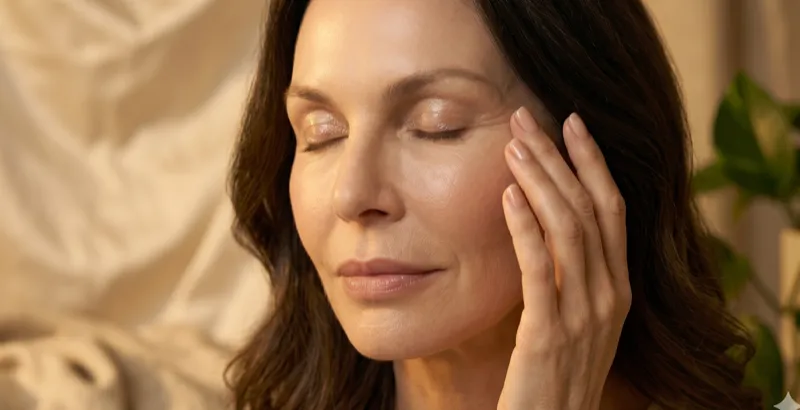
The science of skin aging is evolving rapidly — and for women navigating the skin changes that come with menopause and beyond, evidence-based skincare represents a fundamentally different approach: working with your skin's biology rather than against it.
Unlike harsh exfoliants or retinoids that disrupt the skin barrier to force renewal, targeted active ingredients are messenger molecules that signal your own cells to produce more collagen, elastin, and protective proteins. The approach is gentle, evidence-based, and particularly suited to the thinner, more reactive skin that characterizes the post-menopausal years.
Ingredients That Actually Tighten the Thinnest Skin on Your Body
Selecting an effective eyelid firming cream requires understanding the unique limitations of eyelid skin — it is 3-5 times thinner than other facial skin, lacks sebaceous glands (making it prone to dryness), contains minimal subcutaneous fat (providing no volume buffer), and is subject to 15,000+ mechanical deformations daily from blinking. An effective eyelid cream must deliver collagen-stimulating ingredients at concentrations the eyelid can tolerate while also providing firming and tightening effects specific to this ultra-thin tissue.[1]
Tier 1 ingredients (evidence-based eyelid firming): Retinol at 0.1-0.3% — the collagen-stimulating gold standard, but at reduced concentration for eyelid tolerance. Studies show that even 0.1% retinol applied to the periorbital area produces measurable collagen improvement after 3-6 months. Peptide complex (acetyl tetrapeptide-5 + palmitoyl tripeptide-1 + hexapeptide-11) — targets periorbital collagen synthesis, glycation, and microcirculation simultaneously. Caffeine (1-3%) — a vasoconstrictor and phosphodiesterase inhibitor that reduces puffiness (by constricting dilated blood vessels) and firms skin (by promoting lipase-mediated fat metabolism in the superficial fat layer). A study of caffeine-containing eye cream showed 22% reduction in puffiness and 15% improvement in skin firmness after 4 weeks.
Clinical research confirms that tier 2 ingredients (supporting): Niacinamide (2-4%) — stimulates endogenous collagen and ceramide production, less irritating than retinol, making it ideal for the sensitive eyelid. Vitamin C (ascorbyl glucoside or sodium ascorbyl phosphate at 5-10% — gentler derivatives than L-ascorbic acid, which can sting the eye area) — provides collagen cross-linking support. Hyaluronic acid (multi-weight) — hydrates the thin eyelid dermis, temporarily plumping fine lines and improving skin texture. Ceramides — restore the barrier in sebaceous-gland-deficient eyelid skin, preventing the dryness that makes thin skin appear more crepey.
Ingredients to avoid in eyelid products: Fragrance — the most common cause of contact dermatitis in the periorbital area, and the thin eyelid skin allows greater irritant penetration than other facial sites. High-concentration retinoids (>0.3% retinol, any concentration of tretinoin) — cause excessive peeling and irritation that can thin already-thin eyelid skin. Alpha-hydroxy acids (glycolic, lactic) at >5% — too exfoliating for eyelid tissue. Essential oils — documented contact sensitizers that are particularly problematic near the eyes. Application technique matters as much as product: always use the ring finger (weakest finger, gentlest touch), apply in a tapping/patting motion never rubbing, and apply to the orbital bone rather than directly on the mobile eyelid for upper lid products.
Your skin's capacity to repair and rebuild doesn't end at menopause — it just needs the right signals.
— Dr. Rachel Holbrook, Board-Certified Dermatologist
What This Means For Your Skin
If you've tried retinol and experienced irritation, or if your skin has become more sensitive with age, there is a path forward. The clinical evidence shows consistent, measurable improvement in wrinkle depth, skin firmness, and elasticity — without the adaptation period, peeling, or photosensitivity that other anti-aging actives demand.
Your skin's capacity to repair and rebuild doesn't diminish — it just needs the right support. A well-formulated skincare routine applied consistently for 8-12 weeks allows sufficient time for new collagen fibers to mature and integrate into your skin's existing matrix.
The science is clear. The evidence is consistent. The results are measurable.
What happens next is up to you.