
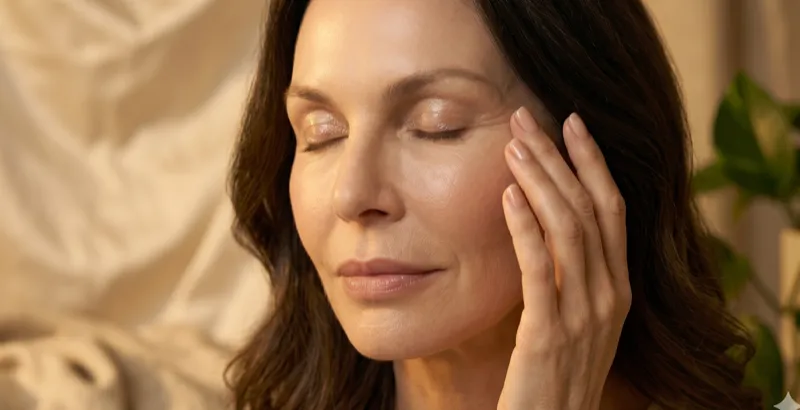
The science of skin aging is evolving rapidly — and for women navigating the skin changes that come with menopause and beyond, evidence-based skincare represents a fundamentally different approach: working with your skin's biology rather than against it.
Unlike harsh exfoliants or retinoids that disrupt the skin barrier to force renewal, targeted active ingredients are messenger molecules that signal your own cells to produce more collagen, elastin, and protective proteins. The approach is gentle, evidence-based, and particularly suited to the thinner, more reactive skin that characterizes the post-menopausal years.
Non-Surgical Options to Lift and Firm Drooping Upper Lids
Non-surgical treatment for hooded eyelids has advanced significantly, offering meaningful improvement for mild-to-moderate lid drooping that previously had no option between 'do nothing' and blepharoplasty (surgical eyelid lift). The non-surgical approach targets the skin quality component of hooded lids — rebuilding collagen density and elasticity in the eyelid dermis so that the skin is firmer, tighter, and less prone to draping over the lid crease. While non-surgical treatment cannot replicate the dramatic result of removing excess skin surgically, it can visibly improve lid appearance and delay the point at which surgery becomes necessary.[1]
Topical treatment for hooded eyelids requires eye-area-specific formulations. Standard retinoids at facial concentrations (0.5-1.0% retinol, 0.025-0.05% tretinoin) are too irritating for the 0.5mm eyelid dermis — they cause peeling, redness, and can actually thin the eyelid further through excessive exfoliation. Eye-specific retinol at 0.1-0.3% provides collagen stimulation at a concentration the eyelid can tolerate. Apply with the ring finger (lightest touch) using patting motions rather than rubbing. A study of low-concentration retinol applied to the periorbital area showed 15% improvement in skin firmness and 12% improvement in eyelid position after 6 months.
Clinical research confirms that peptides are particularly well-suited to eyelid treatment because they deliver collagen-stimulating signaling without the irritation potential of retinoids. Acetyl tetrapeptide-5 (Eyeseryl) specifically targets periorbital concerns — it reduces glycation-related collagen stiffening and improves microcirculation. Palmitoyl tripeptide-1 (part of Matrixyl 3000) stimulates collagen I and III synthesis. Hexapeptide-11 promotes fibroblast activity. A peptide-based eye cream used twice daily for 12 weeks showed measurable improvement in upper eyelid firmness and reduced skin laxity in a controlled study of women aged 40-60.
Professional non-surgical treatments for hooded eyelids: Plasma pen (fibroblast therapy) creates controlled micro-injuries on the excess eyelid skin, causing tissue contraction as it heals — producing visible tightening within 2-4 weeks. A clinical study showed 20-30% improvement in upper lid hooding after a single plasma pen treatment. RF micro-needling at reduced settings for the periorbital area stimulates deeper collagen remodeling while respecting the thin eyelid structure. Thermage Eye (radiofrequency with a specialized periorbital tip) is FDA-approved for periorbital treatment and produces gradual tightening over 3-6 months. The most effective non-surgical approach combines daily topical peptide/retinol treatment with periodic professional treatments — producing cumulative improvement of 25-40% in lid hooding over 6-12 months.
Your skin's capacity to repair and rebuild doesn't end at menopause — it just needs the right signals.
— Dr. Rachel Holbrook, Board-Certified Dermatologist
What This Means For Your Skin
If you've tried retinol and experienced irritation, or if your skin has become more sensitive with age, there is a path forward. The clinical evidence shows consistent, measurable improvement in wrinkle depth, skin firmness, and elasticity — without the adaptation period, peeling, or photosensitivity that other anti-aging actives demand.
Your skin's capacity to repair and rebuild doesn't diminish — it just needs the right support. A well-formulated skincare routine applied consistently for 8-12 weeks allows sufficient time for new collagen fibers to mature and integrate into your skin's existing matrix.
The science is clear. The evidence is consistent. The results are measurable.
What happens next is up to you.