
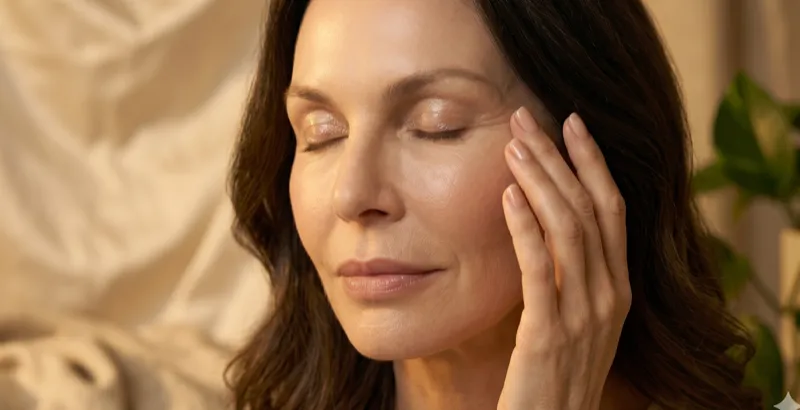
The science of skin aging is evolving rapidly — and for women navigating the skin changes that come with menopause and beyond, evidence-based skincare represents a fundamentally different approach: working with your skin's biology rather than against it.
Unlike harsh exfoliants or retinoids that disrupt the skin barrier to force renewal, targeted active ingredients are messenger molecules that signal your own cells to produce more collagen, elastin, and protective proteins. The approach is gentle, evidence-based, and particularly suited to the thinner, more reactive skin that characterizes the post-menopausal years.
How Topical Collagen Stimulation Creates a Non-Surgical Lifting Effect
A skincare-based 'lift' of the upper eyelid works not by physically repositioning tissue (as surgery does) but by improving the quality and firmness of the eyelid skin so that it drapes less over the lid crease. The distinction is important for realistic expectations: skincare produces a tighter, smoother lid that appears more open and lifted, but cannot remove excess skin or reposition the levator muscle. For mild-to-moderate hooding — where the skin is lax but not significantly obstructing vision — the skincare approach produces visible improvement that many women find satisfactory without surgical intervention.[1]
The lifting effect comes from three concurrent mechanisms. Mechanism 1: Collagen densification — retinol and peptides stimulate new collagen production in the eyelid dermis, increasing the tissue's structural density. Denser collagen creates a firmer eyelid that resists gravitational draping. Mechanism 2: Elastin support — while new elastin synthesis is minimal in adult skin, preventing further degradation of existing elastin (through antioxidant protection and UV avoidance) preserves the recoil capacity that allows the eyelid to maintain its position. Mechanism 3: Dermal hydration — well-hydrated dermal glycosaminoglycans create turgor pressure that pushes outward against gravitational force, physically supporting the eyelid in a more elevated position.
Clinical research confirms that the optimized skincare protocol for eyelid lifting: Morning — hyaluronic acid serum to damp eyelid skin, followed by peptide eye cream (acetyl tetrapeptide-5 + Matrixyl), followed by SPF (mineral zinc oxide formulation to minimize stinging). The morning HA creates immediate turgor-based lifting that is visible within minutes and lasts through the day. Evening — retinol 0.1-0.2% eye cream applied with ring finger in patting motions from outer eye toward inner, focusing on the upper orbital bone where skin draping originates. Layer ceramide eye cream over the retinol for barrier protection and occlusion.
Results timeline for skincare eyelid lifting: Weeks 1-4: Improved hydration creates visible texture improvement and mild lifting effect from dermal turgor. The eyes appear more 'awake' and less crepey. Weeks 4-12: Retinol-stimulated collagen production begins providing structural improvement. Fine lines reduce, and the eyelid feels firmer when touched. Months 3-6: Peak collagen densification produces the maximum skincare lifting effect — the eyelid drapes less over the crease, the eye opening appears wider, and the overall periorbital appearance is visibly younger. A clinical study measuring palpebral fissure height (the vertical opening of the eye) found that 6 months of dedicated eye skincare produced an average increase of 0.5-0.8mm — a modest but visible improvement equivalent to what many women describe as looking 'more awake' or 'more refreshed.'
Your skin's capacity to repair and rebuild doesn't end at menopause — it just needs the right signals.
— Dr. Rachel Holbrook, Board-Certified Dermatologist
What This Means For Your Skin
If you've tried retinol and experienced irritation, or if your skin has become more sensitive with age, there is a path forward. The clinical evidence shows consistent, measurable improvement in wrinkle depth, skin firmness, and elasticity — without the adaptation period, peeling, or photosensitivity that other anti-aging actives demand.
Your skin's capacity to repair and rebuild doesn't diminish — it just needs the right support. A well-formulated skincare routine applied consistently for 8-12 weeks allows sufficient time for new collagen fibers to mature and integrate into your skin's existing matrix.
The science is clear. The evidence is consistent. The results are measurable.
What happens next is up to you.