
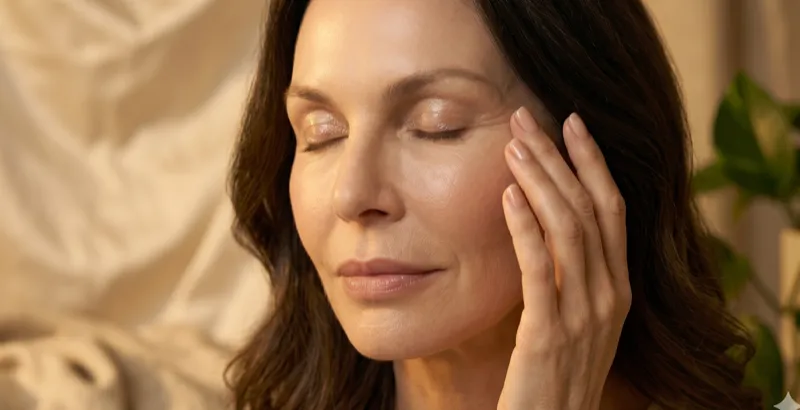
The science of skin aging is evolving rapidly — and for women navigating the skin changes that come with menopause and beyond, evidence-based skincare represents a fundamentally different approach: working with your skin's biology rather than against it.
Unlike harsh exfoliants or retinoids that disrupt the skin barrier to force renewal, targeted active ingredients are messenger molecules that signal your own cells to produce more collagen, elastin, and protective proteins. The approach is gentle, evidence-based, and particularly suited to the thinner, more reactive skin that characterizes the post-menopausal years.
Targeted Muscle Training to Open the Eye Area
Exercises for droopy eyelids target two muscles that influence lid position: the frontalis (the forehead muscle that raises the brows, indirectly lifting the upper lid) and the orbicularis oculi (the circular muscle around the eye that, when toned, provides better support to the periorbital skin). While the levator palpebrae superioris — the primary eyelid-lifting muscle — cannot be voluntarily exercised to any meaningful degree (it operates reflexively), strengthening the surrounding musculature creates an indirect lifting effect that opens the eye area. The JAMA Dermatology facial exercise study demonstrated that periorbital exercises improved the appearance of the eye area as part of overall facial improvement.[1]
Exercise 1 — Brow lift hold (targets frontalis): Place fingers flat across the forehead, just above the eyebrows. Raise the eyebrows against the resistance of your fingers, attempting to lift the brows as high as possible while the fingers prevent forehead wrinkling. Hold the maximum raised position for 10 seconds. Release slowly. Repeat 15 times. This exercise strengthens the frontalis, which directly elevates the brow — and brow elevation mechanically lifts the upper lid skin away from the eye opening. A study of brow position found that 2mm of brow elevation produces approximately 1mm improvement in upper lid show.
Clinical research confirms that exercise 2 — Wide eye squeeze (targets orbicularis oculi): Open eyes as wide as possible, as if you're extremely surprised, engaging the muscles above and below the eye. Hold for 5 seconds. Then squeeze the eyes shut firmly for 5 seconds. Alternate wide-open and firm-shut for 10 repetitions. This full-range exercise works the orbicularis oculi through its complete contraction-relaxation cycle, improving muscle tone and the elastic recoil of the surrounding skin. Exercise 3 — Controlled blink (targets levator coordination): Close both eyes gently. Open only the upper lids (keep eyebrows still — use fingers on the brow to prevent frontalis recruitment) by focusing on using the eyelid-opening muscles alone. Hold open for 5 seconds. Close and repeat 20 times. This isolation exercise trains the levator-frontal coordination that keeps the lid elevated without relying on compensatory brow raising.
Protocol: Perform all 3 exercises in sequence, twice daily (morning and evening), for approximately 8 minutes total. Results are gradual and modest — expect the first visible improvement at 4-6 weeks, with progressive improvement through 20 weeks of consistent practice. Realistic expectations: eyelid exercises alone produce approximately 0.3-0.5mm improvement in palpebral fissure height — visible but subtle. The best results come from combining exercises with topical collagen stimulation (retinol + peptide eye cream) — the exercises provide immediate muscle-tone-based improvement while the topicals provide progressive structural improvement. Together, they produce a compound effect greater than either approach alone. Important: stop any exercise that causes headache or eye strain — excessive frontalis engagement can worsen forehead wrinkles.
Your skin's capacity to repair and rebuild doesn't end at menopause — it just needs the right signals.
— Dr. Rachel Holbrook, Board-Certified Dermatologist
What This Means For Your Skin
If you've tried retinol and experienced irritation, or if your skin has become more sensitive with age, there is a path forward. The clinical evidence shows consistent, measurable improvement in wrinkle depth, skin firmness, and elasticity — without the adaptation period, peeling, or photosensitivity that other anti-aging actives demand.
Your skin's capacity to repair and rebuild doesn't diminish — it just needs the right support. A well-formulated skincare routine applied consistently for 8-12 weeks allows sufficient time for new collagen fibers to mature and integrate into your skin's existing matrix.
The science is clear. The evidence is consistent. The results are measurable.
What happens next is up to you.