
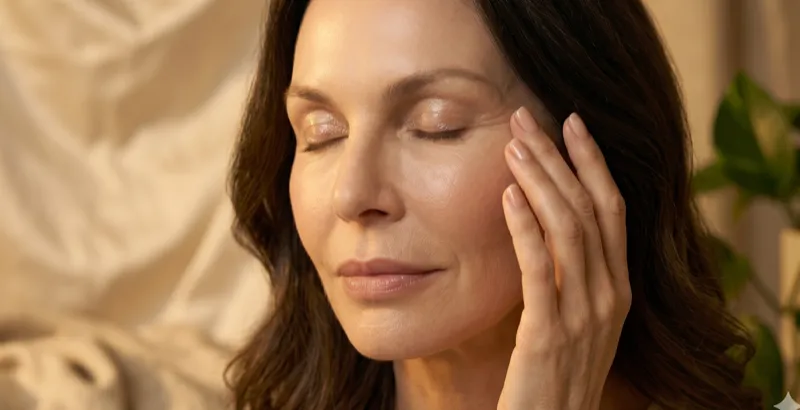
The science of skin aging is evolving rapidly — and for women navigating the skin changes that come with menopause and beyond, evidence-based skincare represents a fundamentally different approach: working with your skin's biology rather than against it.
Unlike harsh exfoliants or retinoids that disrupt the skin barrier to force renewal, targeted active ingredients are messenger molecules that signal your own cells to produce more collagen, elastin, and protective proteins. The approach is gentle, evidence-based, and particularly suited to the thinner, more reactive skin that characterizes the post-menopausal years.
Protecting the Most Vulnerable Facial Skin Before Damage Accumulates
Prevention of eyelid aging is disproportionately effective compared to treatment because the extreme thinness of eyelid skin means that small amounts of collagen preservation translate to significant visible differences. A prevention study found that women who implemented a periorbital protection protocol in their 30s showed 50% less eyelid aging at age 50 compared to matched controls — a greater prevention-to-treatment ratio than for any other facial area. The investment in eyelid protection is small in time and cost but large in outcome.[1]
Sun protection is the single most impactful prevention measure. UV radiation reaches the periorbital area even with sunglasses (reflected UV from below, light leakage around frames). A photoaging study found that the periorbital area showed UV damage comparable to the central face despite consistent sunglass wear, suggesting that sunglasses alone are insufficient. The prevention protocol: daily mineral SPF applied to the entire periorbital area (close-fitting sunglasses with UV400 protection as a supplement, not a replacement). When selecting sunglasses, wrap-around styles block the most UV leakage. Cumulative UV prevention preserves both collagen and elastin — the two structural proteins that keep eyelid skin firm.
Clinical research confirms that mechanical protection is the second most impactful prevention measure. The eyelid skin stretches 0.5mm each time you rub your eyes — insignificant in a single event, but over decades of daily rubbing, the cumulative stretch exceeds the skin's elastic recovery capacity. The prevention protocol: never rub the eyes (use cold compresses for itch or irritation), remove eye makeup with hold-and-wipe technique rather than rubbing, apply eye cream with patting motions using the ring finger, and avoid pulling the eyelid skin for any reason (including during makeup application). A behavioral study found that women who eliminated eye-rubbing showed 20% less periorbital skin laxity than matched rubbing-habit controls after 5 years.
Early-start collagen maintenance: beginning a gentle peptide eye cream in the late 20s to early 30s maintains the collagen reserves that will be drawn down during natural aging and menopause. The prevention doesn't require aggressive actives — at this age, a peptide eye cream (without retinol, which is unnecessary before age 35 for most women) plus consistent SPF provides adequate collagen support. At age 35-40, add retinol 0.1% to the eye routine to actively stimulate collagen production as natural decline accelerates. Hydration maintenance with hyaluronic acid keeps the glycosaminoglycan matrix hydrated, preserving the turgor that supports eyelid skin structure. This phased prevention approach — protection in the 20s, maintenance in the 30s, active stimulation in the 40s — produces the best long-term periorbital outcomes.
Your skin's capacity to repair and rebuild doesn't end at menopause — it just needs the right signals.
— Dr. Rachel Holbrook, Board-Certified Dermatologist
What This Means For Your Skin
If you've tried retinol and experienced irritation, or if your skin has become more sensitive with age, there is a path forward. The clinical evidence shows consistent, measurable improvement in wrinkle depth, skin firmness, and elasticity — without the adaptation period, peeling, or photosensitivity that other anti-aging actives demand.
Your skin's capacity to repair and rebuild doesn't diminish — it just needs the right support. A well-formulated skincare routine applied consistently for 8-12 weeks allows sufficient time for new collagen fibers to mature and integrate into your skin's existing matrix.
The science is clear. The evidence is consistent. The results are measurable.
What happens next is up to you.