
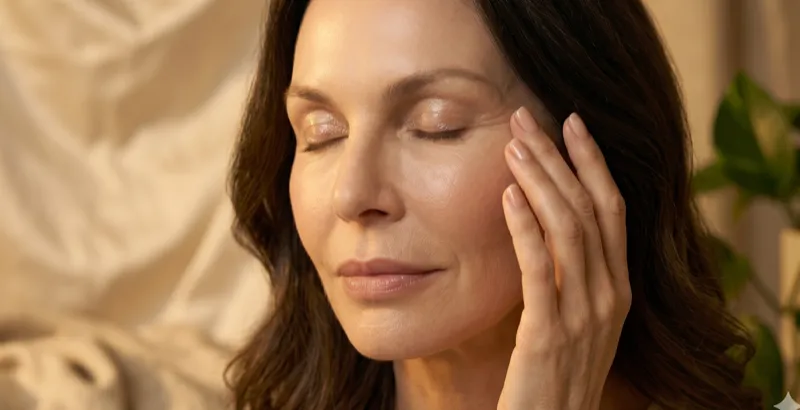
The science of skin aging is evolving rapidly — and for women navigating the skin changes that come with menopause and beyond, evidence-based skincare represents a fundamentally different approach: working with your skin's biology rather than against it.
Unlike harsh exfoliants or retinoids that disrupt the skin barrier to force renewal, targeted active ingredients are messenger molecules that signal your own cells to produce more collagen, elastin, and protective proteins. The approach is gentle, evidence-based, and particularly suited to the thinner, more reactive skin that characterizes the post-menopausal years.
How Estrogen Loss Accelerates the Most Visible Eye Area Changes
The periorbital area is where menopausal aging often becomes visible first — before the cheeks, before the jawline, before the neck. This is because the eyelid's extreme structural thinness means it reaches the threshold of visible aging with smaller absolute collagen losses than any other facial site. A woman who has lost 25% of her cheek collagen may show no visible change because the cheek's thicker dermis still has adequate structural reserve. The same 25% loss in the 0.5mm eyelid dermis may reduce the functional collagen layer to the point where the skin visibly drapes, sags, and loses elasticity.[1]
Estrogen's impact on eyelid aging operates through three mechanisms. First, collagen synthesis: ER-beta receptors on eyelid fibroblasts regulate local collagen production. When estrogen declines, collagen synthesis in the eyelid drops faster than in thicker facial skin — possibly because the eyelid's thin dermis contains fewer fibroblasts per unit area, making each cell's reduced output more impactful. Second, fat compartment changes: estrogen influences orbital fat distribution, and post-menopausal changes in fat metabolism can cause the orbital fat to herniate forward through the weakened septum, creating the puffy or 'baggy' appearance of aging eyelids. Third, fluid dynamics: estrogen modulates vascular permeability, and post-menopausal changes in periorbital vasculature contribute to increased morning puffiness and dark circles.
Clinical research confirms that the clinical presentation of menopausal eyelid aging follows a characteristic sequence. Early perimenopause (ages 42-47): increased fine lines around the eyes (crow's feet deepen), skin texture becomes more crepey, morning puffiness takes longer to resolve. Late perimenopause (ages 47-52): upper lid skin begins to drape over the lid crease (early hooding), lower lid skin loses elasticity (early bags become apparent), dark circles darken due to thinning skin revealing underlying vasculature. Post-menopause (52+): significant hooding may obstruct peripheral vision, fat herniation produces visible bags, and the combination creates the tired, aged appearance that is often the primary motivator for seeking treatment.
Early intervention during perimenopause produces the best outcomes for eyelid aging — the collagen preservation approach. Starting a dedicated eye cream with low-dose retinol (0.1-0.2%) and peptides during perimenopause maintains eyelid collagen above the threshold of visible aging for longer. A prospective study found that women who began periorbital retinol treatment during perimenopause showed 45% less upper lid laxity at 5 years post-menopause compared to untreated controls. Sun protection is critical: daily sunscreen applied to the periorbital area (mineral formulations with zinc oxide are least likely to sting) prevents the UV-mediated collagen degradation that compounds hormonal losses. Combined with gentle eyelid massage (improves lymphatic drainage, reduces puffiness), the prevention approach delays eyelid aging onset by an estimated 5-8 years.
Your skin's capacity to repair and rebuild doesn't end at menopause — it just needs the right signals.
— Dr. Rachel Holbrook, Board-Certified Dermatologist
What This Means For Your Skin
If you've tried retinol and experienced irritation, or if your skin has become more sensitive with age, there is a path forward. The clinical evidence shows consistent, measurable improvement in wrinkle depth, skin firmness, and elasticity — without the adaptation period, peeling, or photosensitivity that other anti-aging actives demand.
Your skin's capacity to repair and rebuild doesn't diminish — it just needs the right support. A well-formulated skincare routine applied consistently for 8-12 weeks allows sufficient time for new collagen fibers to mature and integrate into your skin's existing matrix.
The science is clear. The evidence is consistent. The results are measurable.
What happens next is up to you.