
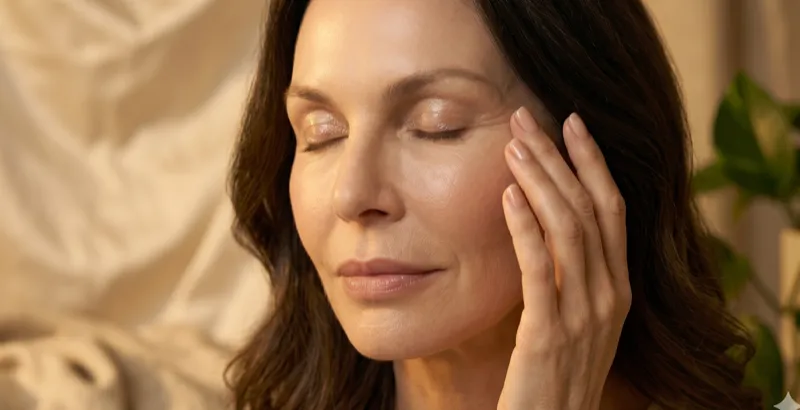
The science of skin aging is evolving rapidly — and for women navigating the skin changes that come with menopause and beyond, evidence-based skincare represents a fundamentally different approach: working with your skin's biology rather than against it.
Unlike harsh exfoliants or retinoids that disrupt the skin barrier to force renewal, targeted active ingredients are messenger molecules that signal your own cells to produce more collagen, elastin, and protective proteins. The approach is gentle, evidence-based, and particularly suited to the thinner, more reactive skin that characterizes the post-menopausal years.
Why Upper Eyelid Skin Loses Structure Faster Than Any Other Facial Area
The upper eyelid is uniquely vulnerable to aging because it contains the thinnest skin on the entire body — just 0.5mm of dermis, compared to 1.5-2.5mm on the cheeks and 2-4mm on the back. This extreme thinness means that even modest collagen and elastin losses produce visible structural change far earlier than on thicker facial skin. A histological study comparing eyelid dermis across age groups found that women in their 40s showed 35-40% less collagen density in eyelid skin compared to their 20s — a rate of decline significantly faster than that measured on the cheeks or forehead of the same subjects.[1]
The structural anatomy of the upper eyelid creates specific vulnerability. The orbital septum — a thin fibrous membrane that contains the orbital fat behind the eyelid — weakens with age, allowing fat to herniate forward (creating the puffy or full appearance of aging upper lids). Simultaneously, the levator aponeurosis — the tendon that connects the eyelid-lifting muscle to the tarsal plate — stretches and thins, reducing the muscle's mechanical advantage for holding the lid open. When combined with excess skin from dermal thinning and collagen loss, the result is the characteristic hooded, heavy-lidded appearance that many women first notice in their early to mid-40s.
Clinical research confirms that estrogen decline accelerates eyelid aging disproportionately. Eyelid skin contains estrogen receptors (ER-alpha and ER-beta) that regulate local collagen synthesis, sebaceous gland function, and dermal thickness. When estrogen declines during perimenopause and menopause, the already-thin eyelid dermis thins further — losing an additional 15-20% of its remaining collagen within the first 5 post-menopausal years. A clinical study tracking eyelid skin thickness across the menopausal transition found that upper eyelid dermis thinned by 0.08mm in the 5 years pre-menopause versus 0.15mm in the 5 years post-menopause — nearly double the rate.
Environmental factors compound the structural aging. The periorbital area receives significant UV exposure (sunglasses protect incompletely, and many women apply less sunscreen around the eyes due to stinging concerns). The constant mechanical action of blinking (approximately 15,000-20,000 times per day) creates repetitive stress on an already-thin dermal structure. Makeup application and removal — particularly if using rubbing motions or harsh removers — mechanically stretches the delicate eyelid skin. Each factor individually is minor, but the cumulative effect on 0.5mm-thick skin with declining collagen support is significant over years and decades.
Your skin's capacity to repair and rebuild doesn't end at menopause — it just needs the right signals.
— Dr. Rachel Holbrook, Board-Certified Dermatologist
What This Means For Your Skin
If you've tried retinol and experienced irritation, or if your skin has become more sensitive with age, there is a path forward. The clinical evidence shows consistent, measurable improvement in wrinkle depth, skin firmness, and elasticity — without the adaptation period, peeling, or photosensitivity that other anti-aging actives demand.
Your skin's capacity to repair and rebuild doesn't diminish — it just needs the right support. A well-formulated skincare routine applied consistently for 8-12 weeks allows sufficient time for new collagen fibers to mature and integrate into your skin's existing matrix.
The science is clear. The evidence is consistent. The results are measurable.
What happens next is up to you.