
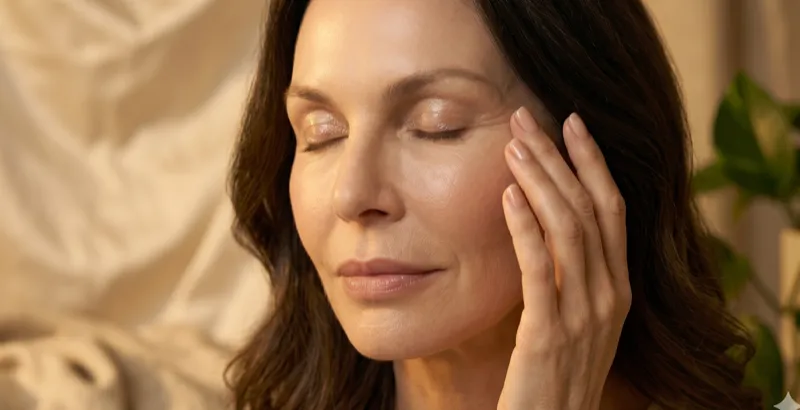
The science of skin aging is evolving rapidly — and for women navigating the skin changes that come with menopause and beyond, evidence-based skincare represents a fundamentally different approach: working with your skin's biology rather than against it.
Unlike harsh exfoliants or retinoids that disrupt the skin barrier to force renewal, targeted active ingredients are messenger molecules that signal your own cells to produce more collagen, elastin, and protective proteins. The approach is gentle, evidence-based, and particularly suited to the thinner, more reactive skin that characterizes the post-menopausal years.
Why Eyelid Skin Darkens With Age and How to Address It
Eyelid darkening with age — periorbital hyperpigmentation — is a multi-factorial condition that differs from facial dark spots in both cause and treatment approach. While facial hyperpigmentation is primarily melanin-driven (UV exposure, hormonal changes), eyelid darkening involves three overlapping mechanisms: vascular show-through (thinning eyelid skin reveals the underlying purple-blue vascular network), true melanin deposition (hormonal and UV-mediated melanocyte stimulation), and post-inflammatory hyperpigmentation (from years of rubbing, allergies, and product irritation). A spectrophotometric study found that vascular show-through accounted for 40-50% of perceived eyelid darkness in women over 45, melanin deposition for 30-40%, and structural shadows from skin laxity for the remaining 10-20%.[1]
Addressing vascular show-through — the most common component in aging women — requires thickening the eyelid dermis so that the underlying vasculature is less visible. Retinol at 0.1-0.2% stimulates collagen production that increases dermal opacity over 3-6 months. Niacinamide at 4-5% improves barrier function and reduces vascular translucency. Vitamin K oxide — one of the few ingredients with evidence for reducing periorbital dark circles — strengthens capillary walls and reduces the micro-leakage of red blood cells into the periorbital tissue. A study of vitamin K oxide eye cream found 25% improvement in dark circle appearance after 8 weeks.
Clinical research confirms that addressing melanin deposition requires gentle brightening agents — the standard facial brightening ingredients (hydroquinone 4%, high-concentration vitamin C, strong retinoids) are too aggressive for the thin eyelid dermis. Safe periorbital brighteners include: arbutin (a natural hydroquinone derivative at 1-2%), kojic acid (at 1%), azelaic acid (at 10% — also anti-inflammatory), and niacinamide (which inhibits melanosome transfer from melanocytes to keratinocytes). Vitamin C in gentle derivatives (ascorbyl glucoside at 5-10%) provides antioxidant protection and mild melanin inhibition. Apply brightening products to the eyelid and periorbital area nightly, always followed by SPF in the morning to prevent UV-triggered melanin production from negating the treatment benefit.
Post-inflammatory hyperpigmentation (PIH) from chronic rubbing, allergic shiners, or product irritation requires eliminating the trigger first. Stop rubbing the eyes (substitute cold compresses for itch or allergy episodes). Switch to fragrance-free, minimal-ingredient eye products. Treat any underlying allergies (seasonal allergies produce the chronic vascular congestion that causes 'allergic shiners'). Once the inflammatory trigger is removed, the PIH fades gradually over 3-6 months — brightening agents can accelerate this process. The realistic timeline for treating dark eyelids: visible improvement at 6-8 weeks, significant improvement at 3-4 months, maximum benefit at 6 months of consistent treatment addressing all three contributing mechanisms.
Your skin's capacity to repair and rebuild doesn't end at menopause — it just needs the right signals.
— Dr. Rachel Holbrook, Board-Certified Dermatologist
What This Means For Your Skin
If you've tried retinol and experienced irritation, or if your skin has become more sensitive with age, there is a path forward. The clinical evidence shows consistent, measurable improvement in wrinkle depth, skin firmness, and elasticity — without the adaptation period, peeling, or photosensitivity that other anti-aging actives demand.
Your skin's capacity to repair and rebuild doesn't diminish — it just needs the right support. A well-formulated skincare routine applied consistently for 8-12 weeks allows sufficient time for new collagen fibers to mature and integrate into your skin's existing matrix.
The science is clear. The evidence is consistent. The results are measurable.
What happens next is up to you.