
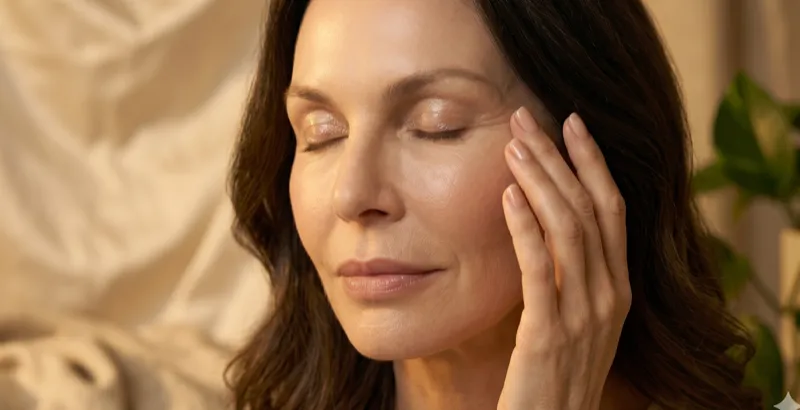
The science of skin aging is evolving rapidly — and for women navigating the skin changes that come with menopause and beyond, evidence-based skincare represents a fundamentally different approach: working with your skin's biology rather than against it.
Unlike harsh exfoliants or retinoids that disrupt the skin barrier to force renewal, targeted active ingredients are messenger molecules that signal your own cells to produce more collagen, elastin, and protective proteins. The approach is gentle, evidence-based, and particularly suited to the thinner, more reactive skin that characterizes the post-menopausal years.
Rebuilding Collagen in the Lower Periorbital Area
Under-eye skin tightening after 40 addresses the lower periorbital area — a region that shows aging through three distinct concerns: fine crepey lines (from collagen and moisture loss), puffiness or bags (from fat herniation through the weakened orbital septum), and dark circles (from vascular show-through and melanin). Unlike upper lid hooding, which is primarily a skin excess issue, under-eye aging involves all three tissue layers — skin, fat, and ligament — each requiring different treatment strategies.[1]
For crepey lines and skin laxity: the same collagen-stimulating approach used for upper lids applies to the under-eye area but with even gentler application. Apply retinol 0.1-0.2% eye cream along the orbital bone below the eye (not directly under the lash line) every other night. The retinol migrates slightly to cover the under-eye area without direct application to the most sensitive tissue. Peptide eye cream applied morning and evening provides continuous collagen signaling. A clinical study of periorbital retinol use found 18% improvement in under-eye fine lines and 15% improvement in skin firmness after 6 months of consistent use.
Clinical research confirms that for puffiness and bags: the distinction between fluid-related puffiness (morning-worse, improves with upright position) and fat-related bags (constant, doesn't change with position) determines treatment. Fluid puffiness responds to caffeine-containing eye creams (vasoconstrictor effect), cold compresses, elevated sleeping position, and reduced sodium intake. Fat herniation bags respond less to topical treatment — they represent orbital fat pushing through a weakened septum, and the structural correction requires either professional RF tightening of the septum or surgical intervention. However, improving the skin quality overlying the bag reduces its visual impact even if the underlying fat position doesn't change.
Professional treatments for under-eye tightening produce more dramatic results than topicals alone. RF micro-needling with settings adjusted for the thin under-eye area tightens both the skin and the underlying septum, reducing fat herniation and improving skin quality simultaneously — a clinical study showed 30% improvement in under-eye laxity after 3 treatments. Injectable treatments — hyaluronic acid filler in the tear trough (the depression between the under-eye bag and the cheek) can camouflage bags by filling the adjacent hollow, but this is a specialized technique with significant complication risk if performed incorrectly. The most reliable non-surgical approach combines daily topical peptide + retinol protocol with 2-3 sessions of periorbital RF treatment, producing 25-40% total improvement in under-eye appearance over 6 months.
Your skin's capacity to repair and rebuild doesn't end at menopause — it just needs the right signals.
— Dr. Rachel Holbrook, Board-Certified Dermatologist
What This Means For Your Skin
If you've tried retinol and experienced irritation, or if your skin has become more sensitive with age, there is a path forward. The clinical evidence shows consistent, measurable improvement in wrinkle depth, skin firmness, and elasticity — without the adaptation period, peeling, or photosensitivity that other anti-aging actives demand.
Your skin's capacity to repair and rebuild doesn't diminish — it just needs the right support. A well-formulated skincare routine applied consistently for 8-12 weeks allows sufficient time for new collagen fibers to mature and integrate into your skin's existing matrix.
The science is clear. The evidence is consistent. The results are measurable.
What happens next is up to you.