
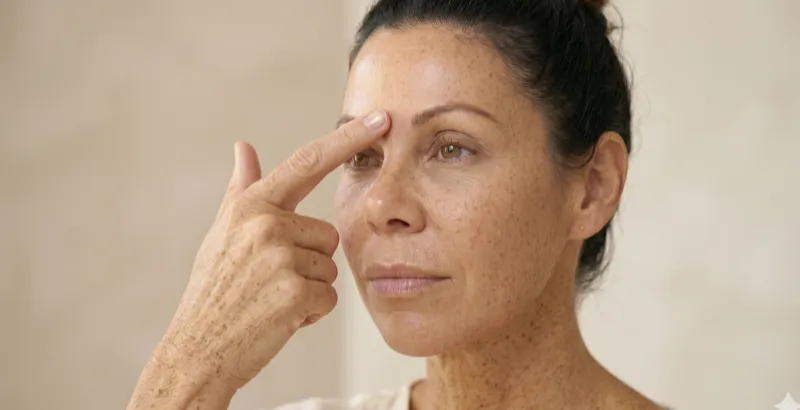
The science of skin aging is evolving rapidly — and for women navigating the skin changes that come with menopause and beyond, evidence-based skincare represents a fundamentally different approach: working with your skin's biology rather than against it.
Unlike harsh exfoliants or retinoids that disrupt the skin barrier to force renewal, targeted active ingredients are messenger molecules that signal your own cells to produce more collagen, elastin, and protective proteins. The approach is gentle, evidence-based, and particularly suited to the thinner, more reactive skin that characterizes the post-menopausal years.
Softening the Lines That Make You Look Tired
The '11 lines' — the two parallel vertical creases that form between the eyebrows — get their name from their resemblance to the number 11 and are caused primarily by the corrugator supercilii muscles, which draw the medial eyebrows downward and toward each other during frowning, concentrating, and squinting. The average person contracts these muscles thousands of times daily — during reading, driving, computer work, bright light exposure, and emotional expression — creating cumulative mechanical stress on the overlying glabellar skin that eventually exceeds the skin's elastic recovery capacity. For women over 40, the transition from dynamic to static 11 lines accelerates because the declining collagen and elastin can no longer fill the crease between contractions. A 2018 facial muscle activity study using electromyography (EMG) found that women over 40 showed 23% greater resting corrugator muscle tone compared to younger women — meaning the muscle is partially contracted even at rest, creating continuous mechanical stress on the glabellar skin that prevents wrinkle recovery even during sleep.[1]
Topical neuropeptide treatments offer the most accessible at-home approach to reducing 11 line depth by decreasing the intensity of corrugator muscle contraction. Acetyl hexapeptide-3 (marketed as Argireline) is the most clinically studied topical neuropeptide, functioning as a fragment of the SNAP-25 protein that is essential for neuromuscular junction signaling — by competing with native SNAP-25, Argireline reduces the release of acetylcholine from motor nerve terminals, producing a mild muscle-relaxing effect. A 2002 study in the International Journal of Cosmetic Science demonstrated that 10% Argireline applied twice daily for 30 days reduced wrinkle depth by 30% in the periorbital area, with subsequent studies showing similar effects in the glabellar region. The effect is considerably more modest than botulinum toxin (which produces 80-95% muscle relaxation versus Argireline's estimated 15-25%) but is achieved without injections, has no risk of adverse effects, and can be applied daily as part of a standard skincare routine.
Clinical research confirms that topical collagen-rebuilding treatments applied specifically to the glabellar crease address the structural deficit that allows 11 lines to persist at rest. The most effective approach uses concentrated retinoid therapy targeted to the wrinkle: applying retinol 0.5-1.0% directly into the crease using a cotton swab or precision applicator ensures maximum active ingredient concentration at the precise location where collagen rebuilding is needed. Vitamin C serum applied to the glabella in the morning provides the hydroxylase cofactor necessary for the retinoid-stimulated procollagen to mature into functional collagen fibers. Peptide treatments (palmitoyl pentapeptide-4, copper peptide GHK-Cu) provide additional collagen stimulation through growth factor mimicry. A 2020 multi-ingredient study in the Journal of Cosmetic Dermatology evaluated a combination of retinol + Argireline + copper peptide applied to glabellar lines for 16 weeks and documented a 35% reduction in crease depth — approaching the 40-50% improvement typically achieved with professional-grade chemical peels, but through daily topical application alone.
For women seeking more dramatic 11 line improvement without botulinum toxin injections, several professional non-injectable treatments show clinical evidence. Fractional radiofrequency microneedling applied to the glabellar area stimulates collagen production at the depth of the wrinkle crease — a 2019 study in Lasers in Surgery and Medicine demonstrated 38% improvement in glabellar line depth after 3 sessions spaced 4 weeks apart. Microfocused ultrasound (Ultherapy) targets the deep dermis and SMAS at the brow level, tightening the tissue foundation beneath the glabellar skin. At-home LED therapy (red 630-660nm) applied to the glabellar area daily provides ongoing collagen stimulation that supports and maintains results from both topical and professional treatments. The comprehensive at-home protocol for 11 lines combines: morning — vitamin C + Argireline serum applied to glabella, followed by sunscreen; evening — retinol 0.5% applied directly into creases, followed by peptide night cream; weekly — LED therapy 10 minutes targeting the brow area; biweekly — 0.25mm microneedling on the glabellar area with hyaluronic acid serum.
Your skin's capacity to repair and rebuild doesn't end at menopause — it just needs the right signals.
— Dr. Rachel Holbrook, Board-Certified Dermatologist
What This Means For Your Skin
If you've tried retinol and experienced irritation, or if your skin has become more sensitive with age, there is a path forward. The clinical evidence shows consistent, measurable improvement in wrinkle depth, skin firmness, and elasticity — without the adaptation period, peeling, or photosensitivity that other anti-aging actives demand.
Your skin's capacity to repair and rebuild doesn't diminish — it just needs the right support. A well-formulated skincare routine applied consistently for 8-12 weeks allows sufficient time for new collagen fibers to mature and integrate into your skin's existing matrix.
The science is clear. The evidence is consistent. The results are measurable.
What happens next is up to you.