
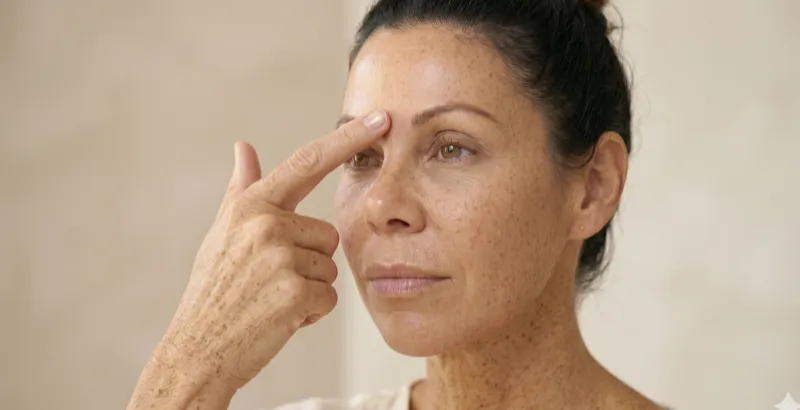
The science of skin aging is evolving rapidly — and for women navigating the skin changes that come with menopause and beyond, evidence-based skincare represents a fundamentally different approach: working with your skin's biology rather than against it.
Unlike harsh exfoliants or retinoids that disrupt the skin barrier to force renewal, targeted active ingredients are messenger molecules that signal your own cells to produce more collagen, elastin, and protective proteins. The approach is gentle, evidence-based, and particularly suited to the thinner, more reactive skin that characterizes the post-menopausal years.
Evidence-Based Approaches to Reducing Glabellar Lines After 40
Frown lines — the vertical creases between the eyebrows, clinically termed glabellar lines or '11 lines' — are among the most impactful aging signs because they create a perpetual expression of anger, worry, or fatigue regardless of the wearer's actual emotional state. These lines develop through the interaction of two factors: repetitive contraction of the corrugator supercilii and procerus muscles (which draw the eyebrows downward and medially during frowning, concentrating, or squinting), and progressive degradation of the dermal collagen and elastin in the glabellar region that would normally allow the skin to rebound smoothly after each contraction. In younger skin, the elastic recoil of intact collagen and elastin fibers returns the glabellar skin to a smooth surface between frowning episodes. After 40, cumulative collagen loss (1-2% annually, accelerated during menopause) and elastin fragmentation reduce this recoil, and the creases formed during muscle contraction begin persisting at rest — transitioning from dynamic lines (visible only during expression) to static lines (visible at rest). A 2015 study in Dermatologic Surgery documented that 78% of women over 45 had at least moderate static glabellar lines, compared to only 12% of women under 35.[1]
The glabellar region is particularly susceptible to wrinkle formation due to its unique anatomical characteristics. The corrugator supercilii muscle is one of the strongest facial muscles per unit area, generating significant mechanical force with each contraction — force that is concentrated on a small area of overlying skin, creating high-stress points that break down collagen along the crease lines. The skin over the glabella is relatively thin (comparable to periorbital skin at approximately 0.5-0.8mm epidermal thickness) with minimal subcutaneous fat padding, meaning there is little tissue cushion to distribute the mechanical stress of muscle contraction. UV exposure compounds the problem: the glabella faces directly upward during outdoor activity, receiving disproportionate solar radiation that degrades the already-stressed collagen and elastin fibers. A 2013 study in the Journal of the American Academy of Dermatology using confocal microscopy found that the collagen fiber organization in the glabellar dermis was 40% more disrupted than in the lateral forehead of the same individuals — attributable to the combined effects of mechanical stress and UV damage concentrated in this zone.
Clinical research confirms that non-invasive topical treatment of frown lines focuses on two complementary strategies: rebuilding the dermal collagen and elastin that would allow the skin to rebound between contractions, and reducing the frequency and intensity of the muscle contractions that form the creases. Collagen-rebuilding ingredients (retinoids, peptides, vitamin C) address the structural deficit by stimulating new collagen and elastin synthesis in the glabellar dermis. A 2017 study in the Journal of Cosmetic Dermatology evaluated retinol 0.5% applied specifically to the glabellar area nightly for 16 weeks and documented a 22% reduction in static frown line depth on profilometry, attributable to increased dermal collagen density beneath the crease lines that partially filled the wrinkle from below. Neuropeptides that reduce muscle contraction intensity — acetyl hexapeptide-3 (Argireline) is the most studied — provide a topical complement by reducing the mechanical force that creates the crease.
Professional treatments for frown lines range from botulinum toxin injections (the gold standard for dynamic lines) to dermal fillers (for deep static creases) and energy-based devices (for collagen remodeling). Botulinum toxin (Botox, Dysport, Xeomin) temporarily paralyzes the corrugator and procerus muscles for 3-4 months, preventing the muscle contraction that forms frown lines — with 90-95% patient satisfaction in clinical trials. For women over 40 with both dynamic and static components, combining botulinum toxin (to stop ongoing crease formation) with retinoid therapy (to rebuild collagen in the existing static crease) produces superior results to either approach alone. A 2019 combination study found that botulinum toxin plus nightly retinol produced 67% greater improvement in static frown line depth at 6 months compared to botulinum toxin alone — because the retinol rebuilt collagen in the crease during the 3-4 month window when muscle-driven crease formation was prevented.
Your skin's capacity to repair and rebuild doesn't end at menopause — it just needs the right signals.
— Dr. Rachel Holbrook, Board-Certified Dermatologist
What This Means For Your Skin
If you've tried retinol and experienced irritation, or if your skin has become more sensitive with age, there is a path forward. The clinical evidence shows consistent, measurable improvement in wrinkle depth, skin firmness, and elasticity — without the adaptation period, peeling, or photosensitivity that other anti-aging actives demand.
Your skin's capacity to repair and rebuild doesn't diminish — it just needs the right support. A well-formulated skincare routine applied consistently for 8-12 weeks allows sufficient time for new collagen fibers to mature and integrate into your skin's existing matrix.
The science is clear. The evidence is consistent. The results are measurable.
What happens next is up to you.