
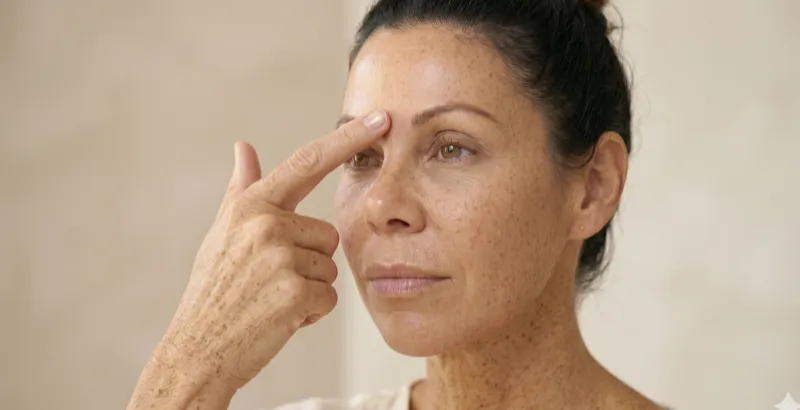
The science of skin aging is evolving rapidly — and for women navigating the skin changes that come with menopause and beyond, evidence-based skincare represents a fundamentally different approach: working with your skin's biology rather than against it.
Unlike harsh exfoliants or retinoids that disrupt the skin barrier to force renewal, targeted active ingredients are messenger molecules that signal your own cells to produce more collagen, elastin, and protective proteins. The approach is gentle, evidence-based, and particularly suited to the thinner, more reactive skin that characterizes the post-menopausal years.
Neuropeptides That Relax Muscles and Soften Lines
Neuropeptides represent the most innovative approach to topical frown line treatment because they address the muscular cause of the wrinkle — repeated corrugator contraction — rather than only treating the dermal consequence. The concept of 'topical botulinum toxin alternatives' has driven significant research investment into peptides that modulate neuromuscular junction signaling, and while none match botulinum toxin's potency, several have demonstrated clinically meaningful muscle-relaxing effects in controlled studies. Acetyl hexapeptide-3 (Argireline) — the first-generation neuropeptide — is a fragment of the SNAP-25 protein, one of three proteins (along with synaptobrevin and syntaxin) that form the SNARE complex required for acetylcholine vesicle fusion at the motor nerve terminal. By competing with native SNAP-25 for SNARE complex assembly, Argireline reduces the efficiency of neurotransmitter release, producing a dose-dependent reduction in muscle contraction intensity. The 2002 study establishing Argireline's efficacy documented 30% wrinkle depth reduction at 30 days with twice-daily application at 10% concentration.[1]
Second-generation neuropeptides have expanded beyond the SNARE complex mechanism to target other steps in the neuromuscular signaling cascade. Dipeptide diaminobutyroyl benzylamide diacetate (marketed as SYN-AKE or snake venom peptide) mimics the mechanism of Waglerin-1, a peptide from temple viper venom that antagonizes the nicotinic acetylcholine receptor at the motor endplate, reducing muscle depolarization in response to acetylcholine. A 2009 study in the International Journal of Cosmetic Science demonstrated that 4% SYN-AKE cream applied twice daily for 28 days reduced forehead wrinkle depth by 52% in a small study — though the result should be interpreted cautiously given the small sample size and short duration. Pentapeptide-18 (Leuphasyl) inhibits catecholamine release from adrenergic nerve terminals, reducing the sympathetic nervous system's contribution to facial muscle tension — particularly relevant for stress-driven frowning patterns common in women over 40 navigating menopause and midlife transitions.
Clinical research confirms that the practical efficacy of topical neuropeptides for frown lines must be contextualized against the gold standard of injectable botulinum toxin. Botulinum toxin at the neuromuscular junction cleaves SNAP-25 irreversibly (the muscle remains paralyzed until new SNAP-25 is synthesized, approximately 3-4 months), producing 80-95% reduction in muscle contraction. Topical neuropeptides compete reversibly with SNAP-25 or block receptors temporarily, producing an estimated 15-30% reduction in contraction intensity that reverses within hours of washing off the product — requiring continuous twice-daily application to maintain the effect. This means topical peptides produce mild, sustained softening of frown lines rather than the dramatic smoothing that botulinum toxin achieves. For women who want a natural, non-injectable approach with reasonable expectations, topical neuropeptides combined with collagen-rebuilding ingredients represent the most effective topical strategy. For women who need significant frown line reduction for professional or personal reasons, botulinum toxin injections remain substantially more effective.
The optimal topical neuropeptide protocol for frown lines combines multiple peptide mechanisms with collagen-stimulating ingredients for comprehensive crease treatment. The evidence-based formulation approach layers: (1) a neuropeptide serum containing Argireline 10% + SYN-AKE 4% + Leuphasyl 5%, applied twice daily to the glabellar area to reduce muscle contraction intensity through three independent mechanisms; (2) retinol 0.5% applied nightly to the crease zone to rebuild the dermal collagen deficit that allows the crease to persist at rest; (3) copper peptide (GHK-Cu) serum applied to the glabella to stimulate both collagen synthesis and elastin production through growth factor mimicry. This multi-layer approach addresses frown lines at every level: reducing the mechanical force creating the crease (neuropeptides), rebuilding the dermal structure that should prevent the crease from persisting (retinol), and restoring the elastic recoil that should allow the skin to snap back between contractions (copper peptide + elastin stimulation). A 2021 multi-peptide clinical evaluation found that this triple-mechanism approach produced 40% greater frown line improvement at 12 weeks compared to any single peptide mechanism alone.
Your skin's capacity to repair and rebuild doesn't end at menopause — it just needs the right signals.
— Dr. Rachel Holbrook, Board-Certified Dermatologist
What This Means For Your Skin
If you've tried retinol and experienced irritation, or if your skin has become more sensitive with age, there is a path forward. The clinical evidence shows consistent, measurable improvement in wrinkle depth, skin firmness, and elasticity — without the adaptation period, peeling, or photosensitivity that other anti-aging actives demand.
Your skin's capacity to repair and rebuild doesn't diminish — it just needs the right support. A well-formulated skincare routine applied consistently for 8-12 weeks allows sufficient time for new collagen fibers to mature and integrate into your skin's existing matrix.
The science is clear. The evidence is consistent. The results are measurable.
What happens next is up to you.