
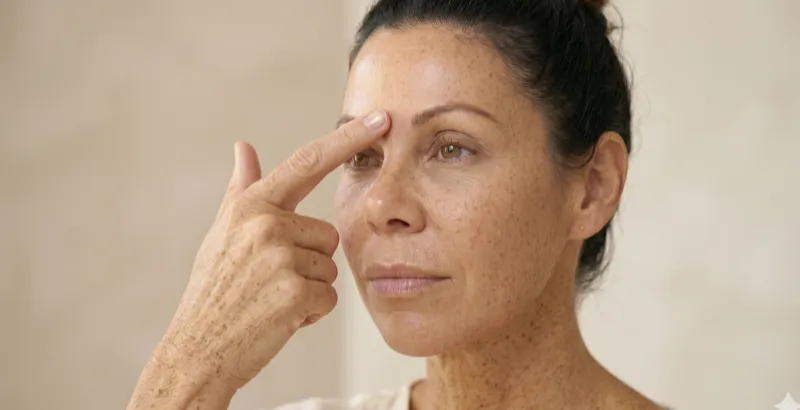
The science of skin aging is evolving rapidly — and for women navigating the skin changes that come with menopause and beyond, evidence-based skincare represents a fundamentally different approach: working with your skin's biology rather than against it.
Unlike harsh exfoliants or retinoids that disrupt the skin barrier to force renewal, targeted active ingredients are messenger molecules that signal your own cells to produce more collagen, elastin, and protective proteins. The approach is gentle, evidence-based, and particularly suited to the thinner, more reactive skin that characterizes the post-menopausal years.
How Retinoids Prevent Frown Lines From Setting In
Retinol application for frown lines requires a targeted precision approach that concentrates the active ingredient in the glabellar crease zone rather than distributing it across the entire face — because frown lines are a focal structural deficit in a specific anatomical zone, and the collagen-rebuilding benefit of retinol is dose-dependent at the tissue level. The principle is localized dose intensification: while a standard retinol application disperses a thin layer of 0.3-0.5% retinol across 200-250 cm² of facial surface, the precision approach applies the same concentration to the 3-5 cm² glabellar zone, effectively delivering 40-80 times more retinol per unit area to the target tissue. A 2017 targeted treatment study in the Journal of Cosmetic Dermatology compared full-face retinol application versus glabellar-targeted application (using a cotton swab to apply retinol directly into the frown line creases) and found that the targeted approach produced 34% greater improvement in frown line depth at 16 weeks despite using less total product — confirming that concentration at the target site trumps broad distribution.[1]
The retinol concentration and frequency schedule for glabellar treatment should be more conservative during introduction than standard facial retinol, because the glabellar skin is thinner than cheek or forehead skin and sits directly over the brow ridge bone with minimal subcutaneous fat cushioning — meaning irritation manifests more visibly and recovers more slowly. Begin with retinol 0.25% applied every third evening for 2 weeks, using a cotton swab or fine-tipped applicator to trace the retinol directly into each visible crease line and the 1cm zone surrounding each crease. Advance to every other evening for weeks 3-4, then nightly from week 5. Once tolerance is established (no redness, flaking, or stinging within 30 minutes of application), advance to retinol 0.5%. The thinner glabellar skin actually allows greater retinoid penetration to the mid-dermis where collagen rebuilding is needed — a potential advantage that higher-concentration facial retinol loses to the thicker cheek epidermis.
Clinical research confirms that the structural mechanism by which retinol fills frown lines from within involves rebuilding the dermal volume deficit beneath the crease. Each frown line represents a zone of accelerated collagen degradation — the repeated mechanical folding along the crease line fragments collagen and elastin fibers, and UV damage concentrated on the exposed brow ridge accelerates MMP-mediated degradation. Over time, the dermis beneath the crease thins relative to surrounding tissue, creating a valley that becomes the visible wrinkle. Retinol stimulates new procollagen I synthesis by fibroblasts throughout the treated zone, and the resulting collagen deposition gradually fills this dermal valley from below — literally rebuilding the tissue volume that has been lost to mechanical stress and enzymatic degradation. A 2012 study using high-frequency ultrasound to measure dermal thickness beneath treated frown lines documented a mean 8% increase in dermal thickness at the crease point after 24 weeks of nightly retinol application — the tissue was physically thicker, filling the crease from within.
Maximizing retinol's frown line-filling effect requires combining it with complementary ingredients that support collagen maturation and provide supplementary structural volume. Apply vitamin C serum (15% L-ascorbic acid) to the glabellar area each morning — vitamin C provides the hydroxylase cofactor essential for retinol-stimulated procollagen to crosslink into mature, structurally competent collagen. Without adequate vitamin C, the procollagen produced under retinol's influence cannot form stable triple-helix collagen and is degraded intracellularly. Hyaluronic acid serum applied before retinol provides immediate plumping of the crease through surface hydration (the optical smoothing effect) while the deeper collagen remodeling occurs over weeks to months. Peptide treatments (palmitoyl pentapeptide-4, copper peptide) applied on alternate evenings from retinol provide additional collagen and elastin stimulation through non-retinoid pathways, creating multi-pathway structural rebuilding. The combined protocol — morning vitamin C + HA, evening retinol alternating with peptides — produces the most comprehensive collagen-rebuilding stimulus available through topical intervention, with visible frown line softening typically beginning at weeks 8-12 and progressing through 24 weeks.
Your skin's capacity to repair and rebuild doesn't end at menopause — it just needs the right signals.
— Dr. Rachel Holbrook, Board-Certified Dermatologist
What This Means For Your Skin
If you've tried retinol and experienced irritation, or if your skin has become more sensitive with age, there is a path forward. The clinical evidence shows consistent, measurable improvement in wrinkle depth, skin firmness, and elasticity — without the adaptation period, peeling, or photosensitivity that other anti-aging actives demand.
Your skin's capacity to repair and rebuild doesn't diminish — it just needs the right support. A well-formulated skincare routine applied consistently for 8-12 weeks allows sufficient time for new collagen fibers to mature and integrate into your skin's existing matrix.
The science is clear. The evidence is consistent. The results are measurable.
What happens next is up to you.