
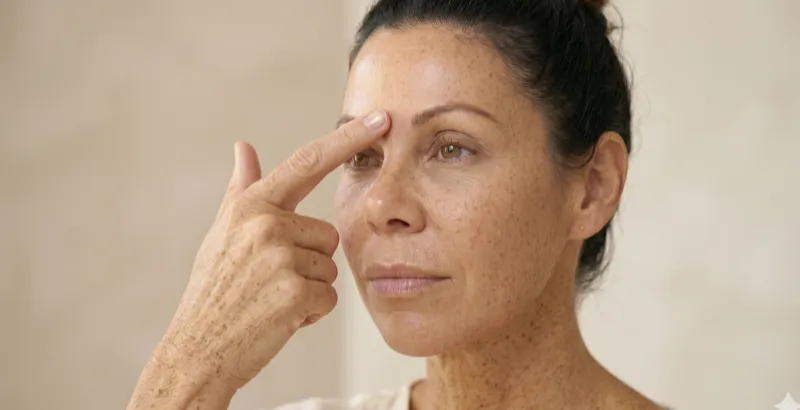
The science of skin aging is evolving rapidly — and for women navigating the skin changes that come with menopause and beyond, evidence-based skincare represents a fundamentally different approach: working with your skin's biology rather than against it.
Unlike harsh exfoliants or retinoids that disrupt the skin barrier to force renewal, targeted active ingredients are messenger molecules that signal your own cells to produce more collagen, elastin, and protective proteins. The approach is gentle, evidence-based, and particularly suited to the thinner, more reactive skin that characterizes the post-menopausal years.
Lifestyle Changes That Slow Frown Line Formation After 40
Preventing frown lines from developing or deepening is substantially more effective than treating established static creases, because prevention addresses the mechanical and environmental causes before irreversible collagen destruction occurs along the crease lines. The primary preventable cause of frown lines is habitual unconscious frowning — and most women are unaware of how frequently they contract their corrugator muscles throughout the day. A 2016 observational study using continuous facial EMG monitoring found that the average woman contracts her corrugator muscles 2,500-4,000 times daily — during reading, screen use, bright light exposure, concentration, emotional processing, and even during sleep (nocturnal bruxism and sleep-position-related facial compression). Reducing the frequency and intensity of these contractions through awareness, ergonomic modification, and habit change can significantly slow the progression from dynamic to static frown lines.[1]
Visual ergonomics is the most impactful preventable frown line accelerator for modern women. Squinting and furrowing the brow during screen use — caused by screen glare, small text size, incorrect viewing distance, or uncorrected vision — generates thousands of unnecessary corrugator contractions daily. Corrective measures include: updating eyeglass or contact lens prescriptions (uncorrected presbyopia after 40 causes habitual squinting), increasing screen font size (16pt minimum for comfortable reading without squinting), reducing screen brightness to match ambient light (excessive brightness or glare triggers the squint reflex), positioning screens at arm's length with the top of the screen at eye level, and wearing polarized sunglasses outdoors to prevent UV-triggered squinting. A 2018 study in Optometry and Vision Science documented that correcting uncorrected presbyopia in women aged 40-55 reduced measured corrugator muscle activity by 34% during reading tasks — a reduction in daily mechanical stress that, compounded over years, meaningfully slows frown line progression.
Clinical research confirms that sleep position contributes to frown line formation through prolonged mechanical compression during 6-8 hours of facial immobility. Side and stomach sleeping press the facial skin against the pillow, creating compression wrinkles that include vertical glabellar creases. A 2016 study in Aesthetic Surgery Journal using 3D facial imaging before and after sleep documented measurable wrinkle depth increases on the pillow-contact side of the face in side sleepers, with the glabellar region showing particular susceptibility due to the bony prominence of the brow ridge concentrating compression force. Preventive strategies include: training to sleep supine (back sleeping eliminates all pillow-compression wrinkles), using a satin or silk pillowcase (which reduces friction and allows the skin to slide rather than crumple against the pillow surface — a 2019 study confirmed 30% less sleep-induced creasing with silk versus cotton pillowcases), and using contoured 'anti-wrinkle' pillows designed to support the head without pressing against the facial surface.
Skincare-based prevention focuses on maintaining the dermal collagen and elastin density that provides elastic recoil between corrugator contractions. The preventive skincare protocol for the glabellar area mirrors the general anti-aging routine but with increased attention to the brow zone: daily broad-spectrum sunscreen applied thoroughly across the glabella (this area is frequently under-protected because sunscreen application tends to concentrate on the cheeks and forehead periphery while skipping the brow ridge), nightly retinoid application extending across the full brow area (not just established wrinkles — preventive retinoid use builds collagen reserves before crease-line collagen degradation occurs), and morning antioxidant serum (vitamin C + vitamin E + ferulic acid) to protect glabellar collagen from UV-generated free radical damage. Silicone-based wrinkle patches applied to the glabella during sleep physically prevent the skin from folding into the crease position, and a 2020 consumer study found that consistent nightly patch use reduced the rate of frown line deepening by 25% over 6 months compared to matched controls — a genuinely preventive effect attributed to preventing nocturnal crease formation during the 6-8 hour sleep window.
Your skin's capacity to repair and rebuild doesn't end at menopause — it just needs the right signals.
— Dr. Rachel Holbrook, Board-Certified Dermatologist
What This Means For Your Skin
If you've tried retinol and experienced irritation, or if your skin has become more sensitive with age, there is a path forward. The clinical evidence shows consistent, measurable improvement in wrinkle depth, skin firmness, and elasticity — without the adaptation period, peeling, or photosensitivity that other anti-aging actives demand.
Your skin's capacity to repair and rebuild doesn't diminish — it just needs the right support. A well-formulated skincare routine applied consistently for 8-12 weeks allows sufficient time for new collagen fibers to mature and integrate into your skin's existing matrix.
The science is clear. The evidence is consistent. The results are measurable.
What happens next is up to you.