
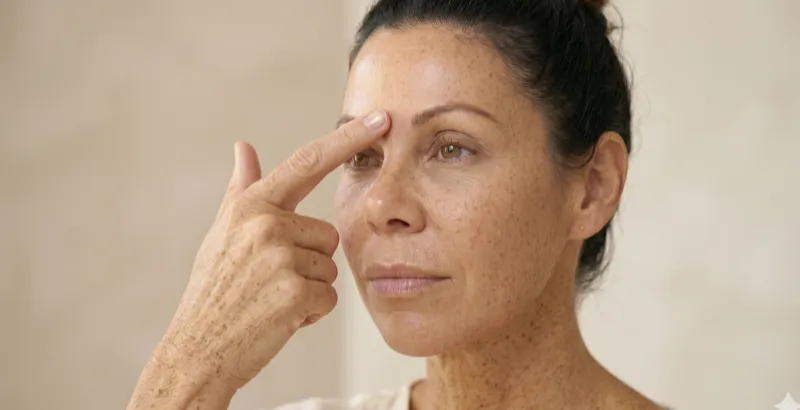
The science of skin aging is evolving rapidly — and for women navigating the skin changes that come with menopause and beyond, evidence-based skincare represents a fundamentally different approach: working with your skin's biology rather than against it.
Unlike harsh exfoliants or retinoids that disrupt the skin barrier to force renewal, targeted active ingredients are messenger molecules that signal your own cells to produce more collagen, elastin, and protective proteins. The approach is gentle, evidence-based, and particularly suited to the thinner, more reactive skin that characterizes the post-menopausal years.
Understanding the Different Causes and Treatments for Each Type
Forehead wrinkles and frown lines are frequently confused by patients but are caused by different muscles, develop through different mechanisms, and respond to different treatments — making accurate identification essential for effective intervention. Forehead wrinkles are horizontal lines that span the forehead, caused by the frontalis muscle contracting to raise the eyebrows during expressions of surprise, inquiry, or emphasis. The frontalis is the only brow elevator, and its contraction creates broad, parallel horizontal creases across the forehead. Frown lines are vertical lines concentrated between the eyebrows, caused by the corrugator supercilii (which draws brows medially and downward) and the procerus (which draws the medial brow downward) — muscles that create the furrowed, concentrated expression. A 2016 anatomical imaging study in Aesthetic Surgery Journal used 3D surface analysis during controlled facial expressions and demonstrated that forehead wrinkles and frown lines activate with zero muscle overlap — they are mechanically independent wrinkle systems that merely coexist in adjacent facial zones.[1]
The treatment implications of this anatomical distinction are significant. Forehead wrinkles respond to full-width treatments applied across the entire forehead (broad retinoid application, full-forehead LED therapy, horizontal resurfacing passes with microneedling or fractional laser), because the wrinkles span the full frontalis muscle width. Frown lines require focused, targeted treatment concentrated on the narrow glabellar region between the eyebrows — precision application of retinol directly into the vertical creases, targeted Argireline serum on the glabella, and focused microneedling or energy device treatment on the 2-3cm zone between the brows. Using a broad forehead treatment approach for frown lines dilutes the active ingredients across the entire forehead rather than concentrating them where the wrinkles are, reducing efficacy. Conversely, treating only the glabella while neglecting the forehead leaves the horizontal lines unaddressed, creating an inconsistent improvement that can look unnatural.
Clinical research confirms that the aging trajectory differs between forehead wrinkles and frown lines, affecting treatment timing. Frown lines typically develop earlier (late 30s to early 40s) because the corrugator muscles are stronger and create higher mechanical stress per unit area — women who habitually frown, concentrate, or squint develop visible static frown lines before comparable horizontal forehead lines appear. Forehead wrinkles tend to develop later (mid-40s to 50s) and are often accelerated by a compensatory mechanism: as upper eyelid ptosis (drooping) develops with age, women unconsciously contract the frontalis more vigorously to raise the drooping brows and maintain visual field, creating forehead wrinkles as a secondary consequence of brow ptosis. A 2017 study in Ophthalmic Plastic and Reconstructive Surgery documented that women with measurable brow ptosis showed 2.1 times more severe forehead wrinkles than women without brow ptosis at the same age — the constant frontalis contraction needed to keep drooping brows elevated accelerates horizontal wrinkle formation.
The comprehensive treatment approach for women over 40 addresses both wrinkle types simultaneously with zone-specific strategies. For the forehead (horizontal wrinkles): apply retinol across the full forehead width, use LED therapy with broad coverage, and consider professional treatments (Botox for dynamic lines, fractional RF for static lines) that address the entire frontalis zone. For the glabella (frown lines): apply concentrated retinol + Argireline directly into the vertical creases, use precision microneedling targeting only the glabellar zone, and consider Botox specifically for the corrugator and procerus muscles — the most common and effective cosmetic botulinum toxin indication. The overarching principle: forehead wrinkles are a broad-area problem requiring broad-area treatment, while frown lines are a focal problem requiring focused treatment. A 2019 patient outcome study comparing zone-specific versus uniform full-forehead treatment approaches found that zone-specific protocols produced 28% greater overall improvement in combined forehead and frown line scores, confirming the value of treating each wrinkle type according to its specific anatomical and mechanical characteristics.
Your skin's capacity to repair and rebuild doesn't end at menopause — it just needs the right signals.
— Dr. Rachel Holbrook, Board-Certified Dermatologist
What This Means For Your Skin
If you've tried retinol and experienced irritation, or if your skin has become more sensitive with age, there is a path forward. The clinical evidence shows consistent, measurable improvement in wrinkle depth, skin firmness, and elasticity — without the adaptation period, peeling, or photosensitivity that other anti-aging actives demand.
Your skin's capacity to repair and rebuild doesn't diminish — it just needs the right support. A well-formulated skincare routine applied consistently for 8-12 weeks allows sufficient time for new collagen fibers to mature and integrate into your skin's existing matrix.
The science is clear. The evidence is consistent. The results are measurable.
What happens next is up to you.