
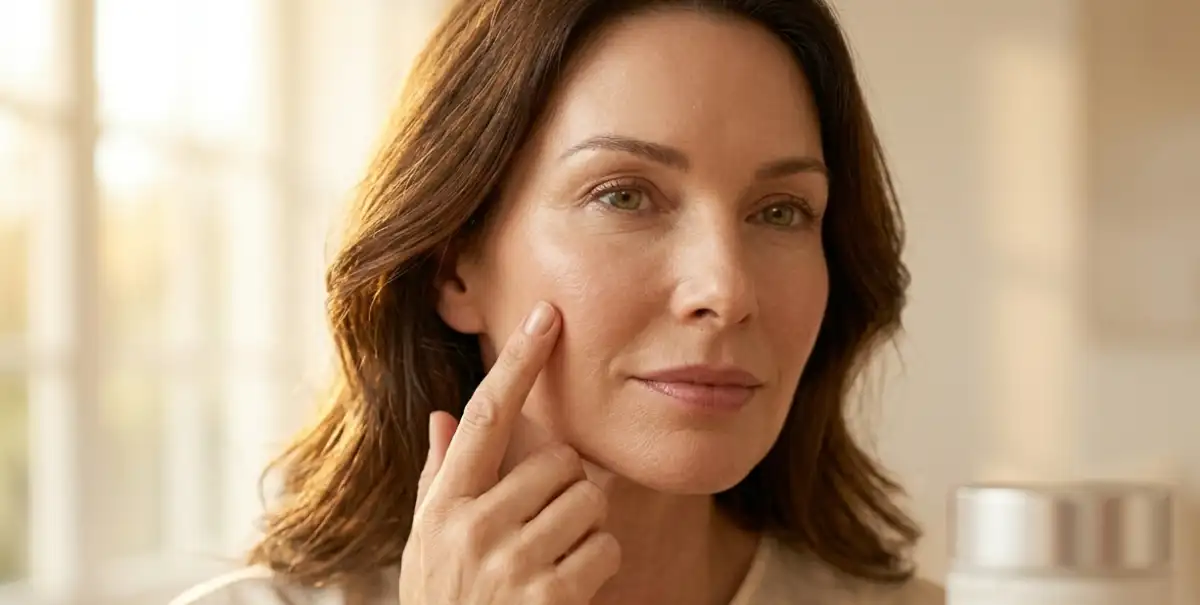
The science of skin aging is evolving rapidly — and for women navigating the skin changes that come with menopause and beyond, evidence-based skincare represents a fundamentally different approach: working with your skin's biology rather than against it.
Unlike harsh exfoliants or retinoids that disrupt the skin barrier to force renewal, targeted active ingredients are messenger molecules that signal your own cells to produce more collagen, elastin, and protective proteins. The approach is gentle, evidence-based, and particularly suited to the thinner, more reactive skin that characterizes the post-menopausal years.
Why Dryness Extends Beyond the Face During Hormonal Decline
While facial dryness receives the most attention, menopausal dryness is a systemic condition that affects the entire body — and body skin often shows more severe dehydration than facial skin because it has fewer sebaceous glands to provide even partial natural moisturization. A whole-body TEWL mapping study in post-menopausal women found that the shins, forearms, and lateral torso showed the highest transepidermal water loss values — exceeding facial measurements by 20-40%. These are the sites where women first notice the scaling, itching, and roughness that signal barrier collapse.[1]
The shins and lower legs are particularly vulnerable because they have the lowest sebaceous gland density of any body site, the thinnest dermis outside of the eyelids, and the greatest exposure to environmental drying (air circulation, contact with clothing). Post-menopausal shin skin frequently develops a pattern dermatologists call 'eczema craquelé' — a network of fine cracks resembling dried mud that indicates severe barrier depletion. A prevalence study found that 35% of post-menopausal women develop eczema craquelé on the shins, compared to less than 5% of pre-menopausal women of similar age.
Clinical research confirms that the arms and torso follow different patterns. The inner arms and antecubital fossae (inner elbows) tend toward sensitivity and potential eczema reactivation, driven by the thin skin and immune dysregulation that menopause produces. The lateral torso and flanks develop roughness and keratosis pilaris-like bumps as desquamation slows in these already-dry areas. The hands, as discussed in hand-specific literature, suffer the compound effect of environmental assault plus hormonal decline. Each body zone requires awareness of its specific vulnerability while sharing the common underlying mechanism of estrogen-driven barrier collapse.
Body-specific treatment requires practical adaptations that differ from facial care. The 'soak and seal' technique — applying ceramide-based body cream within 3 minutes of bathing while skin is still damp — captures moisture in the stratum corneum and seals it with lipids. Bath water temperature should not exceed 37°C (body temperature), as hot water strips barrier lipids more aggressively. Soap-free cleansers preserve the lipids that traditional soap destroys. A clinical study found that switching from soap to syndets (synthetic detergent bars with pH 5.5) alone improved body skin hydration by 20% within 4 weeks, without any additional moisturizer.
Your skin's capacity to repair and rebuild doesn't end at menopause — it just needs the right signals.
— Dr. Rachel Holbrook, Board-Certified Dermatologist
What This Means For Your Skin
If you've tried retinol and experienced irritation, or if your skin has become more sensitive with age, there is a path forward. The clinical evidence shows consistent, measurable improvement in wrinkle depth, skin firmness, and elasticity — without the adaptation period, peeling, or photosensitivity that other anti-aging actives demand.
Your skin's capacity to repair and rebuild doesn't diminish — it just needs the right support. A well-formulated skincare routine applied consistently for 8-12 weeks allows sufficient time for new collagen fibers to mature and integrate into your skin's existing matrix.
The science is clear. The evidence is consistent. The results are measurable.
What happens next is up to you.