
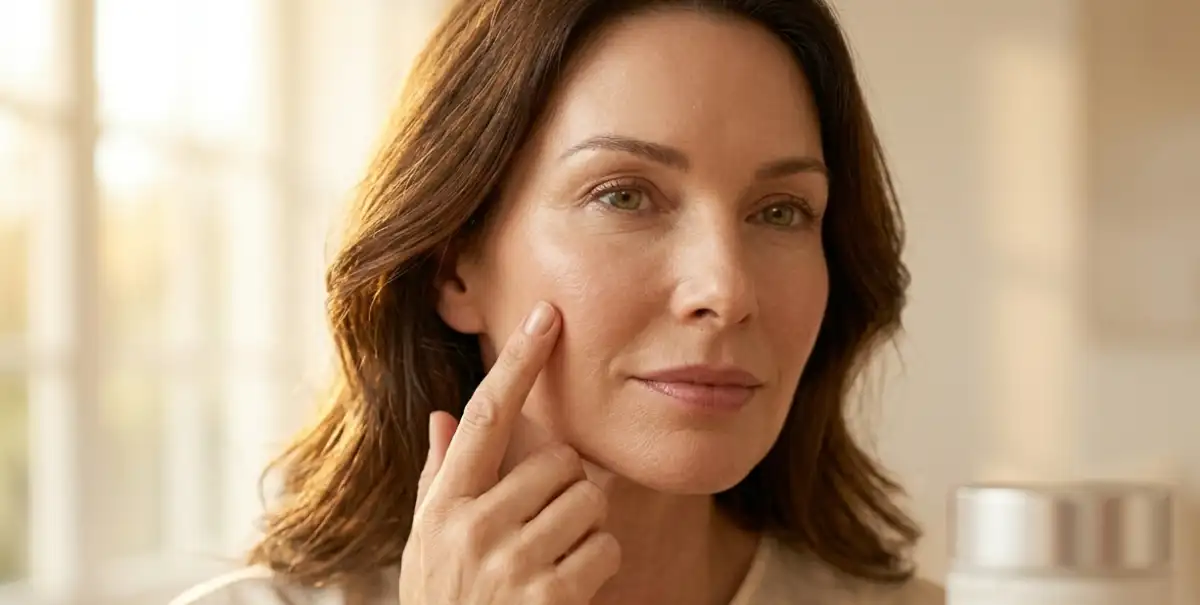
The science of skin aging is evolving rapidly — and for women navigating the skin changes that come with menopause and beyond, evidence-based skincare represents a fundamentally different approach: working with your skin's biology rather than against it.
Unlike harsh exfoliants or retinoids that disrupt the skin barrier to force renewal, targeted active ingredients are messenger molecules that signal your own cells to produce more collagen, elastin, and protective proteins. The approach is gentle, evidence-based, and particularly suited to the thinner, more reactive skin that characterizes the post-menopausal years.
Why Shins and Calves Get So Dry After Menopause
The legs — particularly the shins and lower calves — become the driest skin on the body during menopause, and the anatomical reasons explain why legs suffer disproportionately. Shin skin has the lowest sebaceous gland density of any body site except the palms and soles (which compensate with thick stratum corneum). Pre-menopause, the minimal sebum production on the shins is sufficient because the ceramide-based barrier compensates. Post-menopause, with both sebum and ceramide production declining simultaneously, the shins lose both their primary and backup moisture-retention mechanisms at once.[1]
The development of eczema craquelé — a pattern of fine fissures resembling dried mud that appears predominantly on the shins — is a hallmark of menopausal leg dryness. This condition occurs when the stratum corneum becomes so dehydrated that it contracts and cracks, creating a visible network of fissures through which water loss accelerates further. A dermatological survey found that eczema craquelé affects 35% of post-menopausal women, compared to less than 5% of age-matched pre-menopausal women. The condition is more than cosmetic — the fissures can become deep enough to cause pain and to serve as entry points for bacterial infection.
Clinical research confirms that environmental factors compound the hormonal vulnerability of leg skin. Indoor heating during winter reduces ambient humidity, accelerating surface evaporation from already-compromised skin. Clothing — particularly synthetic fabrics and wool — creates friction that mechanically disrupts the fragile barrier. Hot bathing strips whatever residual lipids the legs still produce. The common winter habit of hot baths followed by a heated room creates a perfect storm of barrier destruction that, in menopausal women, overwhelms the skin's reduced repair capacity. A seasonal study found that leg TEWL values in post-menopausal women increased by 40% between October and February.
Leg-specific treatment requires more aggressive barrier repair than facial care. The 'soak and seal' technique is most effective: brief warm (not hot) shower, immediate application of ceramide-based body cream to still-damp legs, with particular attention to the shins and ankles. For eczema craquelé, overnight occlusion with ceramide cream under cotton pajamas or bandage wraps accelerates healing — a clinical study showed that occluded ceramide treatment resolved eczema craquelé in an average of 10 days versus 35 days for non-occluded application. Urea at 5-10% as a secondary ingredient provides additional keratolytic and hydrating benefits — breaking down the rigid, contracted cells that form the cracked surface while attracting moisture to the repair zone.
Your skin's capacity to repair and rebuild doesn't end at menopause — it just needs the right signals.
— Dr. Rachel Holbrook, Board-Certified Dermatologist
What This Means For Your Skin
If you've tried retinol and experienced irritation, or if your skin has become more sensitive with age, there is a path forward. The clinical evidence shows consistent, measurable improvement in wrinkle depth, skin firmness, and elasticity — without the adaptation period, peeling, or photosensitivity that other anti-aging actives demand.
Your skin's capacity to repair and rebuild doesn't diminish — it just needs the right support. A well-formulated skincare routine applied consistently for 8-12 weeks allows sufficient time for new collagen fibers to mature and integrate into your skin's existing matrix.
The science is clear. The evidence is consistent. The results are measurable.
What happens next is up to you.