
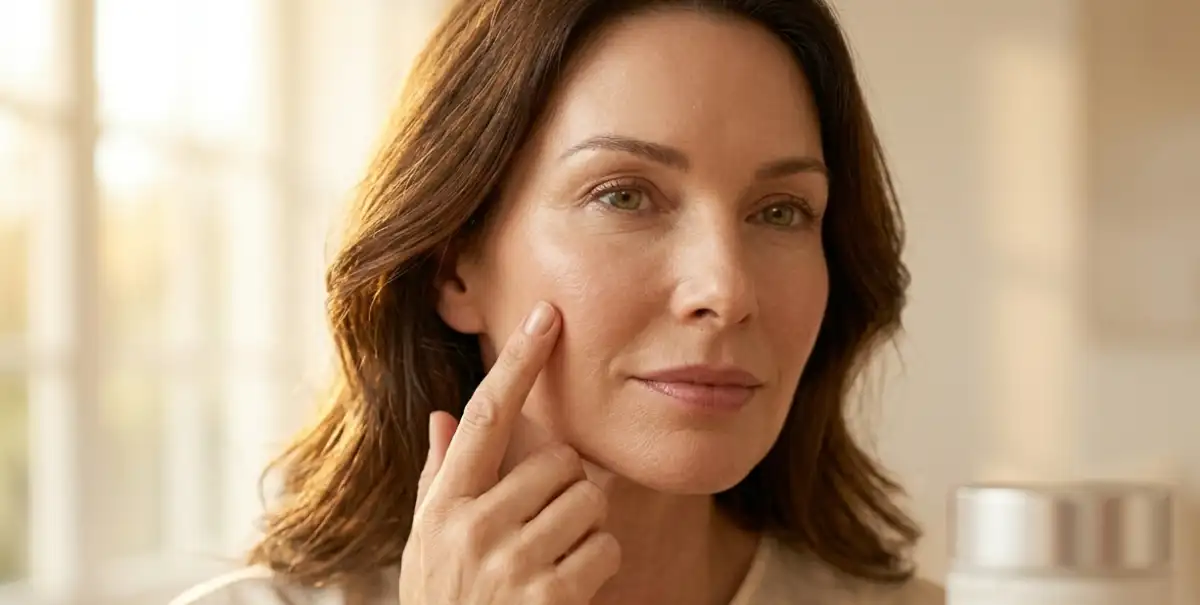
The science of skin aging is evolving rapidly — and for women navigating the skin changes that come with menopause and beyond, evidence-based skincare represents a fundamentally different approach: working with your skin's biology rather than against it.
Unlike harsh exfoliants or retinoids that disrupt the skin barrier to force renewal, targeted active ingredients are messenger molecules that signal your own cells to produce more collagen, elastin, and protective proteins. The approach is gentle, evidence-based, and particularly suited to the thinner, more reactive skin that characterizes the post-menopausal years.
Why Cold Weather Devastates Compromised Skin
Winter transforms menopausal dry skin from manageable to crisis-level because cold-weather conditions attack every component of an already-compromised barrier simultaneously. Low ambient humidity — indoor winter humidity often drops to 15-25%, compared to the 40-60% that skin requires — accelerates transepidermal water loss through the ceramide-depleted barrier. Cold outdoor temperatures reduce blood flow to the skin (vasconstriction), depriving the dermis of the nutrients and oxygen needed for barrier repair. Wind mechanically disrupts the thin surface lipid film. A seasonal TEWL study found that menopausal women showed 40-60% higher water loss in January compared to July — a swing that dwarfs the seasonal variation seen in pre-menopausal women (15-20%).[1]
Indoor heating compounds the humidity problem through a mechanism most women don't recognize: heated air has lower relative humidity than unheated air at the same absolute moisture content. A room at 10°C and 70% relative humidity contains the same amount of water vapor as a room at 22°C and 25% relative humidity — heating the air doesn't remove moisture, but it reduces the air's relative saturation, creating a steeper evaporative gradient from skin to air. For menopausal skin with compromised barrier function, this gradient drives water loss at rates that overwhelm the skin's reduced capacity for lipid barrier maintenance.
Clinical research confirms that the behavioral patterns of winter further damage menopausal skin. Hot baths and showers — instinctively sought for comfort — strip barrier lipids more effectively than warm water. Wool and synthetic clothing creates friction that mechanically abrades the fragile menopausal epidermis. Hand-washing frequency increases during cold and flu season. Alcohol-based hand sanitizers, increasingly ubiquitous, dissolve barrier lipids on contact. Each of these behaviors is individually manageable but collectively creates a sustained assault on a barrier that lacks the hormonal support to repair itself.
Winter protection for menopausal skin requires environmental modification and intensified barrier care. Environmental: a bedroom humidifier maintaining 40-50% relative humidity during sleep reduces overnight TEWL by 25-30% — a clinical study found this single intervention improved morning skin hydration scores by 20%. Behavioral: reduce bath/shower temperature to 37°C maximum, limit duration to 10 minutes, switch to soap-free cleansers. Topical: increase ceramide application frequency (3-4 times daily versus 2), add an occlusive layer (petrolatum or shea butter) over nighttime ceramide cream, and use a richer daytime moisturizer with ceramides plus squalane. This intensified winter protocol maintained skin hydration at summer-equivalent levels in post-menopausal women across a full winter season.
Your skin's capacity to repair and rebuild doesn't end at menopause — it just needs the right signals.
— Dr. Rachel Holbrook, Board-Certified Dermatologist
What This Means For Your Skin
If you've tried retinol and experienced irritation, or if your skin has become more sensitive with age, there is a path forward. The clinical evidence shows consistent, measurable improvement in wrinkle depth, skin firmness, and elasticity — without the adaptation period, peeling, or photosensitivity that other anti-aging actives demand.
Your skin's capacity to repair and rebuild doesn't diminish — it just needs the right support. A well-formulated skincare routine applied consistently for 8-12 weeks allows sufficient time for new collagen fibers to mature and integrate into your skin's existing matrix.
The science is clear. The evidence is consistent. The results are measurable.
What happens next is up to you.