
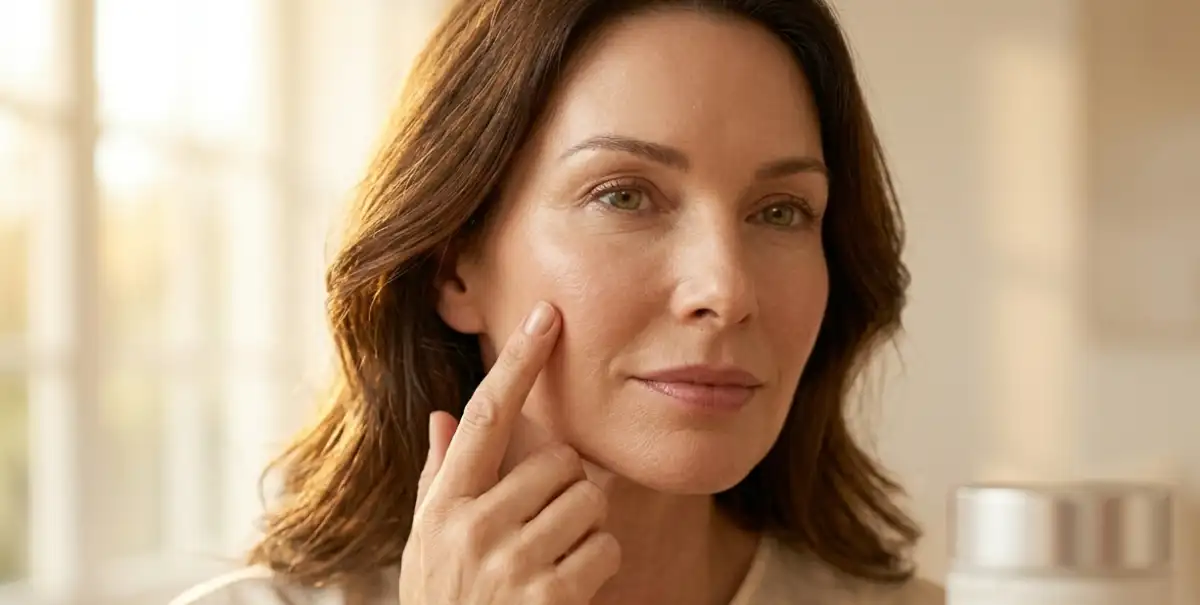
The science of skin aging is evolving rapidly — and for women navigating the skin changes that come with menopause and beyond, evidence-based skincare represents a fundamentally different approach: working with your skin's biology rather than against it.
Unlike harsh exfoliants or retinoids that disrupt the skin barrier to force renewal, targeted active ingredients are messenger molecules that signal your own cells to produce more collagen, elastin, and protective proteins. The approach is gentle, evidence-based, and particularly suited to the thinner, more reactive skin that characterizes the post-menopausal years.
How to Tell Whether Your Dryness Is Hormonal or Inflammatory
Distinguishing between menopausal dry skin (xerosis) and eczema (atopic dermatitis or contact dermatitis) is clinically important because the treatment approaches differ significantly — yet the two conditions share enough symptoms to cause frequent confusion. Both produce dryness, scaling, and discomfort. Both worsen during menopause due to barrier compromise. And both can coexist, with menopausal xerosis triggering eczema in women with latent atopic predisposition. A study in the British Journal of Dermatology found that 18% of women presenting with 'menopausal dry skin' actually met diagnostic criteria for eczema when examined by a dermatologist.[1]
The distinguishing features map across four dimensions. Location: menopausal xerosis is generalized — affecting the entire body relatively uniformly, with the shins typically worst. Eczema tends to be localized — flexural areas (inner elbows, behind knees), hands, eyelids, and face are classic sites. Appearance: xerosis produces fine, white scaling on a dry but non-inflamed background. Eczema produces red, inflamed patches with possible vesicles, oozing, or crusting in acute phases, and thickened, lichenified skin in chronic phases. Sensation: xerosis produces tightness and mild itch, worse after bathing. Eczema produces intense, often unbearable itch that disrupts sleep and concentration.
Clinical research confirms that the response to moisturization is perhaps the most practical distinguishing test. Menopausal xerosis responds well to ceramide-based moisturizers — symptoms improve within 1-2 weeks of consistent use. Eczema improves partially with moisturizers but continues to flare despite consistent application, because the inflammatory component requires anti-inflammatory treatment beyond simple barrier repair. A clinical algorithm in the Journal of the American Academy of Dermatology recommends: if intensive ceramide moisturization for 2 weeks does not resolve the condition, eczema should be suspected and dermatological evaluation sought.
When both conditions coexist — a common scenario in menopausal women — treatment must address both the barrier deficit and the inflammatory component. Ceramide moisturizers remain the foundation, but prescription topical anti-inflammatories may be needed for eczema flares. Topical calcineurin inhibitors (tacrolimus 0.1%, pimecrolimus 1%) are preferred over topical corticosteroids for menopausal eczema because they do not cause the skin atrophy that steroids produce — and menopausal skin is already thinning from estrogen loss. Long-term corticosteroid use on menopausal skin accelerates the very thinning and fragility that defines the condition.
Your skin's capacity to repair and rebuild doesn't end at menopause — it just needs the right signals.
— Dr. Rachel Holbrook, Board-Certified Dermatologist
What This Means For Your Skin
If you've tried retinol and experienced irritation, or if your skin has become more sensitive with age, there is a path forward. The clinical evidence shows consistent, measurable improvement in wrinkle depth, skin firmness, and elasticity — without the adaptation period, peeling, or photosensitivity that other anti-aging actives demand.
Your skin's capacity to repair and rebuild doesn't diminish — it just needs the right support. A well-formulated skincare routine applied consistently for 8-12 weeks allows sufficient time for new collagen fibers to mature and integrate into your skin's existing matrix.
The science is clear. The evidence is consistent. The results are measurable.
What happens next is up to you.