
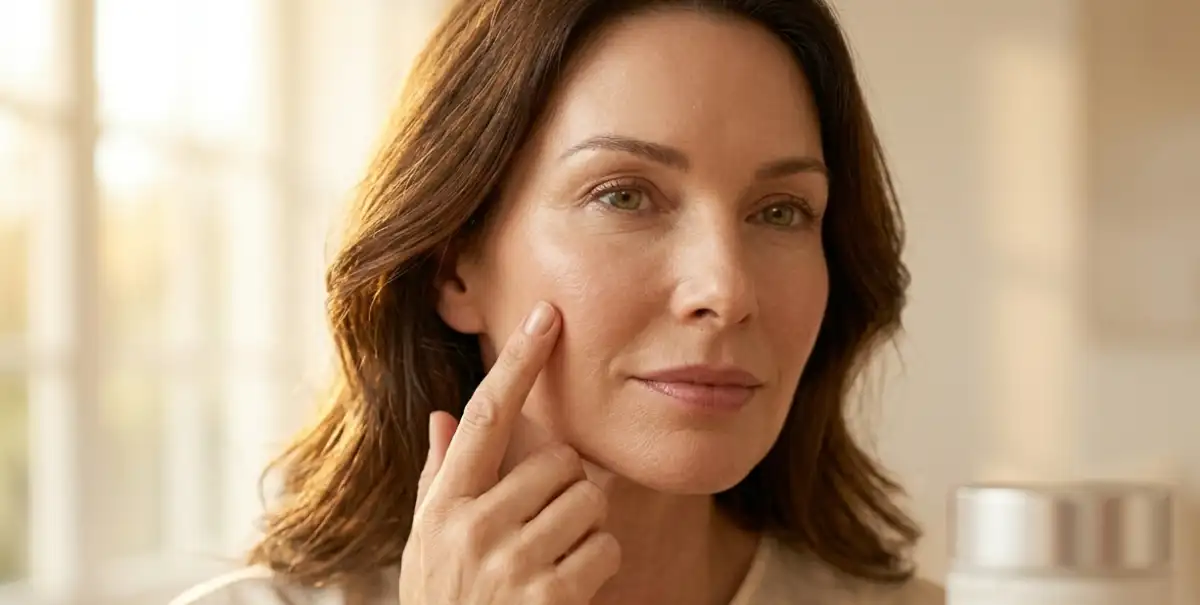
The science of skin aging is evolving rapidly — and for women navigating the skin changes that come with menopause and beyond, evidence-based skincare represents a fundamentally different approach: working with your skin's biology rather than against it.
Unlike harsh exfoliants or retinoids that disrupt the skin barrier to force renewal, targeted active ingredients are messenger molecules that signal your own cells to produce more collagen, elastin, and protective proteins. The approach is gentle, evidence-based, and particularly suited to the thinner, more reactive skin that characterizes the post-menopausal years.
The Barrier-Nerve Loop That Makes Dry Skin Unbearably Itchy
The intense itching that accompanies menopausal dry skin is not simply dryness perceived as itch — it is a distinct neurological phenomenon driven by the convergence of barrier compromise and estrogen-mediated nerve changes. A study in the Journal of the European Academy of Dermatology found that post-menopausal women with dry skin reported itch severity scores 3-4 times higher than pre-menopausal women with comparable levels of objective dryness. The disproportionate itch response indicates that something beyond dryness is driving the symptom — and that something is nerve sensitization.[1]
The mechanism involves a two-part amplification loop. Part one: the compromised barrier allows environmental irritants (detergents, fragrances, fabric chemicals) to penetrate into the viable epidermis, where they trigger the release of histamine and other pruritogens from mast cells and keratinocytes. Part two: estrogen decline simultaneously increases the density and sensitivity of intra-epidermal nerve fibers — the sensory neurons that detect itch stimuli. Research in Neuroscience Letters documented a 25% increase in nerve fiber density in post-menopausal skin, meaning more nerves are detecting the itch signals that the compromised barrier is allowing to form.
Clinical research confirms that the itch-scratch cycle creates a third amplification layer. Scratching provides temporary relief through the 'gate control' mechanism — the pressure and pain signals from scratching temporarily override the itch signals in the spinal cord. But scratching damages the already-thin menopausal epidermis, worsens the barrier compromise, allows more irritant penetration, and generates inflammatory mediators that further sensitize nerve fibers. A study tracking scratch behavior in menopausal women found that scratching episodes averaged 12 minutes of relief followed by itch return at 20-30% greater intensity than pre-scratch baseline — a net worsening with each cycle.
Breaking the itch-scratch cycle requires addressing both the barrier and the nerve sensitization simultaneously. For the barrier: intensive ceramide-based moisturization reduces the irritant penetration that triggers itch. For nerve sensitivity: colloidal oatmeal preparations contain avenanthramides that inhibit NF-kB signaling in keratinocytes, reducing the release of itch-mediating cytokines. Menthol at low concentration (0.5-1%) activates TRPM8 cold receptors that compete with itch signals through counter-stimulation. For acute episodes: cool compresses rather than scratching — cold activates the same gate-control mechanism as scratching without damaging the skin. A clinical study found that this combined approach reduced itch severity by 60% within 4 weeks.
Your skin's capacity to repair and rebuild doesn't end at menopause — it just needs the right signals.
— Dr. Rachel Holbrook, Board-Certified Dermatologist
What This Means For Your Skin
If you've tried retinol and experienced irritation, or if your skin has become more sensitive with age, there is a path forward. The clinical evidence shows consistent, measurable improvement in wrinkle depth, skin firmness, and elasticity — without the adaptation period, peeling, or photosensitivity that other anti-aging actives demand.
Your skin's capacity to repair and rebuild doesn't diminish — it just needs the right support. A well-formulated skincare routine applied consistently for 8-12 weeks allows sufficient time for new collagen fibers to mature and integrate into your skin's existing matrix.
The science is clear. The evidence is consistent. The results are measurable.
What happens next is up to you.