
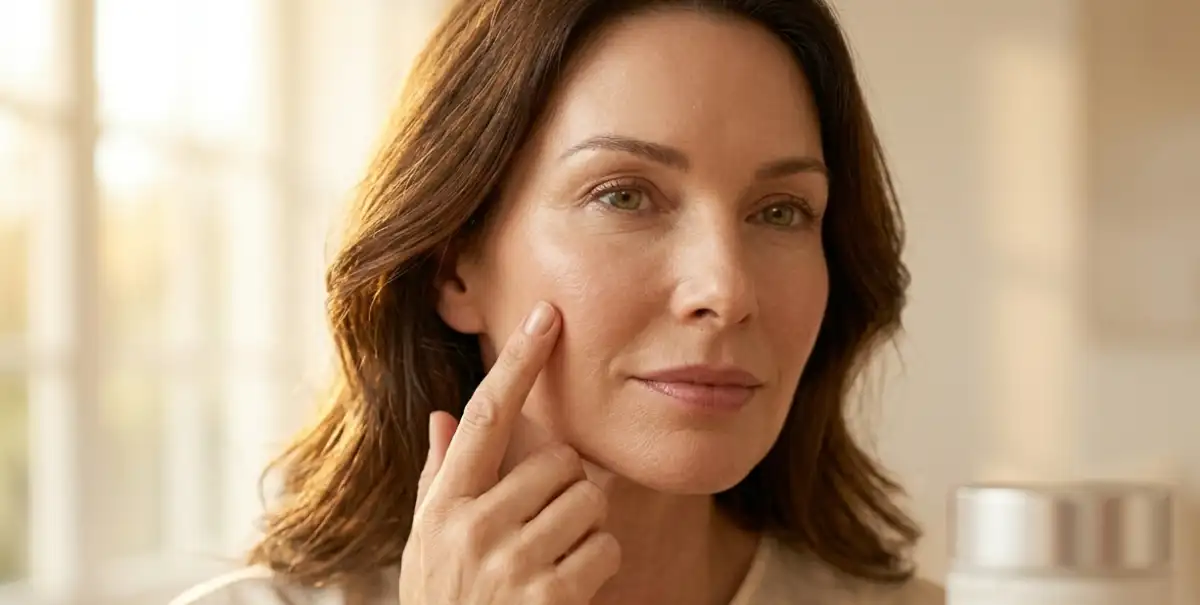
The science of skin aging is evolving rapidly — and for women navigating the skin changes that come with menopause and beyond, evidence-based skincare represents a fundamentally different approach: working with your skin's biology rather than against it.
Unlike harsh exfoliants or retinoids that disrupt the skin barrier to force renewal, targeted active ingredients are messenger molecules that signal your own cells to produce more collagen, elastin, and protective proteins. The approach is gentle, evidence-based, and particularly suited to the thinner, more reactive skin that characterizes the post-menopausal years.
Foods That Support Barrier Function From the Inside Out
The connection between diet and menopausal dry skin is increasingly supported by clinical evidence — not as a replacement for topical barrier repair, but as a complementary approach that addresses the condition from within. The most robust evidence involves omega-3 fatty acids, which serve as building blocks for the anti-inflammatory prostaglandins that modulate skin barrier function. A randomized controlled trial published in the British Journal of Dermatology found that 12 weeks of omega-3 supplementation (2.5g EPA+DHA daily) improved skin hydration by 39% and reduced TEWL by 20% in post-menopausal women compared to placebo.[1]
Phytoestrogens — plant compounds that weakly activate estrogen receptors — represent a dietary approach specific to menopausal skin. Isoflavones from soy (genistein, daidzein) bind to ER-beta receptors on skin fibroblasts and keratinocytes, partially compensating for the declined endogenous estrogen signaling. A clinical study evaluating soy isoflavone supplementation (40mg daily) over 24 weeks in post-menopausal women found statistically significant improvements in skin elasticity, dermal thickness, and hydration. The effect was modest compared to topical estrogen — approximately 15-20% of the improvement seen with prescription topical estradiol — but meaningful as an adjunct to topical care.
Clinical research confirms that ceramide-containing foods represent an emerging area of evidence. Wheat extract, rice bran, and sweet potato contain plant-derived ceramides (phytoceramides) that, when ingested, are absorbed and distributed to the skin. A double-blind placebo-controlled study in Japan found that oral phytoceramide supplementation (1.8mg daily from wheat extract) reduced TEWL and improved skin hydration scores after 12 weeks. While the effect was smaller than topical ceramide application, it provided a systemic boost that topical application alone cannot achieve — reaching skin sites that topical products may miss.
The practical dietary framework for menopausal dry skin includes: fatty fish 2-3 times weekly (salmon, mackerel, sardines for EPA/DHA), soy foods daily (tofu, edamame, tempeh for isoflavones), nuts and seeds (walnuts, flaxseed for alpha-linolenic acid), avocado (monounsaturated fats and vitamin E for barrier support), and adequate water intake (the evidence does not support the '8 glasses' myth, but chronic dehydration does worsen skin dryness). The evidence consistently shows that dietary approaches work best when combined with topical barrier repair — they enhance topical results rather than replacing them.
Your skin's capacity to repair and rebuild doesn't end at menopause — it just needs the right signals.
— Dr. Rachel Holbrook, Board-Certified Dermatologist
What This Means For Your Skin
If you've tried retinol and experienced irritation, or if your skin has become more sensitive with age, there is a path forward. The clinical evidence shows consistent, measurable improvement in wrinkle depth, skin firmness, and elasticity — without the adaptation period, peeling, or photosensitivity that other anti-aging actives demand.
Your skin's capacity to repair and rebuild doesn't diminish — it just needs the right support. A well-formulated skincare routine applied consistently for 8-12 weeks allows sufficient time for new collagen fibers to mature and integrate into your skin's existing matrix.
The science is clear. The evidence is consistent. The results are measurable.
What happens next is up to you.