
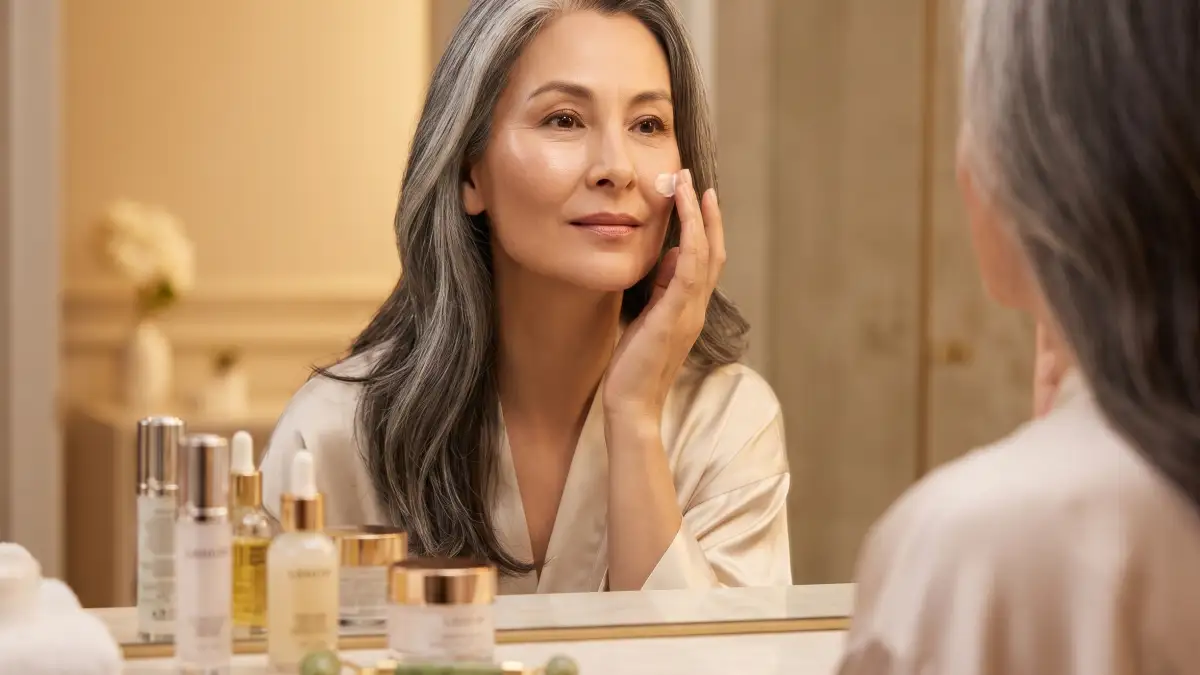
The science of skin aging is evolving rapidly — and for women navigating the skin changes that come with menopause and beyond, evidence-based skincare represents a fundamentally different approach: working with your skin's biology rather than against it.
Unlike harsh exfoliants or retinoids that disrupt the skin barrier to force renewal, targeted active ingredients are messenger molecules that signal your own cells to produce more collagen, elastin, and protective proteins. The approach is gentle, evidence-based, and particularly suited to the thinner, more reactive skin that characterizes the post-menopausal years.
Clinically Proven Actives for Hormonal Skin Changes
The selection of active ingredients for menopausal skin must account for the unique pathophysiology of estrogen-depleted dermis. Retinoids remain the gold standard for collagen stimulation, with tretinoin demonstrating measurable increases in procollagen type I and type III synthesis in postmenopausal skin. However, the compromised barrier function common during menopause necessitates careful titration and concurrent barrier support to prevent irritation-driven inflammation.[1]
Niacinamide at concentrations of 4-5% has emerged as a critical ingredient for menopausal skin, addressing multiple pathways simultaneously. It stimulates ceramide synthesis to rebuild the lipid barrier, reduces transepidermal water loss, inhibits melanin transfer to address hormonal hyperpigmentation, and supports the dermal matrix through increased collagen production. Its tolerability profile makes it particularly suitable for the increased sensitivity many women experience during menopause.
Clinical research confirms that peptide complexes — particularly palmitoyl pentapeptide-4 and copper peptides — provide collagen stimulation through mechanisms distinct from retinoids, allowing for additive effects when combined in a comprehensive routine. These signal peptides mimic collagen fragments to upregulate fibroblast activity without the irritation potential of retinoids, making them ideal for the morning routine while retinoids are reserved for evening application.
Ceramides, cholesterol, and free fatty acids in a physiologic 3:1:1 ratio directly address the lipid barrier deficit that drives menopausal dryness. Clinical studies in postmenopausal women show that barrier-identical lipid formulations restore transepidermal water loss values to premenopausal levels within 4-6 weeks of consistent use, providing the foundation upon which other active ingredients can function optimally.
Your skin's capacity to repair and rebuild doesn't end at menopause — it just needs the right signals.
— Dr. Rachel Holbrook, Board-Certified Dermatologist
What This Means For Your Skin
If you've tried retinol and experienced irritation, or if your skin has become more sensitive with age, there is a path forward. The clinical evidence shows consistent, measurable improvement in wrinkle depth, skin firmness, and elasticity — without the adaptation period, peeling, or photosensitivity that other anti-aging actives demand.
Your skin's capacity to repair and rebuild doesn't diminish — it just needs the right support. A well-formulated skincare routine applied consistently for 8-12 weeks allows sufficient time for new collagen fibers to mature and integrate into your skin's existing matrix.
The science is clear. The evidence is consistent. The results are measurable.
What happens next is up to you.