
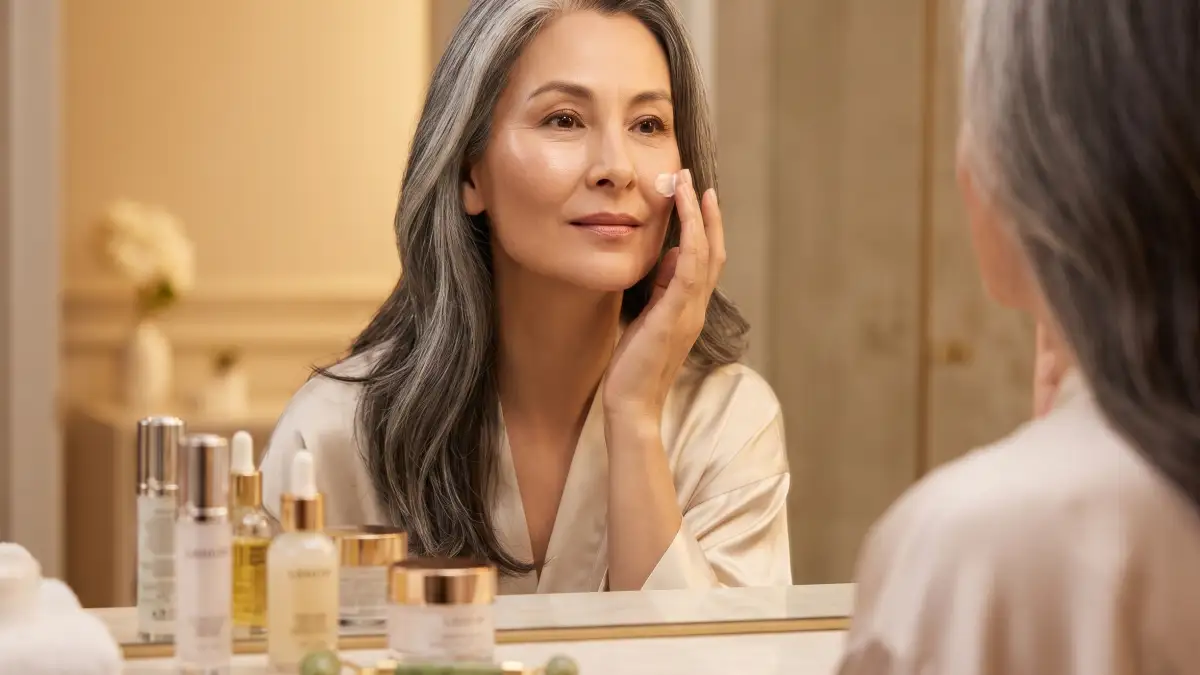
The science of skin aging is evolving rapidly — and for women navigating the skin changes that come with menopause and beyond, evidence-based skincare represents a fundamentally different approach: working with your skin's biology rather than against it.
Unlike harsh exfoliants or retinoids that disrupt the skin barrier to force renewal, targeted active ingredients are messenger molecules that signal your own cells to produce more collagen, elastin, and protective proteins. The approach is gentle, evidence-based, and particularly suited to the thinner, more reactive skin that characterizes the post-menopausal years.
Safe Retinoid Introduction for Sensitive Aging Skin
Retinoids are the most evidence-supported topical intervention for menopausal collagen loss, yet the compromised barrier function common during menopause creates a paradox: the skin that needs retinoids most is also the skin most vulnerable to their irritating effects. Successful retinoid introduction during menopause requires a slower titration schedule, concurrent barrier support, and a different formulation hierarchy than dermatologists typically recommend for younger patients.[1]
The recommended starting point for menopausal skin is encapsulated retinol at 0.025-0.05%, applied once weekly for the first two weeks, then twice weekly for two weeks, building to every other night over six to eight weeks. This gradual approach allows retinoid receptors to upregulate while the barrier adapts to increased cellular turnover. Retinaldehyde at 0.05% offers an alternative starting point with evidence suggesting faster conversion to retinoic acid in mature skin, though availability in consumer products remains limited.
Clinical research confirms that the sandwich method — applying moisturizer before and after retinol — is particularly effective for menopausal skin. The initial moisturizer layer buffers retinol penetration through the weakened barrier, reducing the concentration that reaches viable epidermis while still allowing sufficient absorption for therapeutic effect. The second moisturizer layer provides occlusion and additional barrier lipids. Clinical observations indicate this approach reduces retinoid dermatitis by approximately 60% in postmenopausal patients compared to retinol applied to bare skin.
Signs that retinol tolerance is building successfully include mild flaking without redness, which indicates cellular turnover is increasing without inflammatory disruption. If persistent redness, burning, or peeling occurs, the frequency should be reduced rather than the product abandoned entirely. Most menopausal women achieve stable tolerance at every-other-night application within three to four months, at which point concentration can be gradually increased to maximize collagen-stimulating benefits.
Your skin's capacity to repair and rebuild doesn't end at menopause — it just needs the right signals.
— Dr. Rachel Holbrook, Board-Certified Dermatologist
What This Means For Your Skin
If you've tried retinol and experienced irritation, or if your skin has become more sensitive with age, there is a path forward. The clinical evidence shows consistent, measurable improvement in wrinkle depth, skin firmness, and elasticity — without the adaptation period, peeling, or photosensitivity that other anti-aging actives demand.
Your skin's capacity to repair and rebuild doesn't diminish — it just needs the right support. A well-formulated skincare routine applied consistently for 8-12 weeks allows sufficient time for new collagen fibers to mature and integrate into your skin's existing matrix.
The science is clear. The evidence is consistent. The results are measurable.
What happens next is up to you.