
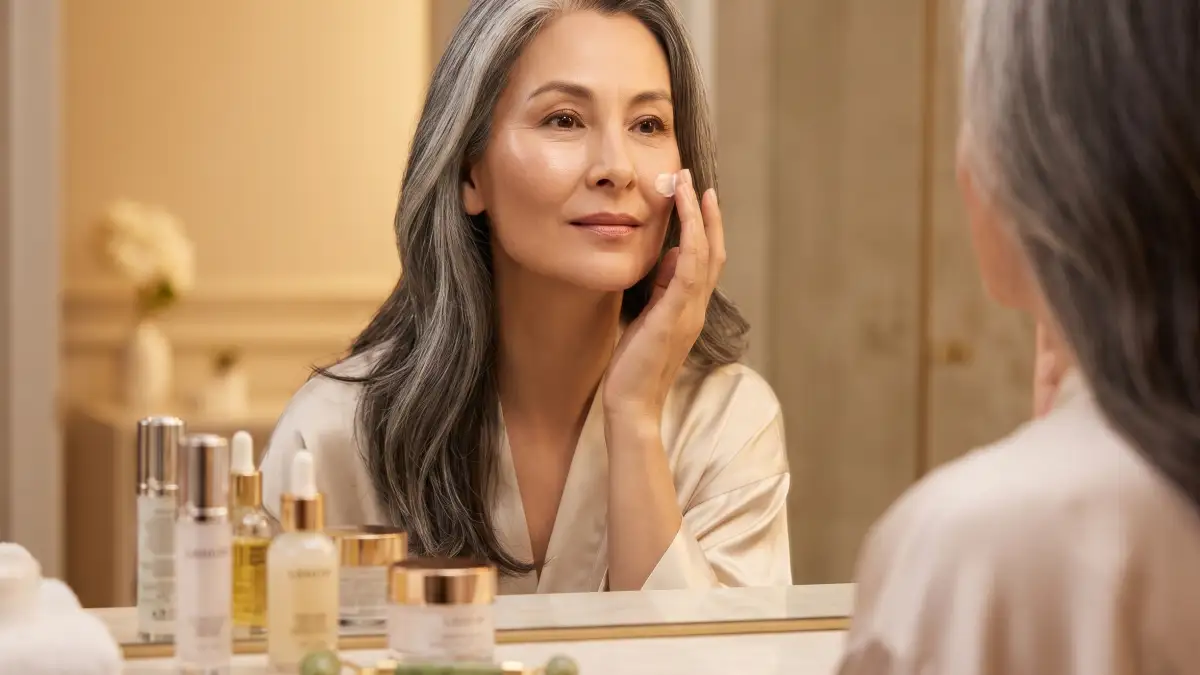
The science of skin aging is evolving rapidly — and for women navigating the skin changes that come with menopause and beyond, evidence-based skincare represents a fundamentally different approach: working with your skin's biology rather than against it.
Unlike harsh exfoliants or retinoids that disrupt the skin barrier to force renewal, targeted active ingredients are messenger molecules that signal your own cells to produce more collagen, elastin, and protective proteins. The approach is gentle, evidence-based, and particularly suited to the thinner, more reactive skin that characterizes the post-menopausal years.
Gentle Protocol for Reactive Menopausal Skin
Menopausal skin sensitivity is a distinct clinical entity driven by the convergence of barrier compromise, neurogenic inflammation, and altered immune function. Estrogen receptors in sensory nerve endings modulate pain perception, and their declining activation lowers the threshold for irritant and stinging responses. This explains why products that were well-tolerated for decades suddenly provoke burning, itching, or redness during menopause — the skin's neurological sensitivity has fundamentally changed, not just its barrier integrity.[1]
The foundation of a sensitive menopausal skin routine is radical simplification. A maximum of four products — cleanser, treatment serum, moisturizer, and sunscreen — minimizes the number of potential irritants while still addressing core menopausal skin needs. Each product should contain fewer than 15 ingredients, avoid known sensitizers including fragrance, essential oils, denatured alcohol, and sodium lauryl sulfate, and carry clinical testing data specifically on sensitive or mature skin populations.
Clinical research confirms that centella asiatica extract and its derivatives — madecassoside and asiaticoside — represent the optimal active treatment for sensitive menopausal skin. These compounds provide collagen stimulation through TGF-beta pathway activation while simultaneously exerting anti-inflammatory effects through inhibition of NF-kB signaling. This dual action addresses the menopausal collagen deficit without triggering the inflammatory responses that retinoids and vitamin C can provoke in neurogenically sensitized skin.
Mineral-only sunscreen with zinc oxide is essential for sensitive menopausal skin, as chemical UV filters — particularly avobenzone, oxybenzone, and octinoxate — are among the most common triggers for contact sensitization in perimenopausal and postmenopausal women. Modern micronized zinc oxide formulations at 15-20% provide broad-spectrum SPF 30-50 protection with minimal white cast, while the zinc itself offers anti-inflammatory properties that actively calm reactive skin throughout the day.
Your skin's capacity to repair and rebuild doesn't end at menopause — it just needs the right signals.
— Dr. Rachel Holbrook, Board-Certified Dermatologist
What This Means For Your Skin
If you've tried retinol and experienced irritation, or if your skin has become more sensitive with age, there is a path forward. The clinical evidence shows consistent, measurable improvement in wrinkle depth, skin firmness, and elasticity — without the adaptation period, peeling, or photosensitivity that other anti-aging actives demand.
Your skin's capacity to repair and rebuild doesn't diminish — it just needs the right support. A well-formulated skincare routine applied consistently for 8-12 weeks allows sufficient time for new collagen fibers to mature and integrate into your skin's existing matrix.
The science is clear. The evidence is consistent. The results are measurable.
What happens next is up to you.