
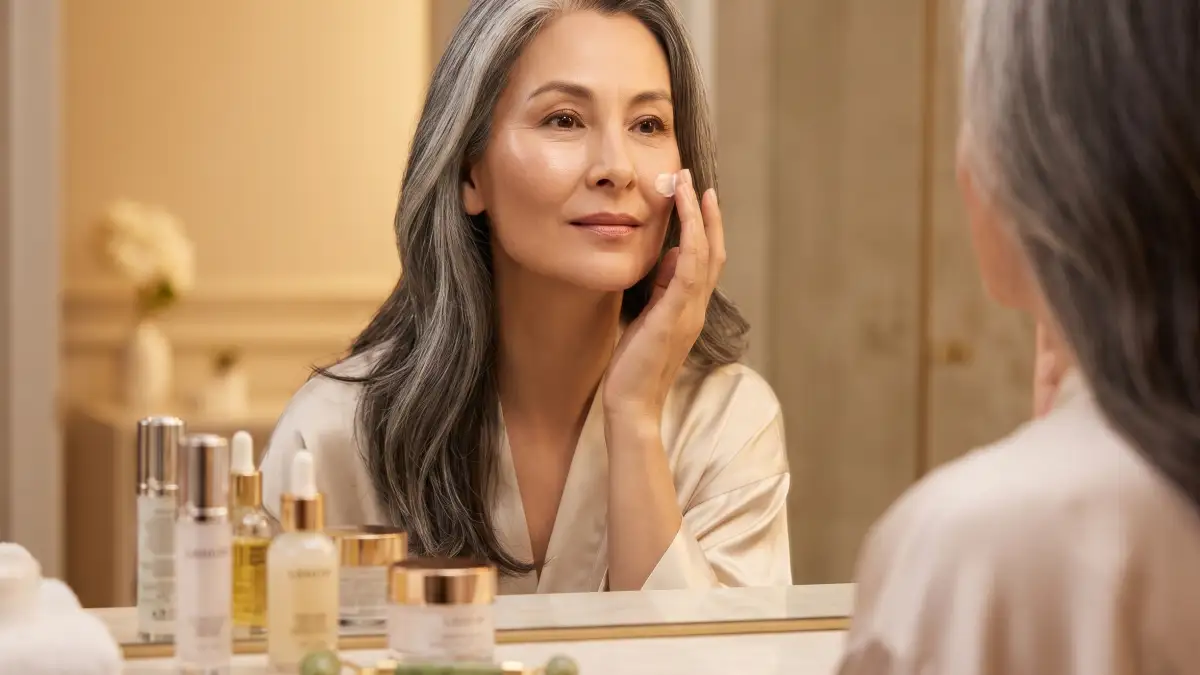
The science of skin aging is evolving rapidly — and for women navigating the skin changes that come with menopause and beyond, evidence-based skincare represents a fundamentally different approach: working with your skin's biology rather than against it.
Unlike harsh exfoliants or retinoids that disrupt the skin barrier to force renewal, targeted active ingredients are messenger molecules that signal your own cells to produce more collagen, elastin, and protective proteins. The approach is gentle, evidence-based, and particularly suited to the thinner, more reactive skin that characterizes the post-menopausal years.
Common Errors That Accelerate Hormonal Skin Aging
The most prevalent mistake women make during menopause is continuing their pre-menopausal skincare routine without modification. Formulations designed for skin with adequate estrogen levels — lightweight gels, foaming cleansers, mattifying products — actively worsen menopausal skin conditions by further depleting an already-compromised lipid barrier. Dermatological assessments show that women who fail to transition their routines experience measurably faster skin thinning and greater moisture loss compared to those who adapt within the first year of menopause.[1]
Over-exfoliation represents the second most damaging error in menopausal skincare. Many women interpret the dullness and texture changes of hormonal aging as a need for aggressive exfoliation, introducing high-concentration AHAs, physical scrubs, and enzymatic peels simultaneously. In estrogen-depleted skin where cellular turnover is already slowed and barrier recovery takes 50-60% longer than in younger skin, this approach triggers chronic low-grade inflammation that paradoxically accelerates collagen breakdown.
Clinical research confirms that neglecting the neck and decolletage is a critical oversight with compounding consequences. The skin in these areas has fewer sebaceous glands and less subcutaneous fat than facial skin, making it even more vulnerable to menopausal collagen loss. Women who extend their facial routine to the neck from the onset of perimenopause maintain significantly better skin quality in these areas, while those who begin treatment after visible damage has appeared face a much steeper recovery curve.
Using sunscreen inconsistently or at insufficient SPF undermines every other investment in menopausal skincare. Postmenopausal skin has reduced melanocyte function, thinner epidermis, and less capacity for DNA repair after UV exposure. A single significant sunburn can degrade months of collagen-building progress. Daily broad-spectrum SPF 30 minimum — reapplied every two hours during sun exposure — is the single highest-impact habit for preserving menopausal skin quality.
Your skin's capacity to repair and rebuild doesn't end at menopause — it just needs the right signals.
— Dr. Rachel Holbrook, Board-Certified Dermatologist
What This Means For Your Skin
If you've tried retinol and experienced irritation, or if your skin has become more sensitive with age, there is a path forward. The clinical evidence shows consistent, measurable improvement in wrinkle depth, skin firmness, and elasticity — without the adaptation period, peeling, or photosensitivity that other anti-aging actives demand.
Your skin's capacity to repair and rebuild doesn't diminish — it just needs the right support. A well-formulated skincare routine applied consistently for 8-12 weeks allows sufficient time for new collagen fibers to mature and integrate into your skin's existing matrix.
The science is clear. The evidence is consistent. The results are measurable.
What happens next is up to you.