
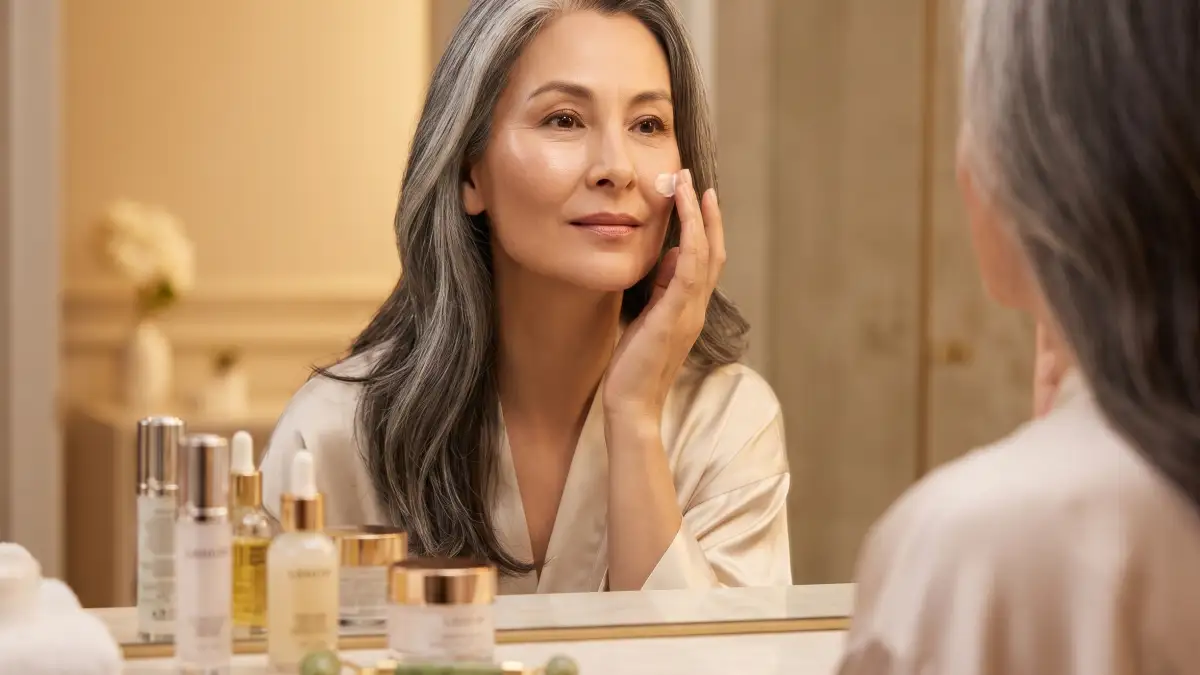
The science of skin aging is evolving rapidly — and for women navigating the skin changes that come with menopause and beyond, evidence-based skincare represents a fundamentally different approach: working with your skin's biology rather than against it.
Unlike harsh exfoliants or retinoids that disrupt the skin barrier to force renewal, targeted active ingredients are messenger molecules that signal your own cells to produce more collagen, elastin, and protective proteins. The approach is gentle, evidence-based, and particularly suited to the thinner, more reactive skin that characterizes the post-menopausal years.
Rebuilding the Lipid Barrier After Estrogen Decline
The skin barrier — a complex structure of corneocytes embedded in a lipid matrix of ceramides, cholesterol, and free fatty acids — undergoes significant deterioration during menopause. Estrogen receptors in keratinocytes directly regulate ceramide synthesis, and their declining activation leads to measurable reductions in all major ceramide species. This lipid deficit creates gaps in the stratum corneum that increase transepidermal water loss and allow irritant penetration, explaining why previously tolerated products suddenly cause stinging and redness.[1]
Barrier repair in menopausal skin requires a physiologic approach that replaces the specific lipids being lost rather than simply occluding the surface. Formulations containing ceramides, cholesterol, and free fatty acids in a 3:1:1 molar ratio — the same ratio found in healthy stratum corneum — integrate into the existing lipid lamellae and restore barrier function from within. Studies demonstrate that this physiologic lipid replacement normalizes transepidermal water loss within four to six weeks, compared to occlusive-only approaches that provide temporary relief without structural repair.
Clinical research confirms that during active barrier repair, simplification of the skincare routine is essential. Active ingredients like retinoids, vitamin C at high concentrations, and chemical exfoliants should be paused until barrier integrity is restored, as their penetration through a compromised barrier can trigger inflammatory responses disproportionate to their intended effects. A stripped-back routine of gentle cleanser, barrier-repair moisturizer, and sunscreen for four to six weeks allows the lipid matrix to rebuild before active ingredients are reintroduced one at a time.
Pre-biotic and post-biotic ingredients are emerging as valuable additions to menopausal barrier repair protocols. The skin microbiome shifts during menopause, with decreased microbial diversity correlating with increased barrier dysfunction and sensitivity. Formulations containing thermal spring water, lactobacillus ferment lysate, or beta-glucans support microbiome recovery alongside lipid barrier repair, addressing two interconnected aspects of menopausal skin compromise simultaneously.
Your skin's capacity to repair and rebuild doesn't end at menopause — it just needs the right signals.
— Dr. Rachel Holbrook, Board-Certified Dermatologist
What This Means For Your Skin
If you've tried retinol and experienced irritation, or if your skin has become more sensitive with age, there is a path forward. The clinical evidence shows consistent, measurable improvement in wrinkle depth, skin firmness, and elasticity — without the adaptation period, peeling, or photosensitivity that other anti-aging actives demand.
Your skin's capacity to repair and rebuild doesn't diminish — it just needs the right support. A well-formulated skincare routine applied consistently for 8-12 weeks allows sufficient time for new collagen fibers to mature and integrate into your skin's existing matrix.
The science is clear. The evidence is consistent. The results are measurable.
What happens next is up to you.