
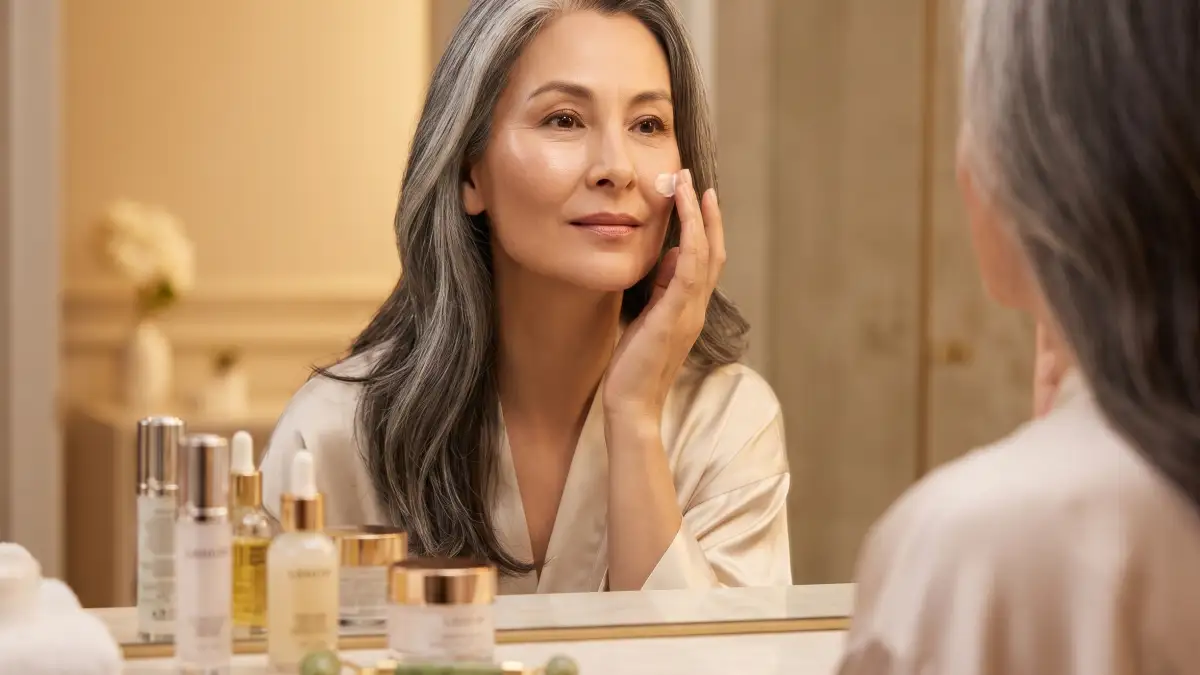
The science of skin aging is evolving rapidly — and for women navigating the skin changes that come with menopause and beyond, evidence-based skincare represents a fundamentally different approach: working with your skin's biology rather than against it.
Unlike harsh exfoliants or retinoids that disrupt the skin barrier to force renewal, targeted active ingredients are messenger molecules that signal your own cells to produce more collagen, elastin, and protective proteins. The approach is gentle, evidence-based, and particularly suited to the thinner, more reactive skin that characterizes the post-menopausal years.
What to Expect Month by Month From Your New Routine
Setting realistic expectations for menopausal skincare outcomes requires understanding the biology of skin renewal in estrogen-depleted tissue. Epidermal turnover, which averages 28 days in young adults, extends to 40-50 days in postmenopausal women. This means that any topical intervention requires a minimum of six to eight weeks before surface-level improvements become visible, and deeper structural changes — collagen density, dermal thickness — require four to six months of consistent use to reach measurable thresholds.[1]
During weeks one through four, the primary observable changes are related to hydration and barrier function. Ceramide-based moisturizers begin restoring lipid barrier integrity, and transepidermal water loss decreases measurably within two weeks. Skin feels less tight and uncomfortable, morning dryness diminishes, and the stinging reaction to previously tolerated products resolves as barrier gaps close. These early improvements, while not dramatic visually, represent the essential foundation upon which all subsequent results depend.
Clinical research confirms that months two through three bring the first visible texture and tone improvements. Retinoid-driven increases in cellular turnover smooth the skin surface, reducing the rough, dull appearance characteristic of menopausal skin. Niacinamide begins to fade hormonal hyperpigmentation, though complete resolution of established dark spots requires six to twelve months. Skin appears more luminous as the smoother surface reflects light more evenly, and fine lines around the eyes and mouth begin to soften — though they will not disappear entirely.
Months four through six mark the threshold for collagen-level improvements. Ultrasound studies in postmenopausal women using retinoids show measurable increases in dermal thickness beginning at the four-month mark, with progressive improvement continuing through twelve months. Skin firmness improves as new collagen fibers mature, and the jawline definition that estrogen decline eroded begins to stabilize. These results are cumulative and maintenance-dependent — discontinuing the routine reverses gains within three to four months as the underlying hormonal deficit persists.
Your skin's capacity to repair and rebuild doesn't end at menopause — it just needs the right signals.
— Dr. Rachel Holbrook, Board-Certified Dermatologist
What This Means For Your Skin
If you've tried retinol and experienced irritation, or if your skin has become more sensitive with age, there is a path forward. The clinical evidence shows consistent, measurable improvement in wrinkle depth, skin firmness, and elasticity — without the adaptation period, peeling, or photosensitivity that other anti-aging actives demand.
Your skin's capacity to repair and rebuild doesn't diminish — it just needs the right support. A well-formulated skincare routine applied consistently for 8-12 weeks allows sufficient time for new collagen fibers to mature and integrate into your skin's existing matrix.
The science is clear. The evidence is consistent. The results are measurable.
What happens next is up to you.