
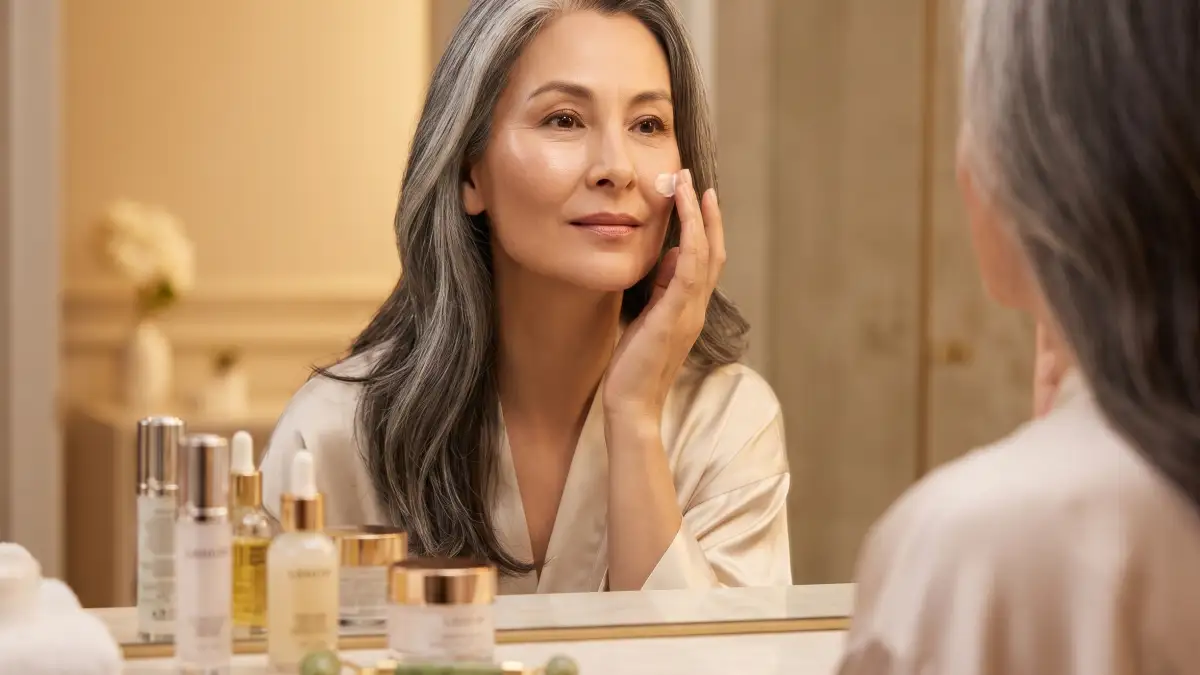
The science of skin aging is evolving rapidly — and for women navigating the skin changes that come with menopause and beyond, evidence-based skincare represents a fundamentally different approach: working with your skin's biology rather than against it.
Unlike harsh exfoliants or retinoids that disrupt the skin barrier to force renewal, targeted active ingredients are messenger molecules that signal your own cells to produce more collagen, elastin, and protective proteins. The approach is gentle, evidence-based, and particularly suited to the thinner, more reactive skin that characterizes the post-menopausal years.
Your AM Protocol for Hormonal Skin Protection
The morning skincare routine for menopausal skin serves a fundamentally different purpose than its evening counterpart. While nighttime focuses on repair and stimulation, the AM routine must prioritize antioxidant defense, UV protection, and barrier maintenance throughout the day. This distinction is particularly important for menopausal skin, where reduced melanocyte function and thinner epidermis increase vulnerability to photodamage and environmental oxidative stress.[1]
Cleansing in the morning should employ a gentle, non-foaming formula that preserves the skin's already-compromised lipid barrier. Menopausal skin produces significantly less sebum than premenopausal skin, and aggressive morning cleansing strips the minimal protective oils that accumulate overnight. A micellar water or cream cleanser maintains the acid mantle while removing overnight metabolic waste without disrupting barrier lipids.
Clinical research confirms that vitamin C serum at 10-20% concentration is the cornerstone of the menopausal morning routine. L-ascorbic acid provides dual benefits: it stimulates collagen synthesis through its role as a cofactor for prolyl hydroxylase and lysyl hydroxylase — enzymes essential for collagen cross-linking — while simultaneously neutralizing free radicals generated by UV exposure. For menopausal skin, the collagen-stimulating pathway is particularly valuable, as it operates independently of estrogen signaling.
Broad-spectrum SPF 30-50 is non-negotiable for menopausal skin, applied as the final step before makeup. Estrogen decline reduces the skin's intrinsic photoprotective capacity, and the thinner postmenopausal epidermis transmits more UV radiation to the dermis where collagen degradation occurs. Chemical and mineral sunscreen combinations provide the most comprehensive protection, with mineral filters offering additional anti-inflammatory benefits that soothe the heightened reactivity common during menopause.
Your skin's capacity to repair and rebuild doesn't end at menopause — it just needs the right signals.
— Dr. Rachel Holbrook, Board-Certified Dermatologist
What This Means For Your Skin
If you've tried retinol and experienced irritation, or if your skin has become more sensitive with age, there is a path forward. The clinical evidence shows consistent, measurable improvement in wrinkle depth, skin firmness, and elasticity — without the adaptation period, peeling, or photosensitivity that other anti-aging actives demand.
Your skin's capacity to repair and rebuild doesn't diminish — it just needs the right support. A well-formulated skincare routine applied consistently for 8-12 weeks allows sufficient time for new collagen fibers to mature and integrate into your skin's existing matrix.
The science is clear. The evidence is consistent. The results are measurable.
What happens next is up to you.