
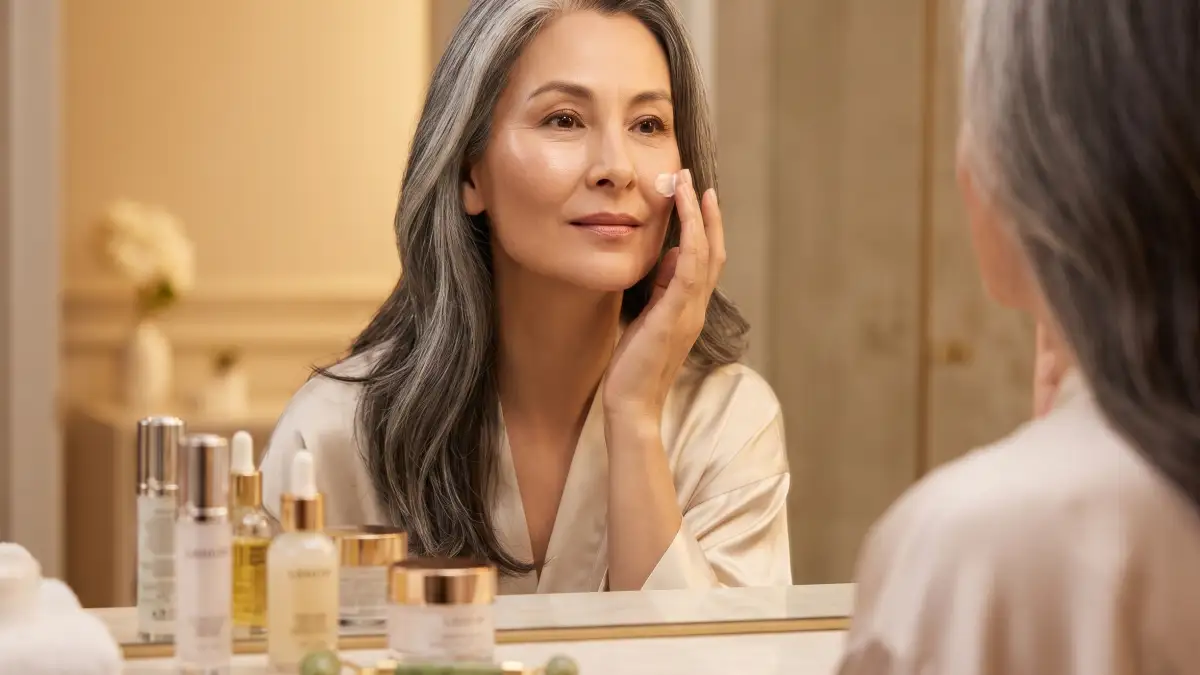
The science of skin aging is evolving rapidly — and for women navigating the skin changes that come with menopause and beyond, evidence-based skincare represents a fundamentally different approach: working with your skin's biology rather than against it.
Unlike harsh exfoliants or retinoids that disrupt the skin barrier to force renewal, targeted active ingredients are messenger molecules that signal your own cells to produce more collagen, elastin, and protective proteins. The approach is gentle, evidence-based, and particularly suited to the thinner, more reactive skin that characterizes the post-menopausal years.
Effective Drugstore Options for Hormonal Skin Changes
The active ingredients that drive results in menopausal skincare — retinol, niacinamide, hyaluronic acid, ceramides, and vitamin C — are available at therapeutic concentrations in drugstore formulations at a fraction of luxury pricing. The key differentiator between effective and ineffective products is not price but formulation: concentration of active ingredients, pH optimization for stability and penetration, and packaging that prevents degradation. A dermatologist-guided drugstore routine can achieve 80-90% of the clinical outcomes of a premium regimen.[1]
CeraVe, Vanicream, and La Roche-Posay Toleriane lines provide barrier-repair moisturizers containing the physiologic ceramide ratios essential for menopausal skin at price points under fifteen dollars. These formulations have been validated in clinical studies and contain the same ceramide species — ceramide NP, AP, and EOP — found in products costing five to ten times more. The vehicle differences between drugstore and luxury formulations are primarily cosmetic elegance rather than therapeutic efficacy.
Clinical research confirms that retinol introduction on a budget is best achieved through adapalene 0.1% gel, which is available over the counter and provides a retinoid with documented collagen-stimulating properties at a cost of approximately twelve dollars for a three-month supply. While adapalene was developed primarily for acne, studies in photoaged skin demonstrate improvements in fine wrinkles, skin texture, and collagen markers comparable to other retinoids. Its superior stability compared to retinol esters means the active ingredient remains potent throughout the product's shelf life.
The most cost-effective menopausal skincare investment is daily broad-spectrum sunscreen, which prevents more collagen degradation than any other single product can repair. Drugstore mineral and chemical sunscreens from brands with established dermatological research programs provide equivalent UV protection to premium alternatives. The difference between a ten-dollar sunscreen and a sixty-dollar sunscreen is texture and finish — not protection level — and consistent daily application of an affordable sunscreen outperforms sporadic use of an expensive one.
Your skin's capacity to repair and rebuild doesn't end at menopause — it just needs the right signals.
— Dr. Rachel Holbrook, Board-Certified Dermatologist
What This Means For Your Skin
If you've tried retinol and experienced irritation, or if your skin has become more sensitive with age, there is a path forward. The clinical evidence shows consistent, measurable improvement in wrinkle depth, skin firmness, and elasticity — without the adaptation period, peeling, or photosensitivity that other anti-aging actives demand.
Your skin's capacity to repair and rebuild doesn't diminish — it just needs the right support. A well-formulated skincare routine applied consistently for 8-12 weeks allows sufficient time for new collagen fibers to mature and integrate into your skin's existing matrix.
The science is clear. The evidence is consistent. The results are measurable.
What happens next is up to you.