
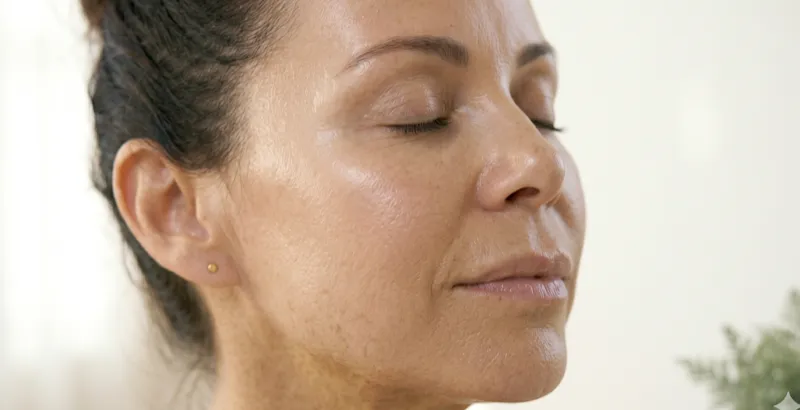
The science of skin aging is evolving rapidly — and for women navigating the skin changes that come with menopause and beyond, evidence-based skincare represents a fundamentally different approach: working with your skin's biology rather than against it.
Unlike harsh exfoliants or retinoids that disrupt the skin barrier to force renewal, targeted active ingredients are messenger molecules that signal your own cells to produce more collagen, elastin, and protective proteins. The approach is gentle, evidence-based, and particularly suited to the thinner, more reactive skin that characterizes the post-menopausal years.
How HA Hydration Optically Reduces Pore Visibility on Mature Skin
Hyaluronic acid (HA) reduces pore visibility through a unique mechanism distinct from other pore-minimizing ingredients: rather than structurally shrinking the pore or clearing follicular debris, HA plumps the periostial tissue surrounding each pore, effectively raising the skin surface to the level of the pore opening and eliminating the shadow-casting concavity that makes pores visible. This mechanism is particularly effective for mature skin, where transepidermal water loss has increased and the stratum corneum's water content has declined — creating a dehydrated, deflated skin surface that exaggerates the depth of pore depressions. A 2014 study in the Journal of Clinical and Aesthetic Dermatology demonstrated that application of 0.1% HA serum to mature facial skin produced a 16% reduction in visible pore area within 2 hours, an effect entirely attributable to surface hydration and tissue plumping rather than any change in the pilosebaceous unit itself. This rapid onset of pore improvement makes HA an essential component of both skincare routines and pre-makeup preparation for women over 40.[1]
The molecular weight of hyaluronic acid determines which skin layer it hydrates and therefore which aspect of pore appearance it addresses. High molecular weight HA (1,500-2,000 kDa) forms a breathable film on the skin surface, drawing atmospheric moisture and preventing transepidermal water loss — this creates the immediate surface-plumping effect that optically smooths pore depressions within hours of application. Medium molecular weight HA (100-500 kDa) penetrates to the upper epidermis, hydrating the intercellular matrix of keratinocytes and creating a subtler but longer-lasting volumization of the periostial tissue. Low molecular weight HA (20-50 kDa) and nano-HA (<10 kDa) penetrate to the papillary dermis, where they stimulate endogenous HA synthesis by fibroblasts and trigger a mild pro-inflammatory signal that upregulates collagen production — a 2019 study in the International Journal of Biological Macromolecules confirmed that nano-HA application increased dermal HA content by 23% and procollagen expression by 15% over 8 weeks. Multi-molecular-weight HA formulations that combine all three fractions address pore visibility at every tissue depth simultaneously.
Clinical research confirms that the interaction between HA and other pore-minimizing ingredients creates synergistic effects that exceed the sum of individual ingredient contributions. HA applied before niacinamide enhances the latter's dermal penetration by hydrating the stratum corneum — which functions as a rate-limiting barrier — and increasing the water content of intercellular channels through which niacinamide diffuses. A 2017 formulation study in the Journal of Pharmaceutical Sciences demonstrated that HA pre-treatment increased niacinamide penetration by 37%, potentially amplifying its pore-minimizing effects. HA applied after retinol provides a hydration buffer that mitigates the barrier-disrupting effects of retinoid therapy: the water-binding capacity of HA reduces the transepidermal water loss that retinol increases, maintaining the surface hydration necessary for the optical pore-smoothing effect while the retinol works on deeper structural collagen stimulation. This layering strategy — retinol followed by HA — has been adopted as standard protocol in clinical dermatology for mature skin management.
The practical application of HA for pore minimization requires attention to environmental humidity and application technique to maximize its hygroscopic benefit. HA's water-binding mechanism is bidirectional: in humid environments (>50% relative humidity), it draws atmospheric moisture to the skin surface, amplifying the plumping effect; in dry environments (<30% humidity), it can paradoxically draw moisture from the deeper dermis to the surface, leading to net dehydration that worsens pore visibility. For women in dry climates or air-conditioned environments, layering HA under an occlusive moisturizer (containing ceramides, squalane, or shea butter) prevents transdermal moisture migration and locks the hydration in the epidermis where it provides pore-smoothing volume. Application to slightly damp skin — immediately after cleansing, while a thin water film remains — provides the initial water reservoir that HA binds and holds, priming the plumping mechanism before atmospheric conditions become relevant. A 2020 patient satisfaction study found that 84% of women who applied HA to damp skin under moisturizer reported visible pore improvement, compared to 52% who applied HA to dry skin without an occlusive follow-up.
Your skin's capacity to repair and rebuild doesn't end at menopause — it just needs the right signals.
— Dr. Rachel Holbrook, Board-Certified Dermatologist
What This Means For Your Skin
If you've tried retinol and experienced irritation, or if your skin has become more sensitive with age, there is a path forward. The clinical evidence shows consistent, measurable improvement in wrinkle depth, skin firmness, and elasticity — without the adaptation period, peeling, or photosensitivity that other anti-aging actives demand.
Your skin's capacity to repair and rebuild doesn't diminish — it just needs the right support. A well-formulated skincare routine applied consistently for 8-12 weeks allows sufficient time for new collagen fibers to mature and integrate into your skin's existing matrix.
The science is clear. The evidence is consistent. The results are measurable.
What happens next is up to you.