
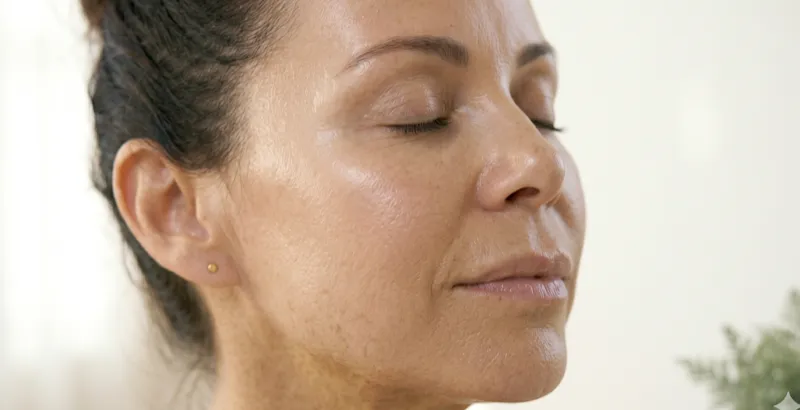
The science of skin aging is evolving rapidly — and for women navigating the skin changes that come with menopause and beyond, evidence-based skincare represents a fundamentally different approach: working with your skin's biology rather than against it.
Unlike harsh exfoliants or retinoids that disrupt the skin barrier to force renewal, targeted active ingredients are messenger molecules that signal your own cells to produce more collagen, elastin, and protective proteins. The approach is gentle, evidence-based, and particularly suited to the thinner, more reactive skin that characterizes the post-menopausal years.
How to Minimize Pores With the Right Primer
Pore-minimizing primers designed for mature skin must navigate a fundamental tension that younger skin types never encounter: the silicone-based polymers that most effectively blur pore visibility can simultaneously settle into fine lines, crepe-like texture, and expression wrinkles, trading one cosmetic concern for another. Dimethicone and cyclomethicone — the two most common silicone pore-fillers — work by physically filling the concavity around pore openings and creating a smooth, light-reflecting surface that optically disguises pore depth. However, a 2018 study in the International Journal of Cosmetic Science demonstrated that these same polymers accumulated preferentially in wrinkle troughs on mature skin, creating a visible 'creping' effect within 4-6 hours of application. For women over 40, the primer formulation must balance sufficient pore-filling viscosity with adequate fluidity to avoid wrinkle pooling — newer hybrid primers combining low-viscosity dimethicone with blurring pigments (typically silica microspheres) address this balance by creating optical diffusion without heavy pore-filling.[1]
The optimal primer application technique for mature skin with enlarged pores differs from the broad-sweeping approach used on younger skin. Rather than spreading primer across the entire face, targeted application — using a stippling or patting motion with a fingertip or small brush only on pore-prominent zones (nose, inner cheeks, chin) — concentrates the pore-filling effect where needed without depositing product in wrinkle-prone areas around the eyes, forehead, and nasolabial folds. A 2020 makeup artist consensus paper published in the Journal of Cosmetic Dermatology recommended the 'press and roll' technique: dispense a rice grain-sized amount of primer on the fingertip, press into the pore-prominent area, then roll the fingertip in small circles to work the product into follicular openings. This technique fills pores from within rather than coating the surface, producing a more natural finish that resists the foundation separation and patchiness that occurs when primer forms a thick layer between skin and makeup. Wait 60-90 seconds for the primer to set before applying foundation.
Clinical research confirms that foundation selection and application dramatically influence daytime pore visibility on mature skin. Medium-coverage, water-based or serum foundations with light-diffusing pigments produce the most natural pore-minimizing effect without the mask-like heaviness of full-coverage formulas that accentuate skin texture. Avoid powder foundations, which settle into pore openings and enlarged follicular canals, creating a stippled, dotted appearance by midday. A 2019 clinical photography study comparing foundation types on women aged 45-60 found that mineral loose powder increased visible pore appearance by 23% at the 6-hour mark compared to baseline, while liquid serum foundations reduced apparent pore size by 18% at the same timepoint. Application technique matters equally: using a damp beauty sponge pressed (not dragged) across pore-prominent areas sheers out excess product that would otherwise pool in pore openings. The bouncing motion of the sponge deposits product on the surrounding skin surface while skipping over pore openings, creating an optical evening effect without follicular plugging.
Setting and maintenance strategies throughout the day prevent the midday pore resurgence that occurs as sebum migrates upward and dissolves primer and foundation. Setting spray — particularly formulations containing niacinamide or willow bark extract — locks makeup in place while simultaneously providing ongoing pore-minimizing skincare benefits. For midday touch-ups, blotting papers are superior to pressed powder for women with enlarged pores: blotting removes surface sebum that causes shine and makes pores appear deeper, while pressed powder adds particulate that fills and shadows pore openings, paradoxically increasing their visibility. If powder touch-ups are necessary, use a finely milled translucent powder applied with a small, dense brush in stippling motions only on the T-zone, avoiding pore-prominent cheek areas entirely. The overarching principle for makeup-based pore minimization on mature skin is subtraction over addition: removing shine and oil that deepens pore shadows is more effective than layering products that attempt to physically fill pore openings.
Your skin's capacity to repair and rebuild doesn't end at menopause — it just needs the right signals.
— Dr. Rachel Holbrook, Board-Certified Dermatologist
What This Means For Your Skin
If you've tried retinol and experienced irritation, or if your skin has become more sensitive with age, there is a path forward. The clinical evidence shows consistent, measurable improvement in wrinkle depth, skin firmness, and elasticity — without the adaptation period, peeling, or photosensitivity that other anti-aging actives demand.
Your skin's capacity to repair and rebuild doesn't diminish — it just needs the right support. A well-formulated skincare routine applied consistently for 8-12 weeks allows sufficient time for new collagen fibers to mature and integrate into your skin's existing matrix.
The science is clear. The evidence is consistent. The results are measurable.
What happens next is up to you.