
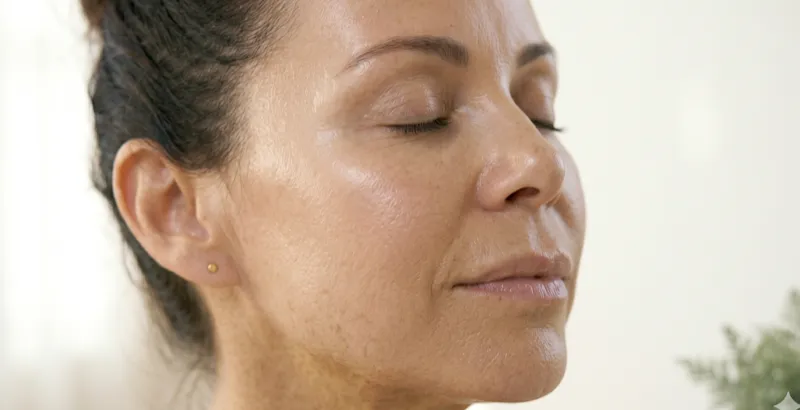
The science of skin aging is evolving rapidly — and for women navigating the skin changes that come with menopause and beyond, evidence-based skincare represents a fundamentally different approach: working with your skin's biology rather than against it.
Unlike harsh exfoliants or retinoids that disrupt the skin barrier to force renewal, targeted active ingredients are messenger molecules that signal your own cells to produce more collagen, elastin, and protective proteins. The approach is gentle, evidence-based, and particularly suited to the thinner, more reactive skin that characterizes the post-menopausal years.
What Science Actually Says About Temperature and Pore Size
The belief that pores 'open' with warm water and 'close' with cold water is perhaps the most persistent myth in skincare, propagated across generations of beauty advice despite having no basis in dermatological anatomy. Pores are not equipped with muscles — they are static openings in the epidermis marking the exit point of pilosebaceous units, and they lack the contractile apparatus (smooth muscle fibers or myoepithelial cells) that would be required for active opening and closing. What temperature changes do affect is the surrounding tissue: warm water causes vasodilation of superficial blood vessels and mild tissue edema, which can make the periostial skin appear slightly plumper and pores slightly less visible (not 'open'); cold water causes vasoconstriction and tissue contraction, which temporarily tightens the surrounding skin and reduces pore visibility for 15-30 minutes. A 2002 study in the Journal of Cosmetic Dermatology confirmed that cold water application produced no measurable change in actual pore diameter (measured by silicone replicas and image analysis), only changes in surrounding skin texture and brightness that altered the optical perception of pore visibility.[1]
Ice application for pore treatment — using ice cubes wrapped in cloth, ice rollers, or cryotherapy globes — does produce real temporary benefits for pore appearance, but through mechanisms entirely different from the 'closing pores' narrative. Cold-induced vasoconstriction reduces blood flow to the superficial dermis, which decreases tissue edema and creates a temporary tightening effect in the periostial tissue — making pores appear smaller for 30-90 minutes. This is the same principle behind the pre-event 'ice facial' that makeup artists use before red carpet appearances. Additionally, cold reduces nerve firing rates and dampens inflammatory mediator release, temporarily reducing the periostial redness and micro-inflammation that optically accentuates pore shadows. However, a 2019 review in the Journal of Clinical and Aesthetic Dermatology cautioned that habitual ice application to mature facial skin can damage fragile capillaries, potentially creating telangiectasia (spider veins) that ironically increase periostial redness and make pores more visible in the long term. The recommendation for women over 40 is to limit ice application to 5-10 seconds per area, using a cloth barrier, no more than 2-3 times per week.
Clinical research confirms that steam and hot towel treatments — the other side of the temperature myth — are marketed as 'opening pores' to facilitate deeper cleansing. The actual mechanism is softening of sebaceous filaments: heat melts the waxy sebum plugs within follicular canals, making them more easily extracted through subsequent cleansing, masking, or manual extraction. This is a genuine and useful effect, but it is not the same as pores physically opening. A 2015 study in Skin Research and Technology measured the effect of 10-minute facial steaming on pore parameters and found no significant change in pore diameter, but a 34% reduction in follicular fill density (the amount of sebum visible within the pore) — confirming that steam affects pore contents, not pore size. For women over 40, the concern with steam is heat-induced vasodilation that can trigger rosacea flares, increase transepidermal water loss, and promote the chronic mild inflammation that accelerates collagen degradation around pore walls. Lukewarm water (30-35°C) is sufficient to soften sebum without the inflammatory risks of hot steam.
The evidence-based reality of pore size modification involves long-term structural interventions, not acute temperature manipulation. True, lasting pore size reduction requires rebuilding the perifollicular collagen scaffold through retinoid therapy, stimulating new collagen via vitamin C and peptides, and preventing further collagen degradation through sun protection. Quick-fix approaches — ice, pore strips, cold water splashing — create temporary optical improvements through tissue contraction and surface debris removal, but have zero effect on the underlying structural causes of age-related pore enlargement. The most helpful reframing for women over 40 is to distinguish between 'pore visibility management' (what temperature, primers, and surface treatments achieve for hours) and 'pore size reduction' (what retinoids, niacinamide, and professional treatments achieve over months). Both have their place in a comprehensive approach, but conflating the two leads to unrealistic expectations from short-term interventions and premature abandonment of long-term treatments that produce genuine structural change.
Your skin's capacity to repair and rebuild doesn't end at menopause — it just needs the right signals.
— Dr. Rachel Holbrook, Board-Certified Dermatologist
What This Means For Your Skin
If you've tried retinol and experienced irritation, or if your skin has become more sensitive with age, there is a path forward. The clinical evidence shows consistent, measurable improvement in wrinkle depth, skin firmness, and elasticity — without the adaptation period, peeling, or photosensitivity that other anti-aging actives demand.
Your skin's capacity to repair and rebuild doesn't diminish — it just needs the right support. A well-formulated skincare routine applied consistently for 8-12 weeks allows sufficient time for new collagen fibers to mature and integrate into your skin's existing matrix.
The science is clear. The evidence is consistent. The results are measurable.
What happens next is up to you.