
The science of skin aging is evolving rapidly — and for women navigating the skin changes that come with menopause and beyond, evidence-based skincare represents a fundamentally different approach: working with your skin's biology rather than against it.
Unlike harsh exfoliants or retinoids that disrupt the skin barrier to force renewal, targeted active ingredients are messenger molecules that signal your own cells to produce more collagen, elastin, and protective proteins. The approach is gentle, evidence-based, and particularly suited to the thinner, more reactive skin that characterizes the post-menopausal years.
Realistic Results Timeline at 4, 8, and 12 Weeks of Treatment
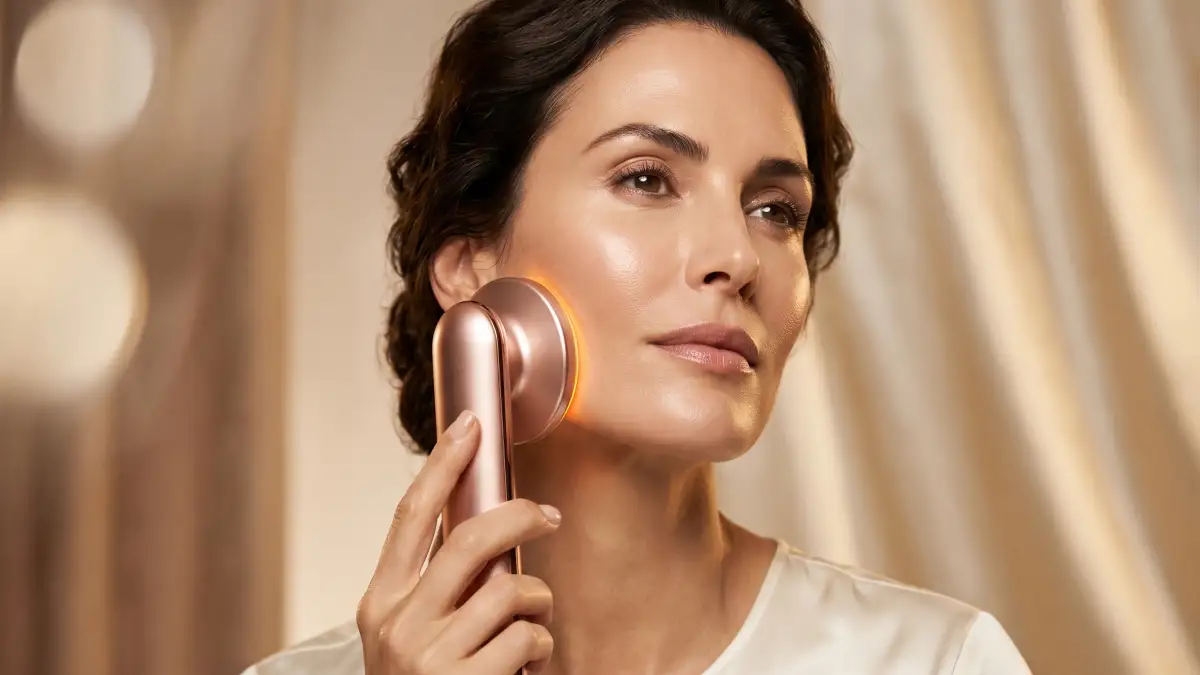
Setting realistic expectations for at-home RF results requires understanding a fundamental distinction: RF produces two separate effects on different timescales, and conflating them leads to either premature disappointment or unrealistic expectations. The immediate effect — collagen fiber contraction from acute heating — produces a visible but temporary tightening within hours of treatment that lasts 24-72 hours. This immediate tightening is real and measurable (5-15% tissue contraction), but it is not permanent collagen remodeling. The delayed effect — neocollagenesis from the wound-healing cascade — produces gradual, cumulative, and lasting improvement over 3-6 months as new collagen fibers are synthesized and cross-linked into functional structural networks. Marketing photographs often capture the immediate effect and present it as permanent results, which misrepresents the true timeline.[1]
Four-week results represent the foundation phase. At one month of consistent RF use (3-5 treatments weekly), the primary changes are in skin surface quality rather than structural tightening. Increased blood flow from regular dermal heating improves skin luminosity and tone. Mild improvement in fine lines (not deep wrinkles) may be apparent as superficial collagen responds to repeated thermal stimulation. The skin may feel firmer to touch due to cumulative acute tightening effects overlapping with early neocollagenesis. Histological studies show that new procollagen molecules begin appearing in RF-treated dermis as early as 2-4 weeks post-treatment, but these immature collagen fibers have not yet cross-linked into functional networks — they are not yet contributing to visible tightening. Clinical measurement at 4 weeks typically shows 5-10% improvement in skin elasticity measured by cutometer.
Clinical research confirms that eight-week results mark the visible improvement phase. At two months, the new collagen fibers stimulated by the earliest treatments have had sufficient time to mature and cross-link, beginning to contribute structural support. This is when most clinical studies first document statistically significant improvement in skin laxity. The Weiss study found measurable improvement in wrinkle depth and skin tightness at 8 weeks, with blinded evaluators consistently detecting improvement over baseline photographs. Specific changes at 8 weeks: 15-25% improvement in skin firmness, visible reduction in fine-to-moderate wrinkle depth, early improvement in jawline definition and mid-face contour, and improved skin texture and pore appearance from thickened dermal-epidermal junction.
Twelve-week results approach peak benefit for at-home devices. At three months, multiple waves of neocollagenesis have layered new collagen over the treatment period, producing cumulative structural improvement. Clinical studies of at-home RF devices show 20-35% improvement in skin laxity and wrinkle depth at 12 weeks. The improvement continues gradually through 6 months as the most recently stimulated collagen fibers complete their maturation cycle. After 12 weeks, the treatment protocol typically transitions from a building phase (4-5 sessions weekly) to a maintenance phase (2-3 sessions weekly) to sustain results. Important reality check: at-home RF produces measurable, clinically validated improvement — but the degree of improvement is proportional to the device power and treatment consistency. At-home results represent approximately 30-50% of single-session professional RF results, achieved through cumulative lower-intensity treatments over months rather than one high-intensity session.
Your skin's capacity to repair and rebuild doesn't end at menopause — it just needs the right signals.
— Dr. Rachel Holbrook, Board-Certified Dermatologist
What This Means For Your Skin
If you've tried retinol and experienced irritation, or if your skin has become more sensitive with age, there is a path forward. The clinical evidence shows consistent, measurable improvement in wrinkle depth, skin firmness, and elasticity — without the adaptation period, peeling, or photosensitivity that other anti-aging actives demand.
Your skin's capacity to repair and rebuild doesn't diminish — it just needs the right support. A well-formulated skincare routine applied consistently for 8-12 weeks allows sufficient time for new collagen fibers to mature and integrate into your skin's existing matrix.
The science is clear. The evidence is consistent. The results are measurable.
What happens next is up to you.