
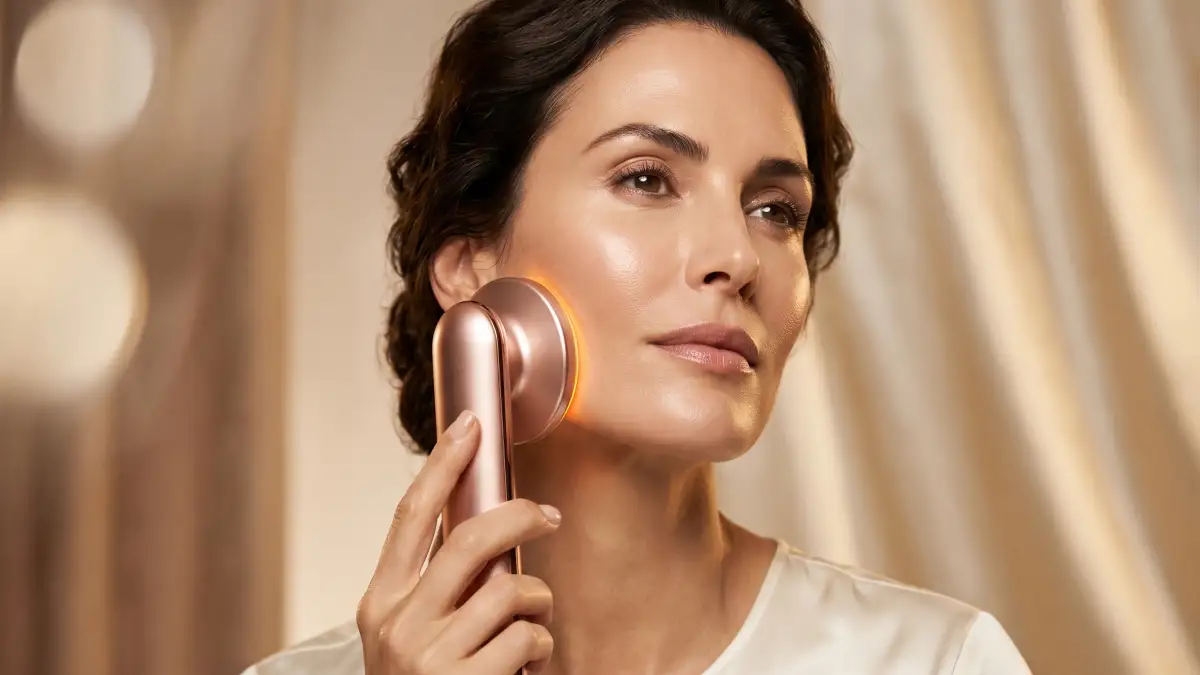
The science of skin aging is evolving rapidly — and for women navigating the skin changes that come with menopause and beyond, evidence-based skincare represents a fundamentally different approach: working with your skin's biology rather than against it.
Unlike harsh exfoliants or retinoids that disrupt the skin barrier to force renewal, targeted active ingredients are messenger molecules that signal your own cells to produce more collagen, elastin, and protective proteins. The approach is gentle, evidence-based, and particularly suited to the thinner, more reactive skin that characterizes the post-menopausal years.
Targeted Radiofrequency Protocol for the Lower Face and Neck
The jawline and neck are among the most responsive areas to radiofrequency treatment because they contain dense collagen networks that undergo significant structural change with aging — and RF's mechanism of collagen contraction and remodeling directly addresses the specific pathology causing laxity in these zones. The lower face ages through a combination of collagen degradation in the dermis (causing skin to loosen from its underlying structures), descent of the malar fat pad (which pushes tissue downward toward the jaw), and weakening of the retaining ligaments that anchor skin to the mandible. RF cannot reverse fat pad descent or restore ligament strength, but it can significantly improve the dermal collagen component — which accounts for approximately 40-60% of visible jawline laxity.[1]
The jawline RF protocol targets three specific zones. Zone 1 — Mandibular border (jawline definition): Apply the RF device along the mandible from chin to ear angle, using slow overlapping strokes. This zone contains thick dermal tissue with dense collagen networks that respond well to thermal remodeling. The goal is to tighten the skin directly overlying the bone, creating a sharper boundary between the face and neck. Treatment time: 3-4 minutes per side. Temperature target: 40-42 degrees Celsius (moderate warmth without discomfort). Caution: avoid the mandibular angle (the bony prominence at the jaw-ear junction) where tissue is thin and bone proximity increases heating risk.
Clinical research confirms that zone 2 — Jowl area (pre-auricular to chin): The jowl forms where skin and soft tissue descend below the mandibular border, creating a pouch of tissue that blurs the clean jaw-neck line. RF applied to the jowl area stimulates collagen contraction and remodeling in the ptotic tissue, gradually tightening the skin back toward the mandible. Use circular motions over the jowl, applying slightly more conductive gel to this area for even energy distribution. Treatment time: 2-3 minutes per side. Zone 3 — Neck and submental area: The neck skin contains thinner dermis than the face, with a large, sheet-like platysma muscle beneath. RF treatment of the neck addresses the dermal collagen component of neck laxity — horizontal necklace lines (which are dermal creases) and overall skin looseness. Apply the device in upward strokes from collarbone to jawline, covering the anterior neck surface. Treatment time: 3-4 minutes. Use lower intensity than the face — neck skin is thinner and reaches therapeutic temperatures more quickly.
Results timeline for jawline and neck RF: Clinical studies of RF applied to the lower face and neck show a specific pattern of improvement. Weeks 1-4: improved skin texture along the jawline and mild immediate tightening effects after each session. Weeks 4-8: early structural improvement as new collagen begins contributing to tissue support — the jawline appears slightly more defined in photographs. Weeks 8-12: measurable improvement in jaw definition and reduction in jowl prominence. The Hruza study documented 20-30% improvement in lower-face skin laxity at 12 weeks of RF treatment, with continued improvement through 6 months. Neck results follow a similar but slightly slower timeline due to thinner tissue and lower treatment intensity. For maximum lower-face results, combine RF (collagen tightening) with microcurrent (muscle toning of the platysma and masseter) on alternating days — RF addresses the dermal component while microcurrent addresses the muscular component, together covering both tissue layers responsible for jawline definition.
Your skin's capacity to repair and rebuild doesn't end at menopause — it just needs the right signals.
— Dr. Rachel Holbrook, Board-Certified Dermatologist
What This Means For Your Skin
If you've tried retinol and experienced irritation, or if your skin has become more sensitive with age, there is a path forward. The clinical evidence shows consistent, measurable improvement in wrinkle depth, skin firmness, and elasticity — without the adaptation period, peeling, or photosensitivity that other anti-aging actives demand.
Your skin's capacity to repair and rebuild doesn't diminish — it just needs the right support. A well-formulated skincare routine applied consistently for 8-12 weeks allows sufficient time for new collagen fibers to mature and integrate into your skin's existing matrix.
The science is clear. The evidence is consistent. The results are measurable.
What happens next is up to you.