
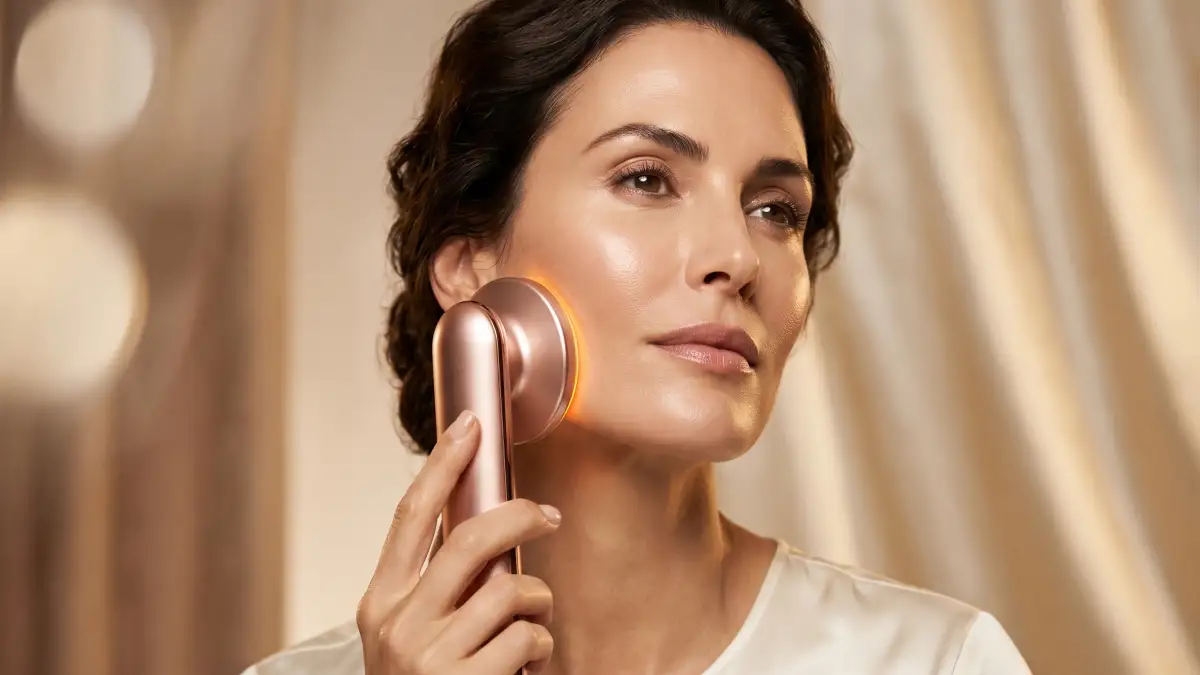
The science of skin aging is evolving rapidly — and for women navigating the skin changes that come with menopause and beyond, evidence-based skincare represents a fundamentally different approach: working with your skin's biology rather than against it.
Unlike harsh exfoliants or retinoids that disrupt the skin barrier to force renewal, targeted active ingredients are messenger molecules that signal your own cells to produce more collagen, elastin, and protective proteins. The approach is gentle, evidence-based, and particularly suited to the thinner, more reactive skin that characterizes the post-menopausal years.
Using Radiofrequency to Improve Collagen Density in Smile Lines
Nasolabial folds — the creases extending from the sides of the nose to the corners of the mouth — are among the most common concerns driving women to explore at-home skin tightening devices, and radiofrequency offers a mechanism that addresses one of the key factors deepening these folds: dermal collagen degradation in the mid-face. The nasolabial fold is formed by the confluence of three age-related changes: descent of the malar fat pad (which pushes tissue downward toward the fold), loss of dermal collagen and elastin (which thins the skin and reduces its ability to resist gravitational folding), and repeated muscular contraction (the zygomaticus muscles that produce smiling create mechanical stress along the fold line). RF treatment specifically addresses the collagen component — and in moderate nasolabial folds where collagen thinning is a significant contributor, RF can produce meaningful improvement in fold depth.[1]
The nasolabial fold RF protocol requires careful technique because the area is bordered by sensitive structures. Treatment zone: Apply the RF device along the fold itself and in a 2-centimeter band on either side, using gentle circular motions. The goal is to stimulate collagen remodeling in the tissue immediately surrounding the fold, increasing dermal density and improving the skin's ability to resist gravitational folding. Treatment time: 2-3 minutes per side. Intensity: moderate — the mid-face skin in this area is moderately thick, tolerating therapeutic heating well, but the proximity to the nose and mouth requires attention to comfort. Technique detail: treat the upper portion of the fold (near the nose) with lighter pressure and shorter dwell time, as the tissue is thinner in this area. The lower portion of the fold (near the mouth corner) can tolerate slightly more intensive treatment.
Clinical research confirms that clinical evidence for RF treatment of nasolabial folds comes from several studies measuring wrinkle depth reduction. Weiss and colleagues documented statistically significant reduction in nasolabial fold depth after RF treatment, with the greatest improvement in moderate folds (Fitzpatrick Wrinkle Scale 5-6) versus deep folds (Scale 7-9). This makes clinical sense: moderate folds have a larger collagen-thinning component that RF can address, while deep folds are dominated by fat pad descent and tissue volume loss that require filler or surgical intervention. Gold and colleagues found that consistent at-home RF use produced 15-25% reduction in nasolabial fold depth at 12 weeks, with improvement correlating strongly with treatment adherence — women who completed 80% or more of recommended sessions showed significantly greater improvement than those with lower adherence.
Maximizing RF results for nasolabial folds requires a multi-modality approach. RF alone addresses the dermal collagen component but cannot reverse fat pad descent or restore lost volume. For comprehensive nasolabial fold improvement, combine RF treatment with: topical retinoid applied to the fold area (stimulating collagen through the retinoic acid receptor pathway, complementing the thermal pathway activated by RF), hyaluronic acid serum applied during the post-RF absorption window (the enhanced blood flow from RF treatment improves penetration of topical humectants), and mid-face microcurrent to lift the zygomaticus muscles that support tissue above the fold. This combined approach — RF for dermal collagen, retinoid for gene activation, microcurrent for muscle lift — addresses three of the four factors contributing to nasolabial fold depth. The fourth factor (volume loss) can only be addressed through injectable fillers or fat grafting, which remain the gold standard for deep nasolabial folds but can be complemented by the at-home protocol for maintenance between professional treatments.
Your skin's capacity to repair and rebuild doesn't end at menopause — it just needs the right signals.
— Dr. Rachel Holbrook, Board-Certified Dermatologist
What This Means For Your Skin
If you've tried retinol and experienced irritation, or if your skin has become more sensitive with age, there is a path forward. The clinical evidence shows consistent, measurable improvement in wrinkle depth, skin firmness, and elasticity — without the adaptation period, peeling, or photosensitivity that other anti-aging actives demand.
Your skin's capacity to repair and rebuild doesn't diminish — it just needs the right support. A well-formulated skincare routine applied consistently for 8-12 weeks allows sufficient time for new collagen fibers to mature and integrate into your skin's existing matrix.
The science is clear. The evidence is consistent. The results are measurable.
What happens next is up to you.