
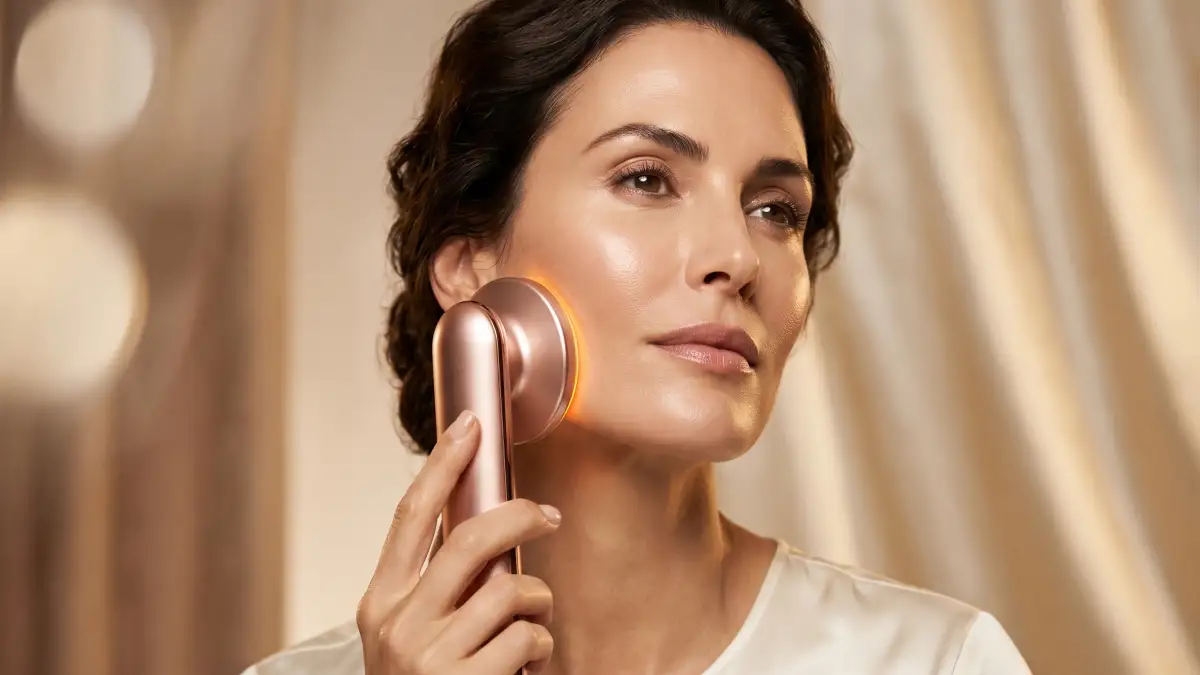
The science of skin aging is evolving rapidly — and for women navigating the skin changes that come with menopause and beyond, evidence-based skincare represents a fundamentally different approach: working with your skin's biology rather than against it.
Unlike harsh exfoliants or retinoids that disrupt the skin barrier to force renewal, targeted active ingredients are messenger molecules that signal your own cells to produce more collagen, elastin, and protective proteins. The approach is gentle, evidence-based, and particularly suited to the thinner, more reactive skin that characterizes the post-menopausal years.
How Radiofrequency Energy Remodels Collagen From the Inside Out
Radiofrequency skin tightening has emerged as one of the most clinically validated non-invasive technologies for addressing skin laxity — the progressive loosening of skin that accelerates after age 40 as collagen production declines and existing collagen fibers lose their structural integrity. Unlike topical treatments that work at the epidermal and superficial dermal level, RF energy penetrates to the deep dermis and subdermis, heating tissue to 40-45 degrees Celsius and triggering two distinct biological responses: immediate collagen fiber contraction (a temporary tightening visible within hours) and a delayed wound-healing cascade that produces new collagen over 3-6 months. Professional RF treatments such as Thermage and Pelleve have demonstrated these effects in multiple controlled clinical trials, and a new generation of at-home RF devices now makes this technology accessible for daily use at lower but cumulative intensities.[1]
The mechanism of RF skin tightening is fundamentally thermal. Radiofrequency energy — electromagnetic waves in the 0.3-10 MHz range — passes through the epidermis without heating it and is absorbed by water molecules in the collagen-rich dermis, generating volumetric heat through molecular oscillation. When dermal temperature reaches 40-42 degrees Celsius, existing collagen fibers undergo partial denaturation — their triple-helix structure contracts, producing immediate tissue tightening of 5-15%. This acute effect is temporary (lasting 24-72 hours) but provides visible proof that the energy is reaching the target tissue. More importantly, the controlled thermal injury triggers a wound-healing response: heat-shock proteins activate fibroblasts, inflammatory cytokines recruit additional fibroblasts to the treated area, and new collagen synthesis begins within days of treatment.
Clinical research confirms that at-home RF devices operate at lower power than professional systems (typically 1-5 watts versus 50-200 watts for clinical devices), which means each individual treatment produces less thermal effect. However, the key advantage of at-home devices is treatment frequency — using the device 3-5 times weekly for months creates a cumulative collagen-stimulating effect that can approach professional results over time. A study by Zelickson and colleagues using histological analysis of RF-treated skin found significant increases in dermal collagen density, with new collagen fibers appearing as early as 4 weeks post-treatment and continuing to accumulate through 6 months. The study also documented thickening of the dermal-epidermal junction and increased expression of heat-shock protein 47, a molecular chaperone essential for collagen synthesis.
For women over 40, RF skin tightening addresses the specific collagen changes that define this decade of aging. Between ages 40-50, women lose approximately 1-2% of dermal collagen annually, with an accelerated loss of 30% in the first five years post-menopause due to estrogen decline. This collagen loss manifests as skin laxity (sagging along the jawline, neck, and periorbital area), increased wrinkle depth (particularly nasolabial folds and marionette lines), and loss of facial volume (hollowing of the cheeks and temples). RF energy directly counteracts this by stimulating new collagen production in the exact tissue layer where loss occurs. Clinical data from Gold and colleagues found that patients using at-home RF devices showed statistically significant improvement in skin laxity, wrinkle depth, and overall skin quality after 8-12 weeks of regular use, with improvements continuing through 6 months of treatment.
Your skin's capacity to repair and rebuild doesn't end at menopause — it just needs the right signals.
— Dr. Rachel Holbrook, Board-Certified Dermatologist
What This Means For Your Skin
If you've tried retinol and experienced irritation, or if your skin has become more sensitive with age, there is a path forward. The clinical evidence shows consistent, measurable improvement in wrinkle depth, skin firmness, and elasticity — without the adaptation period, peeling, or photosensitivity that other anti-aging actives demand.
Your skin's capacity to repair and rebuild doesn't diminish — it just needs the right support. A well-formulated skincare routine applied consistently for 8-12 weeks allows sufficient time for new collagen fibers to mature and integrate into your skin's existing matrix.
The science is clear. The evidence is consistent. The results are measurable.
What happens next is up to you.