
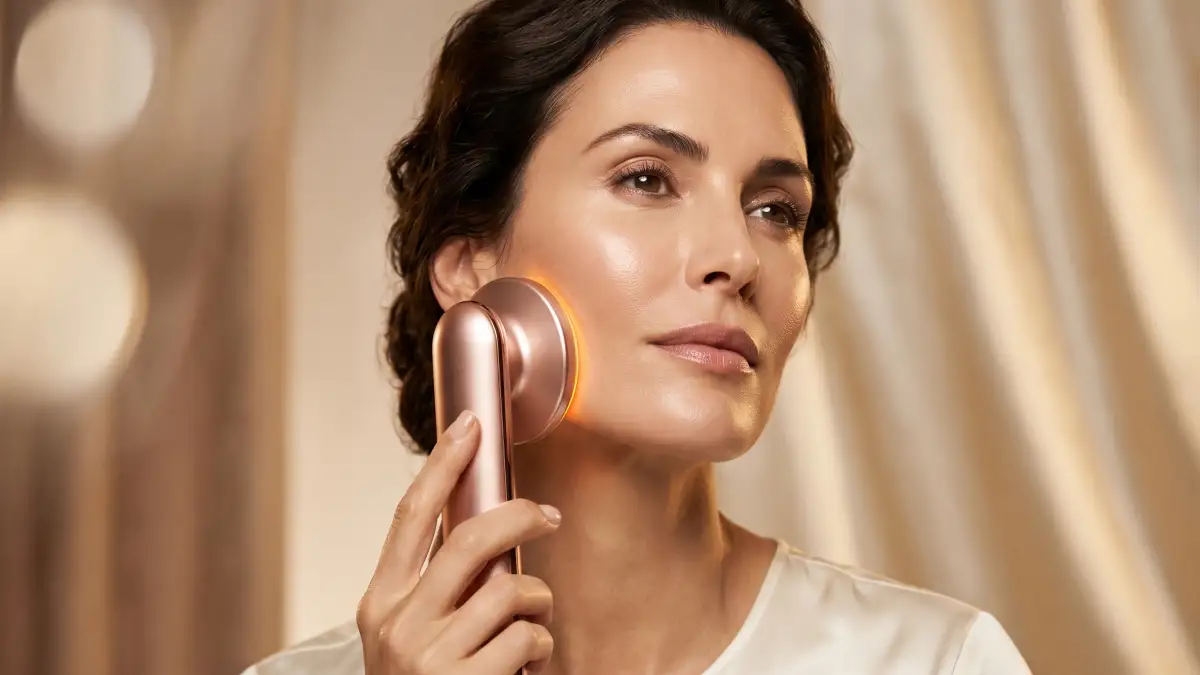
The science of skin aging is evolving rapidly — and for women navigating the skin changes that come with menopause and beyond, evidence-based skincare represents a fundamentally different approach: working with your skin's biology rather than against it.
Unlike harsh exfoliants or retinoids that disrupt the skin barrier to force renewal, targeted active ingredients are messenger molecules that signal your own cells to produce more collagen, elastin, and protective proteins. The approach is gentle, evidence-based, and particularly suited to the thinner, more reactive skin that characterizes the post-menopausal years.
Addressing Accelerated Collagen Loss During Hormonal Transition
Menopause represents the most significant inflection point in skin aging — the decline in estrogen triggers a cascade of dermal changes that accelerate collagen loss, reduce skin thickness, and diminish elasticity at a rate that far exceeds chronological aging alone. Studies have documented that women lose approximately 30% of their dermal collagen in the first five years after menopause, with skin thickness decreasing by 1.13% per year. This is not a gradual continuation of the aging process — it is a sharp acceleration driven by the loss of estrogen's protective effects on fibroblasts, collagen synthesis enzymes, and the extracellular matrix. Radiofrequency skin tightening is particularly relevant for menopausal and post-menopausal women because it directly stimulates the neocollagenesis pathway that estrogen withdrawal has suppressed.[1]
The estrogen-collagen connection explains why menopausal skin aging is qualitatively different from pre-menopausal aging. Estrogen stimulates fibroblast activity through estrogen receptors (ERalpha and ERbeta) expressed on dermal fibroblasts, upregulating collagen synthesis, hyaluronic acid production, and the expression of matrix metalloproteinase inhibitors (TIMPs) that protect existing collagen from enzymatic degradation. When estrogen declines during menopause, three things happen simultaneously: fibroblast collagen production decreases (fewer new collagen molecules are synthesized), existing collagen degradation increases (MMP activity rises without TIMP suppression), and glycosaminoglycan content decreases (reducing dermal hydration and volume). The net effect is rapid thinning, loosening, and drying of the skin that many women experience as a sudden aging acceleration around ages 48-55.
Clinical research confirms that rF treatment partially compensates for estrogen's absence by activating fibroblasts through an alternative pathway — thermal stress. The heat-shock protein response triggered by RF treatment activates fibroblasts and stimulates collagen synthesis independently of estrogen receptor signaling. This is a critical distinction: while hormone replacement therapy (HRT) restores estrogen-mediated collagen stimulation through the hormonal pathway, RF stimulates collagen through the wound-healing pathway, and the two can work additively. A study comparing skin quality in menopausal women using HRT alone, RF alone, and the combination found that all three groups showed improvement over untreated controls, with the combination group showing the greatest improvement in dermal thickness and collagen density.
Optimizing RF for menopausal skin requires adjustments to account for the specific characteristics of post-menopausal tissue. Post-menopausal skin is thinner, drier, and has reduced vascular supply compared to pre-menopausal skin — which affects RF treatment in three ways. First, thinner skin reaches therapeutic temperatures more quickly, so starting at lower intensity and increasing gradually is important to avoid overheating. Second, the reduced dermal water content changes RF energy absorption — using generous amounts of conductive gel compensates for lower tissue hydration. Third, the wound-healing response is somewhat slower in post-menopausal skin, meaning the neocollagenesis timeline extends to 4-8 months rather than 3-6 months for pre-menopausal women. Patience and consistency are especially important. The recommended protocol for post-menopausal women: start with 2-3 RF sessions weekly at moderate intensity for the first month, increasing to 3-4 sessions weekly as skin tolerance is established. Combine with topical retinoid (the most evidence-based topical collagen stimulant), vitamin C (essential cofactor for collagen hydroxylation), and peptides (growth factor signaling) for multi-pathway collagen stimulation that partially compensates for the loss of estrogen-mediated support.
Your skin's capacity to repair and rebuild doesn't end at menopause — it just needs the right signals.
— Dr. Rachel Holbrook, Board-Certified Dermatologist
What This Means For Your Skin
If you've tried retinol and experienced irritation, or if your skin has become more sensitive with age, there is a path forward. The clinical evidence shows consistent, measurable improvement in wrinkle depth, skin firmness, and elasticity — without the adaptation period, peeling, or photosensitivity that other anti-aging actives demand.
Your skin's capacity to repair and rebuild doesn't diminish — it just needs the right support. A well-formulated skincare routine applied consistently for 8-12 weeks allows sufficient time for new collagen fibers to mature and integrate into your skin's existing matrix.
The science is clear. The evidence is consistent. The results are measurable.
What happens next is up to you.