
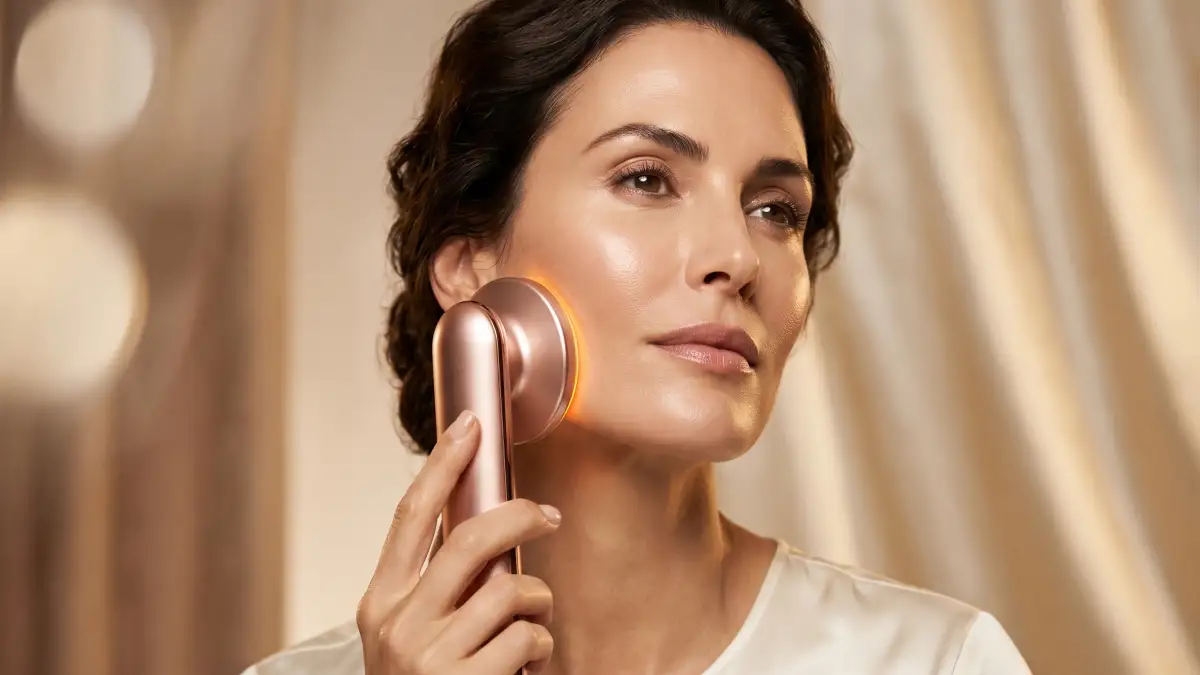
The science of skin aging is evolving rapidly — and for women navigating the skin changes that come with menopause and beyond, evidence-based skincare represents a fundamentally different approach: working with your skin's biology rather than against it.
Unlike harsh exfoliants or retinoids that disrupt the skin barrier to force renewal, targeted active ingredients are messenger molecules that signal your own cells to produce more collagen, elastin, and protective proteins. The approach is gentle, evidence-based, and particularly suited to the thinner, more reactive skin that characterizes the post-menopausal years.
Two Technologies Targeting Different Layers of Facial Aging
Radiofrequency and microcurrent are the two dominant at-home facial tightening technologies, frequently positioned as competitors — but they operate on fundamentally different tissue layers through entirely different mechanisms, making them complementary rather than interchangeable. Choosing between them (or deciding to use both) requires understanding what each technology actually does at the biological level, because the visible results they produce address different components of facial aging.[1]
Radiofrequency operates through thermal energy in the dermis. RF devices emit electromagnetic energy that heats deep dermal tissue to 40-45 degrees Celsius, causing immediate collagen fiber contraction (temporary tightening) and triggering a wound-healing response that produces new collagen over 3-6 months. The primary benefit is skin tightening and texture improvement through collagen remodeling. RF addresses: skin laxity (loose, crepey skin), wrinkle depth (particularly static wrinkles visible at rest), loss of skin elasticity, and thinning of the dermis. RF does not significantly affect muscle tone — it works on the extracellular collagen matrix, not on the muscular system. Best candidates for RF-only: women 45+ whose primary concern is skin looseness, texture degradation, and wrinkle depth rather than facial sagging from muscle tone loss.
Clinical research confirms that microcurrent operates through electrical stimulation of muscles and fibroblasts. Microcurrent devices deliver sub-sensory electrical current (100-600 microamperes) that increases fibroblast ATP production by up to 500% and provides neuromuscular re-education to facial muscles. The primary benefit is facial lifting and contouring through improved muscle tone, with secondary collagen stimulation through the ATP-mediated pathway. Microcurrent addresses: facial sagging from muscle tone loss (jowling, drooping brow, flattened cheeks), loss of facial contour and definition, and reduced cellular energy for collagen production. Microcurrent does not produce deep dermal collagen remodeling — it works at the muscular and cellular-energy level. Best candidates for microcurrent-only: women 35-50 whose primary concern is facial contour loss, mild jowling, and reduced definition rather than skin crepiness or deep wrinkles.
The combined protocol for maximum results addresses both tissue layers simultaneously. Clinical comparison data from Sadick and colleagues found that combined RF plus microcurrent treatment produced approximately 40% greater overall facial improvement than either technology alone at 12 weeks. The practical protocol: use microcurrent 4-5 times weekly for muscle toning and ATP stimulation (morning sessions, 5-10 minutes), and RF 3-4 times weekly for deep collagen remodeling (evening sessions, 10-15 minutes). Space them on different sessions — the skin benefits from focused stimulation of one type per treatment. For women choosing only one technology, the decision framework is straightforward: if your primary concern is sagging and loss of contour (muscle-driven aging), choose microcurrent first. If your primary concern is skin looseness, crepiness, and wrinkle depth (collagen-driven aging), choose RF first. Most women over 45 experience both, making the combined approach the most comprehensive non-surgical option available.
Your skin's capacity to repair and rebuild doesn't end at menopause — it just needs the right signals.
— Dr. Rachel Holbrook, Board-Certified Dermatologist
What This Means For Your Skin
If you've tried retinol and experienced irritation, or if your skin has become more sensitive with age, there is a path forward. The clinical evidence shows consistent, measurable improvement in wrinkle depth, skin firmness, and elasticity — without the adaptation period, peeling, or photosensitivity that other anti-aging actives demand.
Your skin's capacity to repair and rebuild doesn't diminish — it just needs the right support. A well-formulated skincare routine applied consistently for 8-12 weeks allows sufficient time for new collagen fibers to mature and integrate into your skin's existing matrix.
The science is clear. The evidence is consistent. The results are measurable.
What happens next is up to you.