
The science of skin aging is evolving rapidly — and for women navigating the skin changes that come with menopause and beyond, evidence-based skincare represents a fundamentally different approach: working with your skin's biology rather than against it.
Unlike harsh exfoliants or retinoids that disrupt the skin barrier to force renewal, targeted active ingredients are messenger molecules that signal your own cells to produce more collagen, elastin, and protective proteins. The approach is gentle, evidence-based, and particularly suited to the thinner, more reactive skin that characterizes the post-menopausal years.
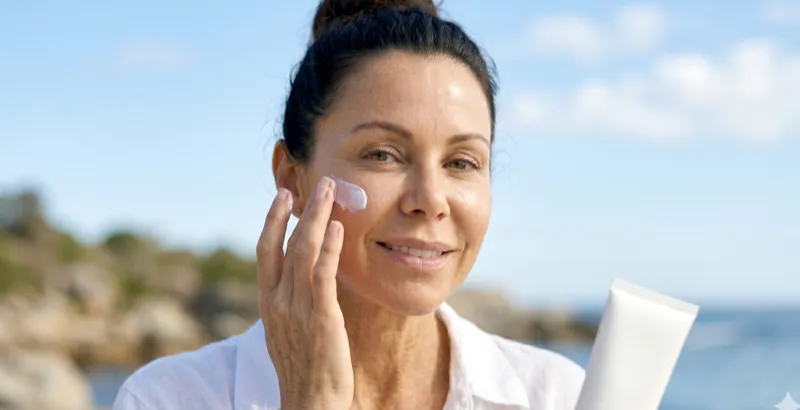
Sunscreen That Protects Aging Skin Without Harm
Sunscreen selection for women over 40 requires fundamentally different criteria than for younger skin, because the mature epidermis presents challenges that standard formulations were not designed to address: thinner skin that allows greater UV penetration, reduced barrier function that increases sensitivity to chemical filters, diminished sebum production that makes drying formulations intolerable, and the presence of fine lines and texture changes that many sunscreens accentuate. A 2019 study in the Journal of the American Academy of Dermatology analyzed UV transmission through facial skin at different ages and found that the epidermis of women over 50 transmits 15-20% more UV-A radiation than the epidermis of women in their 20s, attributable to reduced melanin content and thinner stratum corneum — meaning mature skin requires higher levels of UV-A protection to achieve equivalent biological protection. This finding underscores why SPF alone (which measures primarily UV-B protection) is insufficient for mature skin: the PA rating or broad-spectrum designation indicating UV-A protection is equally important for preventing the collagen-degrading, elastin-damaging, pigmentation-stimulating effects of long-wavelength UV radiation.[1]
Mineral sunscreens containing zinc oxide and titanium dioxide offer specific advantages for mature skin that extend beyond UV filtration. Zinc oxide provides the broadest UV spectrum coverage of any single filter (290-380nm), encompassing both UV-B and UV-A I and II ranges, eliminating the need for multiple chemical filters that increase sensitization risk on compromised mature barriers. A 2016 comparative study in Photodermatology, Photoimmunology & Photomedicine demonstrated that zinc oxide-based sunscreens produced 40% fewer irritation events in women with sensitive mature skin compared to avobenzone-based chemical sunscreens, while providing equivalent photoprotection at matched SPF values. Additionally, zinc oxide has inherent anti-inflammatory properties — it reduces IL-1α and TNF-α expression in UV-exposed keratinocytes — providing anti-aging benefit beyond passive UV blocking. The historical concern about mineral sunscreens leaving a white cast has been largely resolved by micronized and nano-sized zinc oxide particles (100-200nm) that provide transparent application while maintaining UV filtration efficacy, though formulations should specify 'non-nano' zinc oxide for women who prefer to avoid nanoparticle penetration concerns.
Clinical research confirms that chemical sunscreen filters — including avobenzone, octinoxate, homosalate, and oxybenzone — provide lightweight, cosmetically elegant formulations that many women prefer for daily use under makeup. However, several considerations specific to mature skin affect their suitability. Avobenzone, the most effective chemical UV-A filter, degrades by approximately 50% after 60 minutes of sun exposure unless stabilized by octocrylene or Mexoryl SX — unstabilized avobenzone formulations provide progressively diminishing protection throughout the day. For mature skin, the more significant concern is the potential for chemical filters to generate free radicals as they absorb and dissipate UV energy: a 2019 study in Free Radical Biology and Medicine demonstrated that certain chemical filters (particularly oxybenzone and octinoxate) generate reactive oxygen species during UV absorption, potentially creating the very oxidative stress that sunscreen is meant to prevent. This paradoxical pro-oxidant effect is more consequential in mature skin where endogenous antioxidant reserves are already depleted. Newer chemical filters — including bemotrizinol (Tinosorb S) and bisoctrizole (Tinosorb M) — are photostable and generate significantly fewer free radicals, representing a superior chemical filter option for mature skin where available.
The anti-aging sunscreen for women over 40 should ideally combine UV protection with active skincare ingredients that address aging concerns simultaneously. Formulations containing niacinamide provide barrier support and melanin regulation alongside photoprotection. Antioxidant-enriched sunscreens (vitamin E, ferulic acid, green tea extract) neutralize the UV-generated free radicals that penetrate past the UV filters, providing a second line of defense that is particularly important for the depleted antioxidant environment of mature skin. Hyaluronic acid in sunscreen formulations provides the surface hydration that prevents the tight, dry sensation many mature women experience with standard sunscreens while creating the light-reflecting plumpness that improves daytime skin appearance. A 2020 randomized controlled trial in the Journal of Cosmetic Dermatology compared a standard SPF 50 sunscreen against an SPF 50 sunscreen enriched with niacinamide, hyaluronic acid, and vitamin E in women aged 45-60 over 12 weeks and found that the enriched formulation produced 18% better skin hydration scores, 14% better brightness scores, and equivalent photoprotection — demonstrating that sunscreen can serve as an active anti-aging treatment step rather than merely a passive protective one.
Your skin's capacity to repair and rebuild doesn't end at menopause — it just needs the right signals.
— Dr. Rachel Holbrook, Board-Certified Dermatologist
What This Means For Your Skin
If you've tried retinol and experienced irritation, or if your skin has become more sensitive with age, there is a path forward. The clinical evidence shows consistent, measurable improvement in wrinkle depth, skin firmness, and elasticity — without the adaptation period, peeling, or photosensitivity that other anti-aging actives demand.
Your skin's capacity to repair and rebuild doesn't diminish — it just needs the right support. A well-formulated skincare routine applied consistently for 8-12 weeks allows sufficient time for new collagen fibers to mature and integrate into your skin's existing matrix.
The science is clear. The evidence is consistent. The results are measurable.
What happens next is up to you.