
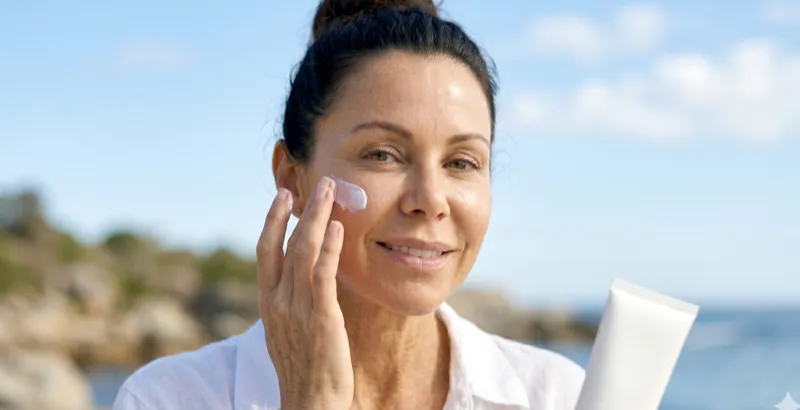
The science of skin aging is evolving rapidly — and for women navigating the skin changes that come with menopause and beyond, evidence-based skincare represents a fundamentally different approach: working with your skin's biology rather than against it.
Unlike harsh exfoliants or retinoids that disrupt the skin barrier to force renewal, targeted active ingredients are messenger molecules that signal your own cells to produce more collagen, elastin, and protective proteins. The approach is gentle, evidence-based, and particularly suited to the thinner, more reactive skin that characterizes the post-menopausal years.
Why Zinc Oxide Is the Gold Standard UV Filter for Women Over 40
Zinc oxide stands alone among UV filters as the only single ingredient that provides truly broad-spectrum protection across the entire UV range (290-380nm), encompassing UV-B (290-315nm), UV-A II (315-340nm), and UV-A I (340-380nm) — the last of which is the most challenging wavelength range to block and the most damaging to dermal collagen. No chemical UV filter matches zinc oxide's spectral breadth: avobenzone covers UV-A I but not UV-B, octinoxate covers UV-B but minimal UV-A, and even the newest generation filters (bemotrizinol, bisoctrizole) require combination to achieve the coverage that zinc oxide provides alone. For mature skin, this single-ingredient broad-spectrum capability translates to a simpler formulation with fewer potential sensitizers — each additional chemical filter in a sunscreen increases the probability of irritation in compromised mature barriers. A 2015 meta-analysis in Dermatologic Surgery reviewed sunscreen adverse event reports and concluded that mineral-only sunscreens (zinc oxide and/or titanium dioxide) had the lowest adverse event rate of any sunscreen category, at 0.3% versus 2.4% for multi-filter chemical formulations.[1]
Beyond UV filtration, zinc oxide provides direct anti-inflammatory and wound-healing benefits that are uniquely valuable for mature skin. Zinc is an essential cofactor for over 300 enzymes in human biochemistry, including superoxide dismutase (SOD) — the primary enzymatic defense against superoxide radicals in the skin. Topical zinc oxide deposits ionic zinc at the skin surface, where it suppresses the release of pro-inflammatory cytokines (IL-1α, IL-6, TNF-α) from UV-exposed keratinocytes, reduces prostaglandin E2 production, and enhances the skin's endogenous antioxidant defenses. A 2007 study in the British Journal of Dermatology demonstrated that zinc oxide sunscreen reduced UV-induced erythema by 28% more than a matched-SPF titanium dioxide sunscreen, attributing the additional protection to zinc oxide's anti-inflammatory activity beyond its UV-blocking function. For women over 40 whose skin exists in a state of chronic low-grade inflammation ('inflammaging'), this anti-inflammatory benefit provides daily therapeutic value in addition to photoprotection.
Clinical research confirms that the cosmetic properties of modern zinc oxide formulations have evolved dramatically from the thick, white pastes that gave mineral sunscreens their poor cosmetic reputation. Micronized zinc oxide (particle size 100-200nm) provides near-transparent application on most skin tones while maintaining full UV filtration efficacy — a 2018 optical study in the International Journal of Cosmetic Science confirmed that micronized zinc oxide at 20% concentration achieved SPF 35 with less than 5% visible whiteness on Fitzpatrick skin types I-IV. Surface-treated zinc oxide particles (coated with silica, alumina, or stearic acid) further improve cosmetic elegance by enhancing compatibility with formulation oils, reducing the chalky texture, and preventing the particle aggregation that creates visible white streaks. For mature skin, zinc oxide in a dimethicone or cyclomethicone base creates a smoothing, primer-like finish that fills fine lines and creates a soft-focus effect — properties that have led many women to replace separate primer products with zinc oxide sunscreen as their pre-makeup base.
The optimal zinc oxide concentration for mature skin anti-aging protection is 15-20%, which provides SPF 25-35 from zinc oxide alone (additional SPF can come from titanium dioxide or the formulation base). Concentrations below 10% provide inadequate UV-A I coverage for anti-aging purposes, while concentrations above 25% become cosmetically challenging even with micronized particles. For women with specific anti-aging priorities, the clinical recommendation is to select zinc oxide sunscreens that also contain: niacinamide (for additional barrier support and melanin regulation), antioxidants (vitamin E, green tea extract, or grape seed extract for free radical neutralization), and hyaluronic acid or glycerin (for hydration that maintains the skin's light-reflecting plumpness throughout the day). This 'active sunscreen' approach transforms the daily SPF step from passive protection to active anti-aging treatment — a particularly efficient strategy for women over 40 who want to minimize the number of products in their routine while maximizing anti-aging benefit per application step.
Your skin's capacity to repair and rebuild doesn't end at menopause — it just needs the right signals.
— Dr. Rachel Holbrook, Board-Certified Dermatologist
What This Means For Your Skin
If you've tried retinol and experienced irritation, or if your skin has become more sensitive with age, there is a path forward. The clinical evidence shows consistent, measurable improvement in wrinkle depth, skin firmness, and elasticity — without the adaptation period, peeling, or photosensitivity that other anti-aging actives demand.
Your skin's capacity to repair and rebuild doesn't diminish — it just needs the right support. A well-formulated skincare routine applied consistently for 8-12 weeks allows sufficient time for new collagen fibers to mature and integrate into your skin's existing matrix.
The science is clear. The evidence is consistent. The results are measurable.
What happens next is up to you.