
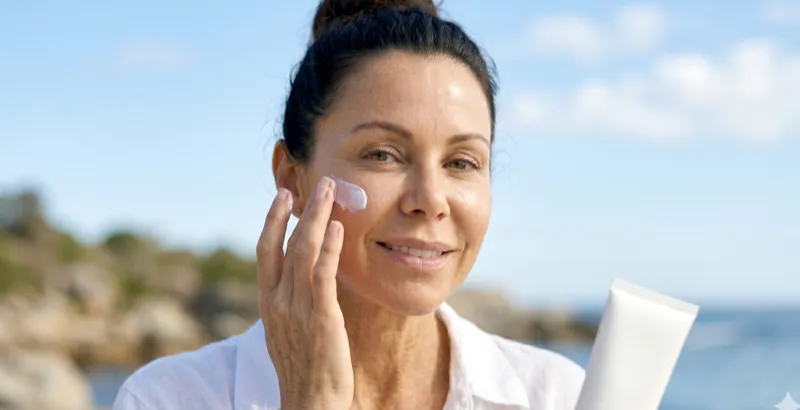
The science of skin aging is evolving rapidly — and for women navigating the skin changes that come with menopause and beyond, evidence-based skincare represents a fundamentally different approach: working with your skin's biology rather than against it.
Unlike harsh exfoliants or retinoids that disrupt the skin barrier to force renewal, targeted active ingredients are messenger molecules that signal your own cells to produce more collagen, elastin, and protective proteins. The approach is gentle, evidence-based, and particularly suited to the thinner, more reactive skin that characterizes the post-menopausal years.
Gentle UV Protection for Hormonally Sensitized Mature Skin
Menopausal skin sensitivity creates a specific sunscreen challenge: declining estrogen reduces barrier function, increases neurovascular reactivity, and lowers the irritation threshold, meaning that sunscreen formulations tolerated for decades may suddenly cause stinging, burning, flushing, or contact dermatitis. A 2017 study in Menopause found that 47% of women reported new-onset skin sensitivity during the menopausal transition, with sunscreen intolerance among the top three newly problematic product categories. The mechanism involves estrogen receptor downregulation in keratinocytes, which reduces ceramide production (weakening the barrier that protects nerve endings from topical irritants), combined with increased expression of transient receptor potential vanilloid 1 (TRPV1) receptors — the same nerve endings that detect capsaicin — which lower the threshold for perceiving chemical irritants as stinging or burning. Chemical sunscreen filters, particularly oxybenzone, avobenzone, and octinoxate, are among the most common triggers for TRPV1 activation in sensitized skin.[1]
Mineral sunscreens are the clear first-choice recommendation for menopausal sensitive skin, with zinc oxide at 15-20% concentration providing the broadest UV protection with the lowest sensitization potential. Zinc oxide's anti-inflammatory properties — suppression of IL-1α, TNF-α, and NF-κB — actively calm the neurogenic inflammation that drives menopausal skin sensitivity, making it a therapeutic agent as well as a UV protectant. Titanium dioxide, while also non-sensitizing, provides narrower UV-A coverage (primarily UV-A II, 320-340nm, with limited UV-A I coverage) and lacks zinc oxide's anti-inflammatory benefits. For maximum tolerance, the sunscreen vehicle should be free of common irritants: no fragrance (synthetic or natural essential oils), no alcohol (denatured alcohol, ethanol, isopropyl alcohol), no chemical preservatives with high sensitization rates (methylisothiazolinone is a particular concern), and no physical exfoliants or alpha-hydroxy acids. A 2020 patch testing study in Contact Dermatitis confirmed that fragrance-free zinc oxide sunscreens in dimethicone or caprylic/capric triglyceride vehicles produced zero positive patch test reactions in 200 women with documented menopausal skin sensitivity.
Clinical research confirms that the application experience of sunscreen on menopausal sensitive skin can be improved through specific formulation features and techniques. The stinging that some women experience upon sunscreen application — even with mineral formulations — is often caused by the formulation's pH rather than the UV filter itself. Sunscreens formulated at pH 5.0-5.5 (matching the skin's acid mantle) produce significantly less application stinging than those at higher or lower pH values. Testing pH is simple: apply a small amount to the inner wrist and wait 60 seconds — if stinging occurs, the formulation is likely pH-mismatched or contains an irritant. For women whose facial skin has become too sensitive for any sunscreen, a period of barrier repair (2-4 weeks of ceramide-rich moisturizer only, no actives) before reintroducing sunscreen can restore sufficient barrier integrity to tolerate mineral SPF. During this repair phase, sun avoidance and physical protection (wide-brimmed hat, UV-protective clothing) provide UV defense without topical product exposure.
Emerging sunscreen technologies offer additional options for menopausal sensitive skin. Encapsulated UV filters — where chemical or mineral filters are enclosed in silica or polymer microspheres — prevent direct contact between the filter and the skin surface, eliminating the sensitization risk while maintaining UV absorption. A 2019 study in the International Journal of Pharmaceutics demonstrated that encapsulated avobenzone produced zero irritation events in sensitized skin while providing equivalent UV-A protection to non-encapsulated avobenzone. DNA repair enzymes (photolyase, endonuclease) incorporated into sunscreen formulations provide a second line of defense by repairing UV-induced DNA damage that penetrates past the UV filters — particularly relevant for mature skin where endogenous DNA repair capacity has declined. Antioxidant-enriched mineral sunscreens (vitamin E, green tea extract, bisabolol) combine UV protection with inflammation suppression, addressing both the cause (UV damage) and the symptom (sensitivity-driven inflammation) of the menopausal skin protection challenge.
Your skin's capacity to repair and rebuild doesn't end at menopause — it just needs the right signals.
— Dr. Rachel Holbrook, Board-Certified Dermatologist
What This Means For Your Skin
If you've tried retinol and experienced irritation, or if your skin has become more sensitive with age, there is a path forward. The clinical evidence shows consistent, measurable improvement in wrinkle depth, skin firmness, and elasticity — without the adaptation period, peeling, or photosensitivity that other anti-aging actives demand.
Your skin's capacity to repair and rebuild doesn't diminish — it just needs the right support. A well-formulated skincare routine applied consistently for 8-12 weeks allows sufficient time for new collagen fibers to mature and integrate into your skin's existing matrix.
The science is clear. The evidence is consistent. The results are measurable.
What happens next is up to you.