
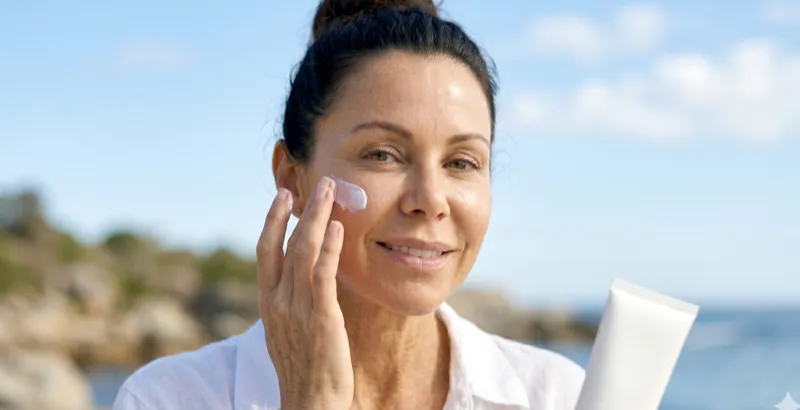
The science of skin aging is evolving rapidly — and for women navigating the skin changes that come with menopause and beyond, evidence-based skincare represents a fundamentally different approach: working with your skin's biology rather than against it.
Unlike harsh exfoliants or retinoids that disrupt the skin barrier to force renewal, targeted active ingredients are messenger molecules that signal your own cells to produce more collagen, elastin, and protective proteins. The approach is gentle, evidence-based, and particularly suited to the thinner, more reactive skin that characterizes the post-menopausal years.
Which Type Better Protects and Supports Mature Skin
The mineral versus chemical sunscreen debate takes on unique dimensions for aging skin, where the decision affects not only UV protection but also barrier integrity, inflammation levels, and the cosmetic appearance of fine lines and wrinkles. Mineral sunscreens (zinc oxide, titanium dioxide) sit on the skin surface and physically reflect and scatter UV radiation, while chemical sunscreens (avobenzone, homosalate, octisalate) absorb into the epidermis and convert UV energy to heat through photochemical reactions. For mature skin, this fundamental mechanistic difference has several clinical implications. Surface-sitting mineral filters do not penetrate the compromised barrier of aging skin, eliminating concerns about systemic absorption that have been raised for chemical filters — a 2019 FDA-funded study in JAMA demonstrated that common chemical filters (avobenzone, oxybenzone, octocrylene, ecamsule) reached plasma concentrations exceeding the FDA's safety threshold of 0.5 ng/mL after just one day of application, while mineral filters showed zero systemic absorption.[1]
The inflammatory profile of mineral versus chemical sunscreens is particularly relevant for mature skin, where chronic low-grade inflammation ('inflammaging') is already accelerating collagen degradation and pigmentation irregularity. Chemical filters can trigger contact sensitization in 1-3% of the general population, but this rate increases to 4-8% in women over 50 with compromised barriers, according to a 2018 patch testing study in Contact Dermatitis. Oxybenzone is the most commonly sensitizing chemical filter, followed by octinoxate and octocrylene. In contrast, zinc oxide and titanium dioxide have near-zero sensitization rates across all skin types and ages — they are classified as Category I (safe and effective) by the FDA and are the only two UV filters that have not been asked to undergo additional safety testing under the FDA's 2019 proposed rule. For women with rosacea-prone mature skin (approximately 10% of women over 40), mineral sunscreens are essentially mandatory: chemical filters are among the top 10 documented rosacea triggers, while zinc oxide's anti-inflammatory properties can actually calm rosacea symptoms.
Clinical research confirms that cosmetic elegance — how the sunscreen looks and feels on the skin — has historically been the Achilles heel of mineral sunscreens, particularly for darker skin tones where white cast is more pronounced. Modern micronized zinc oxide formulations (particle size 100-200nm) have largely addressed this issue, achieving near-transparent application while maintaining UV filtration. Tinted mineral sunscreens offer an additional advantage for mature skin: iron oxide pigments provide protection against visible light (400-700nm), which recent research has shown contributes to hyperpigmentation and collagen degradation in darker skin tones. A 2020 study in the Journal of the American Academy of Dermatology demonstrated that tinted sunscreens containing iron oxides reduced visible light-induced pigmentation by 72% compared to non-tinted SPF in women with Fitzpatrick skin types III-V. For mature skin specifically, tinted mineral sunscreens serve triple duty: UV protection, visible light protection, and cosmetic color correction that evens skin tone and reduces the appearance of age spots without separate foundation.
The practical recommendation for women over 40 is to use mineral sunscreen as the primary daily protectant, with chemical sunscreens reserved for specific situations where their lighter texture provides meaningful practical advantage (beach holidays, athletic activity, under heavy makeup). Daily mineral sunscreen use — SPF 30-50 with at least 15% zinc oxide for broad-spectrum coverage — provides the protection, tolerability, and anti-inflammatory benefits that aging skin requires. Apply as the last step in the morning skincare routine, after moisturizer and before makeup, using approximately 1/4 teaspoon for the face and neck (the amount needed to achieve the SPF value stated on the label). Reapplication every 2 hours during direct sun exposure is essential regardless of sunscreen type — a 2017 study found that the single greatest predictor of photoprotection was reapplication frequency, not SPF value or filter type. For women concerned about the cosmetic finish of mineral sunscreens, look for formulations using dimethicone or cyclopentasiloxane as the vehicle base, which creates a smooth, semi-matte finish that works well as a primer under makeup.
Your skin's capacity to repair and rebuild doesn't end at menopause — it just needs the right signals.
— Dr. Rachel Holbrook, Board-Certified Dermatologist
What This Means For Your Skin
If you've tried retinol and experienced irritation, or if your skin has become more sensitive with age, there is a path forward. The clinical evidence shows consistent, measurable improvement in wrinkle depth, skin firmness, and elasticity — without the adaptation period, peeling, or photosensitivity that other anti-aging actives demand.
Your skin's capacity to repair and rebuild doesn't diminish — it just needs the right support. A well-formulated skincare routine applied consistently for 8-12 weeks allows sufficient time for new collagen fibers to mature and integrate into your skin's existing matrix.
The science is clear. The evidence is consistent. The results are measurable.
What happens next is up to you.