
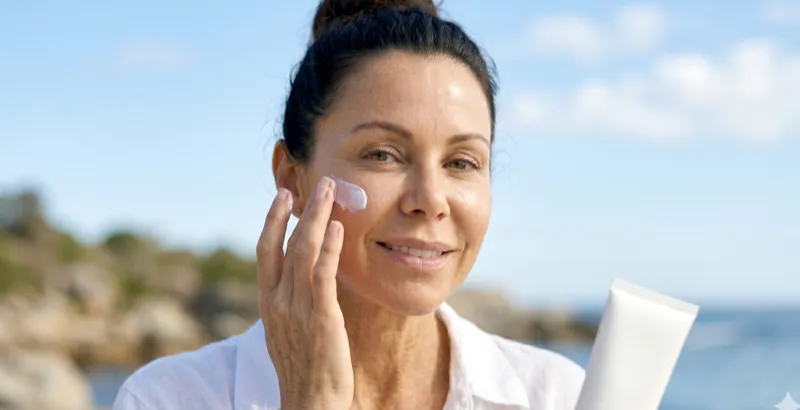
The science of skin aging is evolving rapidly — and for women navigating the skin changes that come with menopause and beyond, evidence-based skincare represents a fundamentally different approach: working with your skin's biology rather than against it.
Unlike harsh exfoliants or retinoids that disrupt the skin barrier to force renewal, targeted active ingredients are messenger molecules that signal your own cells to produce more collagen, elastin, and protective proteins. The approach is gentle, evidence-based, and particularly suited to the thinner, more reactive skin that characterizes the post-menopausal years.
The Clinical Proof That Daily Sunscreen Prevents Skin Aging
The evidence that daily sunscreen use prevents skin aging is among the most robust in all of dermatology, anchored by a landmark randomized controlled trial that provided the gold-standard proof that UV protection directly prevents the clinical signs of aging. The Queensland Institute of Medical Research study, published in the Annals of Internal Medicine in 2013, randomized 903 adults to either daily sunscreen application or discretionary use (applying only when they chose to) for 4.5 years, then assessed skin aging using silicone skin surface replicas analyzed by blinded evaluators. The results were unequivocal: the daily sunscreen group showed no detectable increase in skin aging over the 4.5-year study period, while the discretionary-use group showed a statistically significant increase in aging scores. This means daily sunscreen use effectively stopped measurable photoaging for nearly five years — a finding that no anti-aging cream, serum, or treatment has ever replicated in a controlled trial of this duration and rigor.[1]
The biological mechanisms by which sunscreen prevents aging operate through protection of three key dermal targets: collagen, elastin, and melanocyte regulation. UV-A radiation (315-400nm) penetrates to the deep dermis where it activates matrix metalloproteinases — specifically MMP-1 (collagenase), MMP-3 (stromelysin), and MMP-9 (gelatinase) — that degrade collagen types I and III and elastin fibers. A single significant UV exposure activates MMP expression that persists for 24-48 hours, during which substantial structural damage occurs. Sunscreen blocks this activation at the source. A 2008 study in the Journal of Investigative Dermatology quantified the protective effect: broad-spectrum SPF 30 sunscreen blocked 97% of UV-induced MMP-1 upregulation in human skin biopsies, preserving collagen fiber integrity at near-baseline levels. Over decades, this daily collagen preservation accumulates into the dramatic visible difference between habitual sunscreen users and non-users — a difference that becomes increasingly apparent after age 40 when the margin between protected and damaged collagen determines the rate of visible aging.
Clinical research confirms that the melanocyte-protective effect of sunscreen prevents the pigmentation irregularities — solar lentigines, melasma, generalized mottling — that are among the most aging visual cues in women over 40. UV radiation stimulates melanocytes through multiple pathways: direct DNA damage activating p53-mediated melanin synthesis, oxidative stress triggering the MC1R signaling cascade, and inflammatory mediators from UV-damaged keratinocytes that activate paracrine melanin stimulation. Sunscreen interrupts all three pathways simultaneously by preventing the UV photons from reaching melanocytes and surrounding cells. A 2013 randomized trial in the Journal of Clinical Oncology demonstrated that daily sunscreen use reduced new solar lentigines by 50% over 4.5 years in adults, with the protective effect being most pronounced in individuals over 40 — the age when cumulative UV exposure begins manifesting as visible pigmentary changes. For women already dealing with existing dark spots, daily sunscreen is essential for preventing the ongoing UV-driven melanin stimulation that counteracts topical brightening treatments.
The cost-effectiveness of sunscreen as an anti-aging intervention dramatically exceeds that of any topical treatment, procedure, or supplement. A 2016 analysis in Dermatologic Surgery calculated that daily sunscreen use over 10 years (at approximately $10-20/month) provided greater prevention of clinical aging signs than a single series of fractional laser treatments (at $2,000-6,000), injectable fillers (at $500-1,500 per session, repeated annually), or topical retinoid therapy alone. This is because sunscreen prevents the primary cause of extrinsic aging (UV damage accounts for approximately 80% of visible facial aging), while treatments attempt to repair damage after it has occurred — a fundamentally less efficient approach. For women over 40 who are investing in retinoids, vitamin C, peptides, and professional treatments, daily sunscreen protects these investments: every dollar spent on anti-aging skincare produces greater return when the ongoing source of damage (UV radiation) is blocked. The practical clinical recommendation is clear: sunscreen is the single most effective anti-aging product available, and no anti-aging routine is complete without it as the foundational daily step.
Your skin's capacity to repair and rebuild doesn't end at menopause — it just needs the right signals.
— Dr. Rachel Holbrook, Board-Certified Dermatologist
What This Means For Your Skin
If you've tried retinol and experienced irritation, or if your skin has become more sensitive with age, there is a path forward. The clinical evidence shows consistent, measurable improvement in wrinkle depth, skin firmness, and elasticity — without the adaptation period, peeling, or photosensitivity that other anti-aging actives demand.
Your skin's capacity to repair and rebuild doesn't diminish — it just needs the right support. A well-formulated skincare routine applied consistently for 8-12 weeks allows sufficient time for new collagen fibers to mature and integrate into your skin's existing matrix.
The science is clear. The evidence is consistent. The results are measurable.
What happens next is up to you.